

Key Takeaways
- Calm rooms aren't empty rooms — they're spaces where every element has been chosen with intention.
- Visual rest and personal expression can coexist when you anchor one and allow the other to move.
- Texture, not clutter, is what gives a room warmth and dimensional life.
- Editing ruthlessly doesn't mean removing personality — it means making personality more visible.
- Light quality shapes emotional tone as much as any decorating choice.
Calm and Lived-In Design
A room that feels calm and lived-in strikes a balance between visual order and genuine personal presence — it's serene without being sterile, and personal without feeling chaotic. It reflects the people who actually use the space, rather than performing an idea of how the space should look. This quality isn't achieved through a single style or trend, but through deliberate decisions about what stays, what goes, and what gets to breathe.
Interior designers sometimes call this quality 'controlled warmth' — a room where restraint in one area (say, a neutral palette) creates room for expressiveness in another (layered textiles, meaningful objects).
Why Most Rooms Feel Like One or the Other
We've all been in rooms that feel beautiful but somehow lifeless — showroom-perfect spaces where you're afraid to set down your coffee cup. And we've all been in rooms that feel warm and full of personality, but visually exhausting, where the eye doesn't know where to land. The truth is that most decorating advice optimises for one at the expense of the other: calm or character, serenity or soul.
What makes a room feel both is less a style choice and more a design philosophy — a set of principles that guide which things stay, how they're arranged, and what kind of visual rhythm results. If you've ever felt your space was close but not quite right, this exploration of common spatial missteps may help name what's missing.
The Foundation: Anchor, Then Animate
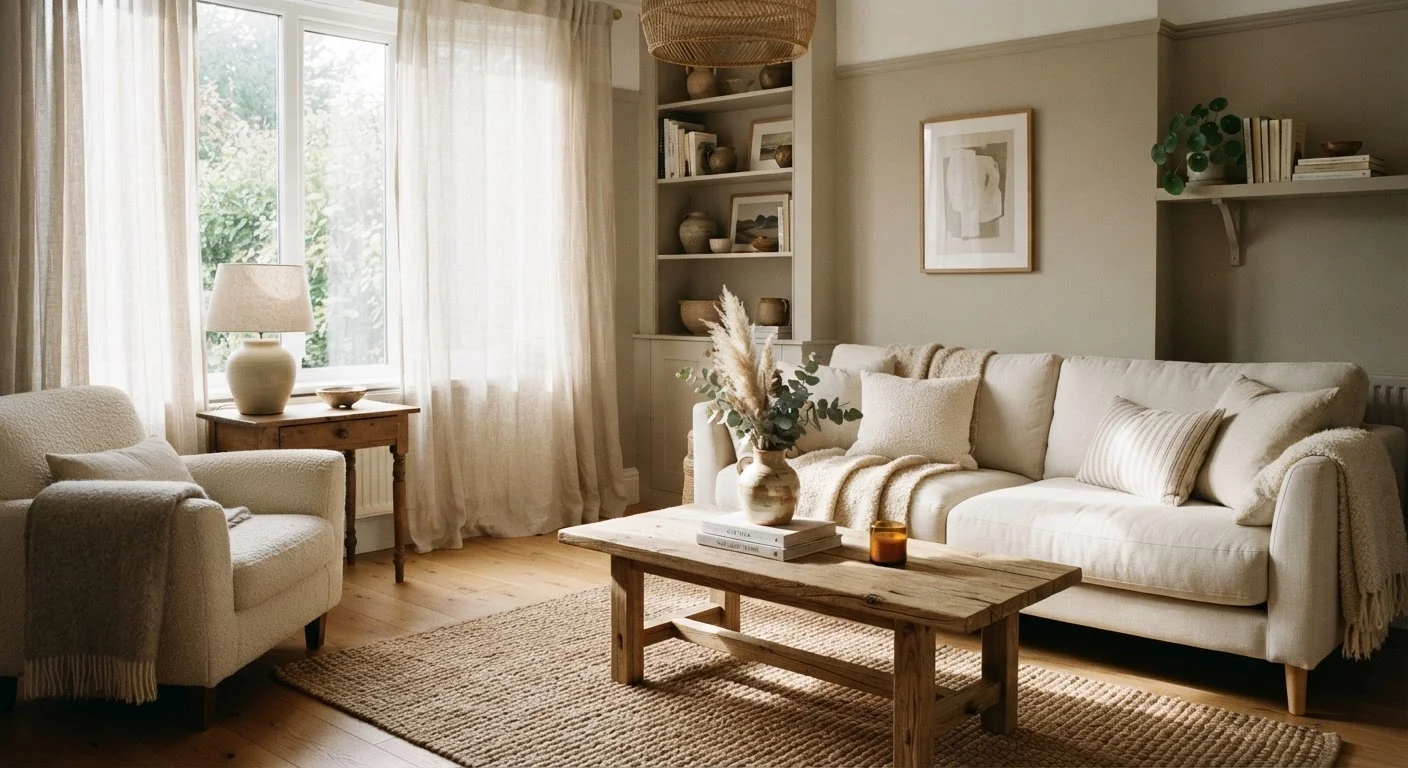
The most reliable principle in calm-yet-lived-in design is the idea of anchoring and animating. You anchor a room with a consistent, restrained base — a palette that doesn't fight itself, furniture with clean lines, surfaces that have room to breathe. Then you animate it with elements that carry personal weight: a stack of books you've actually read, a textile brought back from a trip, a lamp that casts the kind of light you love.
The anchor does the heavy lifting of visual calm. The animation does the work of personality. When both are present, neither overwhelms the other. This is why rooms built around a quiet neutral palette can still feel rich and expressive — the restraint in one area creates space for expressiveness in another.
Start With One Room, Not the Whole House
Trying to re-edit every space at once often leads to decision fatigue and half-finished rooms. Pick one room — ideally the one you spend the most time in — and apply these principles there first. Once you see how the balance feels in practice, it becomes much easier to carry it through the rest of your home.
For smaller spaces, anchoring through furniture scale and layout matters as much as colour. Our guide to styling a small living room covers how to do this without sacrificing personality.
Texture Is the Bridge Between Calm and Warmth
One of the most common misconceptions in interior design is that warmth comes from adding more things. In practice, warmth comes from texture — the way different materials catch and hold light differently, how linen feels visually softer than cotton, how raw wood reads as more relaxed than lacquered finishes. Texture gives a room depth and dimension without visual noise.
Layering materials — a jute rug beneath a linen sofa, ceramic objects on a wooden shelf, a wool throw folded at the end of a bed — is what keeps a simplified room from feeling flat. You can learn how to layer materials with intention to create this kind of depth without overcrowding a space.
Calm Looks Different for Everyone
What reads as serene in one person's home may feel sparse or impersonal to another. These principles are frameworks, not formulas. The goal is always a room that works for you — one that lowers your nervous system's baseline when you walk in, reflects who you actually are, and functions for how you genuinely live.
The Role of Editing: Less Isn't Minimalism
Editing a room ruthlessly doesn't mean stripping it of personality — it means making personality more visible. When ten meaningful objects compete for attention, none of them land. When three objects are given space and good light, each one becomes readable, even memorable. This is the logic behind why a single shelf styled with intention can anchor a whole wall.
A useful practice is maintaining at least one clear, uncluttered surface — not as a minimalist exercise, but as a visual anchor that lets the rest of the room breathe. Editing is also what separates a room that looks intentional from one that simply looks full. The objects you remove are as important as the ones you keep.
Light plays an equally important role in how edited space reads. The direction, warmth, and quality of light can make even a sparse room feel enveloping — or make a rich one feel harsh. Understanding how natural and artificial light shape a room's mood is one of the quieter levers most people underuse.
Personal Presence Without Visual Chaos
The goal isn't a room that looks like no one lives in it — it's a room that looks like someone with taste lives in it. That distinction matters. Personal presence shows up in small, specific ways: the way books are stacked rather than shelved by spine, a piece of art that means something rather than matching the sofa, a worn textile that's stayed because it's genuinely loved.
Rooms that achieve this balance tend to follow a version of the same logic: broad calm at the macro level (palette, scale, layout), warmth and specificity at the micro level (objects, textiles, scent). The sensory layers often overlooked — sound absorption from textiles, warmth from layered lighting, even scent — contribute significantly to how a room feels to actually be in. For a deeper look at those dimensions, this piece on sensory design covers what decorating guides often miss.
A room that feels both calm and lived-in isn't a design achievement — it's a practice of continual, intentional editing. It's built slowly, adjusted often, and always in service of the people who actually live there.