

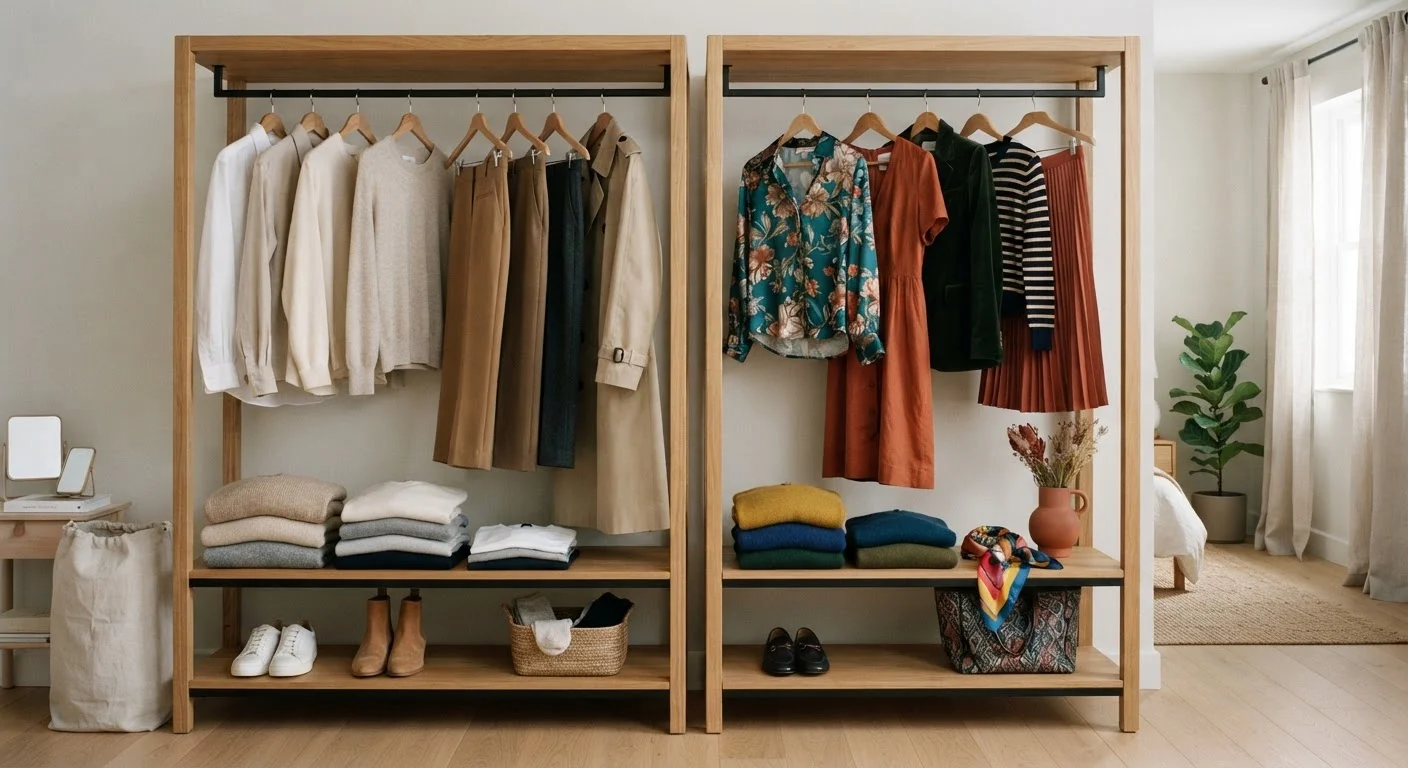
Key Takeaways
- A capsule wardrobe limits quantity to maximize outfit combinations from a tightly edited set.
- A curated closet prioritizes intentionality over restriction — quality and personal fit guide every addition.
- Neither system requires a complete closet overhaul to start delivering results.
- The best approach depends on your lifestyle complexity, not a one-size formula.
- Both methods share a core principle: only keep what you actually wear.
Option A
Capsule Wardrobe
The streamlined, constraint-based system.
Best for: Women who want decision fatigue eliminated through a small, deliberate set of interchangeable pieces.
Option B
Curated Closet
The intentional, personality-forward approach.
Best for: Women who want a closet that reflects their evolving identity without chasing every trend.
If you want to eliminate daily decision fatigue entirely
Capsule Wardrobe
A fixed, small set of pieces with a strict interchangeability rule means fewer choices and faster mornings.
If your life spans multiple dress codes — office, social, active, travel
Curated Closet
A curated approach accommodates life's complexity without forcing every piece to serve every occasion.
If you're starting from scratch and want a clear framework
Capsule Wardrobe
The defined structure of a capsule gives new wardrobe builders a concrete roadmap and spending discipline.
If personal style and self-expression are central to how you move through the world
Curated Closet
Curation keeps individuality intact while still filtering out pieces that don't genuinely serve you.
If you've tried capsule rules and found them too rigid
Curated Closet
The curated model offers the same intentionality without a strict item count or palette limitation.
What Each System Actually Means
Both terms get used interchangeably online, but they describe meaningfully different wardrobe philosophies. Understanding the distinction helps you choose the system that fits how you actually live — not how a style blog imagines you do.
A capsule wardrobe is defined by constraint. The classic formulation, popularized in the 1970s by designer Susie Faux, calls for a small collection — often cited as 30 to 40 pieces — of timeless, neutral items that all work together. Every piece must earn its place by pairing with multiple others. The system trades variety for reliability. For a deeper look at the concept's foundations, see what a capsule wardrobe actually means.
A curated closet has no fixed item count. Instead, it's governed by intention: every piece in the closet was chosen deliberately, fits well, and aligns with your lifestyle and aesthetic. The closet might be larger than a capsule, but nothing in it is accidental. It reflects personality without becoming a trend graveyard.
| Criterion | Capsule Wardrobe | Curated Closet |
|---|---|---|
| Item count | Strictly limited (30–40 pieces typical) | No fixed limit; guided by intention |
| Core principle | Every piece must work with all others | Every piece must belong to your real life |
| Palette | Usually neutral, tightly coordinated | Reflects personal aesthetic; can vary |
| Flexibility | Low — constraint is the feature | High — accommodates lifestyle complexity |
| Decision fatigue | Minimized by design | Reduced through intentional editing |
| Self-expression | Limited within the system's logic | Central to the approach |
| Best entry point | Starting fresh or simplifying aggressively | Refining an existing wardrobe over time |
Where They Diverge: Formulas, Flexibility, and Real Life
The practical gap between these systems becomes clear when life gets complicated. A capsule wardrobe thrives on outfit formulas — structured combinations you repeat with confidence. Tailored trousers plus a white shirt plus a blazer. Straight-leg jeans plus a merino crewneck plus loafers. The formula removes guesswork.
The curated closet also uses formulas, but it allows more variation. You might have three different trouser silhouettes because your week demands it — client meetings, casual Fridays, weekend errands. The guiding question isn't does this mix with everything? but does this belong to a life I actually live?
80%
Of wardrobe items worn rarely or never
A commonly cited wardrobe behavior observation suggests most people regularly wear only around 20% of what they own, though figures vary by study.
33
Average items in a classic capsule wardrobe
The Project 333 minimalist fashion challenge, created by Courtney Carver, popularized a 33-item, 3-month rotating wardrobe framework.
It's worth noting that neither approach is immune to failure. Capsules can feel suffocating if your aesthetic is expressive or your life genuinely spans formal and casual demands. Curated closets can quietly expand back into chaos if the curation standard slips. The practical realities of capsule wardrobes cover this tension honestly.
The most durable insight from both systems: repeatability is the goal. A wardrobe works when getting dressed feels settled, not solved anew each morning. Both approaches get you there — by different routes, for different personalities. Explore wardrobe archetypes and dressing philosophies to locate where your instincts already sit.
Choosing the System That Fits Your Life
Start with an honest inventory of your lifestyle, not your aspirational one. If your week is relatively uniform — similar contexts, consistent dress codes — a capsule wardrobe's tight constraints will serve you well. If your days shift between professional settings, family life, and social occasions, a curated closet gives you enough range without inviting clutter.
Consider your relationship with novelty. Some women feel energized by working within limits; constraints sharpen creativity. Others feel genuinely restricted and start bending the capsule rules within weeks, which undermines the whole system. Neither response is wrong — they just point toward different tools.
You don't have to choose permanently. Many women begin with capsule principles — building a strong foundation of versatile pieces — then loosen into a curated approach as their style matures. Both systems are better understood as wardrobe-building frameworks than fixed rules. The point isn't the system itself. It's the outcome: a closet where everything earns its place and getting dressed stops being a daily negotiation.
The same intentionality that applies here extends beyond clothes — the capsule home concept applies the same principles to living spaces for those who want a coherent, low-friction environment overall.