

Key Takeaways
- Natural and artificial light affect mood differently because of their quality, direction, and colour temperature.
- North-facing rooms receive cooler, more consistent light; south-facing rooms get warmer, shifting light throughout the day.
- Warm artificial light (around 2700–3000K) creates a relaxing atmosphere; cool light promotes alertness and focus.
- Layering multiple light sources — ambient, task, and accent — gives a room more emotional range than a single overhead fixture.
- Mirrors, matte surfaces, and sheer fabrics each interact with light in ways that meaningfully change a room's feel.
Lighting Mood in Interior Design
The way light — whether from the sun or artificial sources — shapes the emotional atmosphere of a room is called its lighting mood. Light influences how we perceive colour, texture, space, and even how safe and comfortable we feel in an environment. Both the quality of light (harsh vs. diffused) and its colour temperature (cool vs. warm) play significant roles in how a room registers emotionally.
Colour temperature is measured in Kelvins (K): lower values (2700–3000K) produce warm, amber tones; higher values (5000K+) produce cool, daylight-mimicking blues.
Why Light Is the Room's Emotional Foundation
Before a piece of furniture is chosen or a paint colour selected, light has already determined how that room will feel. It is the invisible layer that everything else sits within — and most of us underestimate it until something is off and we can't quite say why.
Natural and artificial light don't simply illuminate a space. They shape how colours read, how textures register, how large or intimate a room feels, and whether being inside it is energising or restful. Understanding the distinction between the two — and knowing how to work with both — is one of the most practical things you can do for a home you actually want to spend time in. For a broader look at how sensory elements shape a home's atmosphere, see how scent, sound, and warmth contribute to a space's feel.
68%
Of people cite lighting as key to home comfort
According to a Houzz survey on home design priorities, lighting ranked among the top factors influencing how comfortable residents feel in their homes.
2700K
Ideal colour temperature for relaxation spaces
Lighting researchers and interior designers broadly agree that bulbs in the 2700–3000K range best support restful, evening-appropriate environments.
4x
More light sources recommended vs. single overhead
Interior lighting designers typically recommend layering at least three to four distinct light sources in a living space to achieve dimensional, mood-responsive illumination.
Natural Light: Direction, Season, and Quality
Natural light is dynamic. It shifts in colour, intensity, and angle as the hours pass and as seasons change — meaning a room photographed at noon in July looks and feels fundamentally different from the same room on a grey November afternoon. This variability is part of what makes natural light feel alive.
The orientation of a room's windows determines the character of the light it receives. North-facing rooms get indirect light that tends to be cooler and more consistent throughout the day — flattering for art but sometimes reading as chilly without careful warming through furnishings. South-facing rooms receive warmer, more abundant light that shifts dramatically from morning to afternoon. East-facing rooms catch the soft gold of morning light; west-facing rooms hold the richer, amber tones of late afternoon.
Knowing your room's orientation helps you make smarter choices about wall colour, textile weight, and how you position furniture. A room that gets cool northern light might benefit from warmer-toned linen or wood accents to counterbalance; a sun-saturated south-facing room may be better served by cooler, paler shades that don't amplify the heat. What research actually shows about colour and interior spaces is worth understanding here — the relationship between light direction and perceived colour is more nuanced than most decorating advice conveys.
Artificial Light: Temperature, Layering, and Control
Artificial light gives you something natural light cannot: control. You can set the mood rather than inherit it from the weather or the clock. But that control is only useful if you understand the variables at play.
Colour temperature — measured in Kelvins — is the most important concept to grasp. Bulbs at the warmer end of the scale (2700–3000K) produce the amber, candlelight-adjacent glow associated with relaxation and intimacy. Moving up toward 4000K yields a neutral white closer to midday daylight. At 5000K and above, the light becomes cool and blue-tinged — excellent for task-focused spaces like home offices, but often uncomfortable for areas meant for unwinding.
Beyond bulb choice, the way light is layered within a room matters enormously. A single overhead fixture flattens everything beneath it, eliminating the shadows and gradients that give a space visual depth. Introducing a floor lamp beside a reading chair, a table lamp on a sideboard, and a small accent light near a bookshelf creates a room with multiple pools of light — and multiple moods depending on which combination you use. This is the core logic behind rooms that feel considered rather than lit as an afterthought.
Start With One Change at a Time
If you're not sure where to begin, swap a single overhead bulb for one in the 2700K warm-white range and live with it for a week. Notice how the room feels at different times of day before adding more sources. Incremental changes make it easier to identify what's actually shifting the atmosphere.
Making the Two Sources Work Together
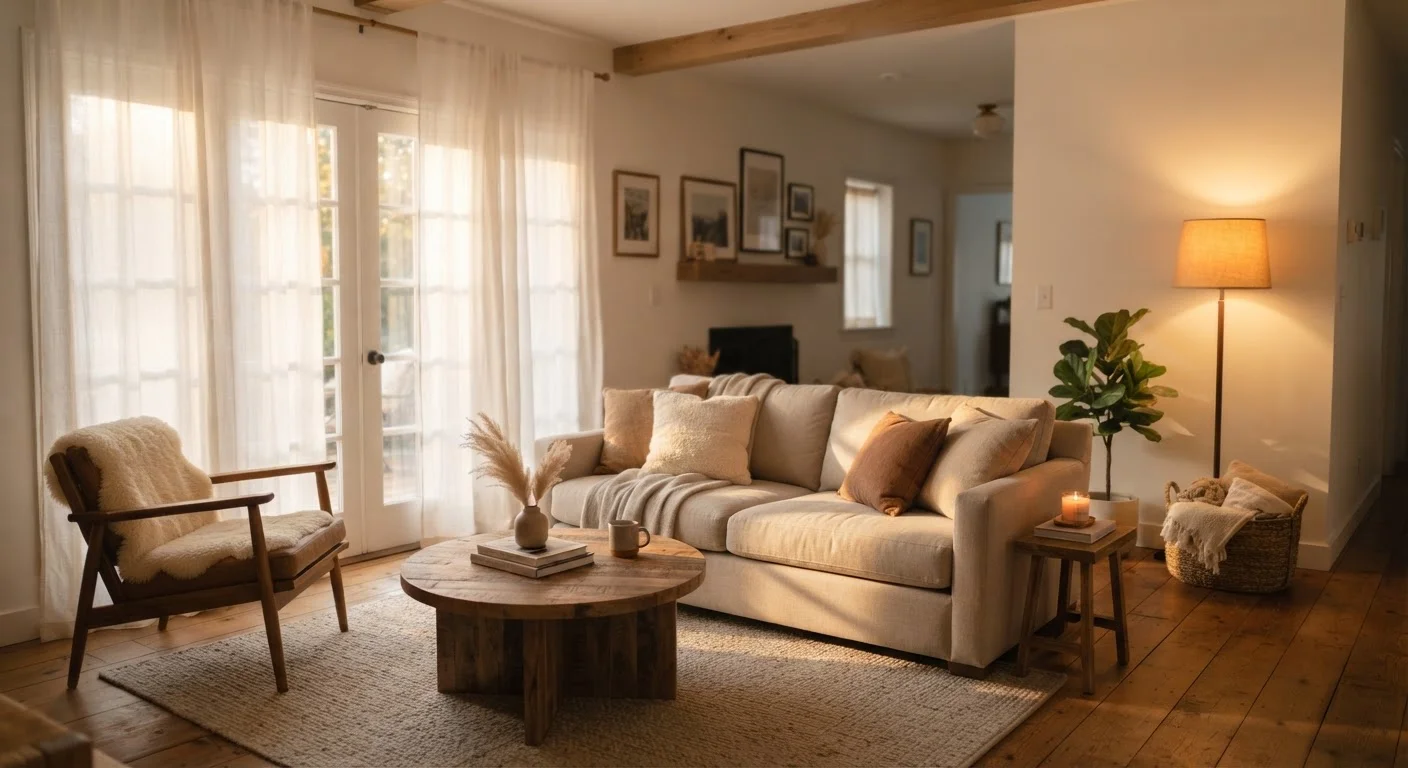
The most liveable rooms treat natural and artificial light as collaborators rather than competitors. During the day, the goal is generally to maximise and direct natural light: sheer curtains allow daylight to diffuse softly rather than blast through, mirrors positioned opposite windows can push light deeper into a room, and matte surfaces absorb rather than create harsh glare.
As natural light fades, artificial sources should ease the transition without abruptly shifting the room's register. This is where dimmer switches earn their keep — they allow the same fixture to read very differently at 100% capacity versus a soft 30%. Keeping the colour temperature of your evening lighting in the warmer range helps maintain the relaxed quality that the afternoon light naturally provided.
For rooms that receive very little natural light, artificial layering becomes especially important. Rather than compensating with a single very bright fixture, a collection of warm-toned lamps at different heights creates the illusion of depth and makes the space feel deliberate rather than compensated. Pair this thinking with the design principles behind rooms that feel calm and lived-in for a fuller picture of how light works alongside texture, furniture scale, and spatial rhythm. The plain-language primer on colour temperature and lamps is also a useful companion reference if the terminology is new to you.