

Key Takeaways
- App-guided meditation lowers the entry barrier for beginners through structure and accountability.
- Unguided sitting can cultivate deeper self-reliance and intuitive awareness over time.
- Research suggests both styles reduce stress — the best one is simply the one you'll actually do.
- Your cognitive style, experience level, and goals all influence which approach fits best.
- Many practitioners eventually blend both methods depending on their needs on a given day.
Low barrier to entry for complete beginners
A teacher's voice removes the uncertainty of 'am I doing this right,' making it far easier to start and return to the practice consistently.
Built-in accountability through streaks and reminders
Habit-tracking features leverage behavioral science principles around consistency, helping women who struggle to prioritize self-care actually show up.
Access to varied techniques and teachers
Apps expose you to body scans, loving-kindness, breath-focused, and visualization practices — broadening your toolkit without requiring in-person instruction.
Helpful on high-stress days when self-direction fails
An external calm voice can interrupt the inner critic cycle in ways that willpower alone often cannot, making guided sessions particularly valuable during difficult periods.
Can prevent development of self-directed awareness
Relying on guidance long-term may mean you never fully learn to anchor your own attention — a skill that becomes essential when stillness is needed without a device nearby.
Screen association undermines the transition to calm
Opening a meditation app on the same device used for email and social media creates a cognitive conflict that can make settling into stillness harder, not easier.
Subscription costs and gamification can distort motivation
Streak anxiety and paywalls can shift the focus from genuine inner inquiry to performance and completion, subtly working against the practice's core purpose.
Our Verdict
Neither app-guided meditation nor unguided sitting is universally superior — each serves a different stage of practice and a different kind of mind. Apps offer scaffolding that makes showing up easier, especially when life feels chaotic. Unguided sitting invites a deeper, quieter relationship with your own mind, one that tends to grow more rewarding with experience.
App-guided meditation suits beginners and anyone who benefits from external structure, while unguided sitting is a strong fit for experienced practitioners ready to deepen self-directed awareness.
Why the Format of Your Meditation Practice Actually Matters
Most conversations about meditation skip straight to how often you should practice and gloss over a genuinely consequential question: what kind of practice works for your brain? The difference between app-guided and unguided meditation isn't just aesthetic — it shapes what skills you develop, how sustainable the habit becomes, and how your nervous system responds over time.
If you're newer to meditation or exploring your options, this complete starting point for women new to the practice covers the foundational concepts. Here, we go deeper into one specific fork in the road: whether a voice in your ear — or silence — serves you better.
A Note on 'Correct' Meditation
There is no single correct way to meditate, and both guided and unguided approaches have robust traditions and evidence behind them. What matters most for well-being outcomes is regularity over perfection — a five-minute daily practice consistently maintained tends to outperform an hour-long session practiced sporadically. Consult a qualified mindfulness teacher or mental health professional if you're unsure which approach suits your particular needs or history.
App-Guided Meditation: The Case For It
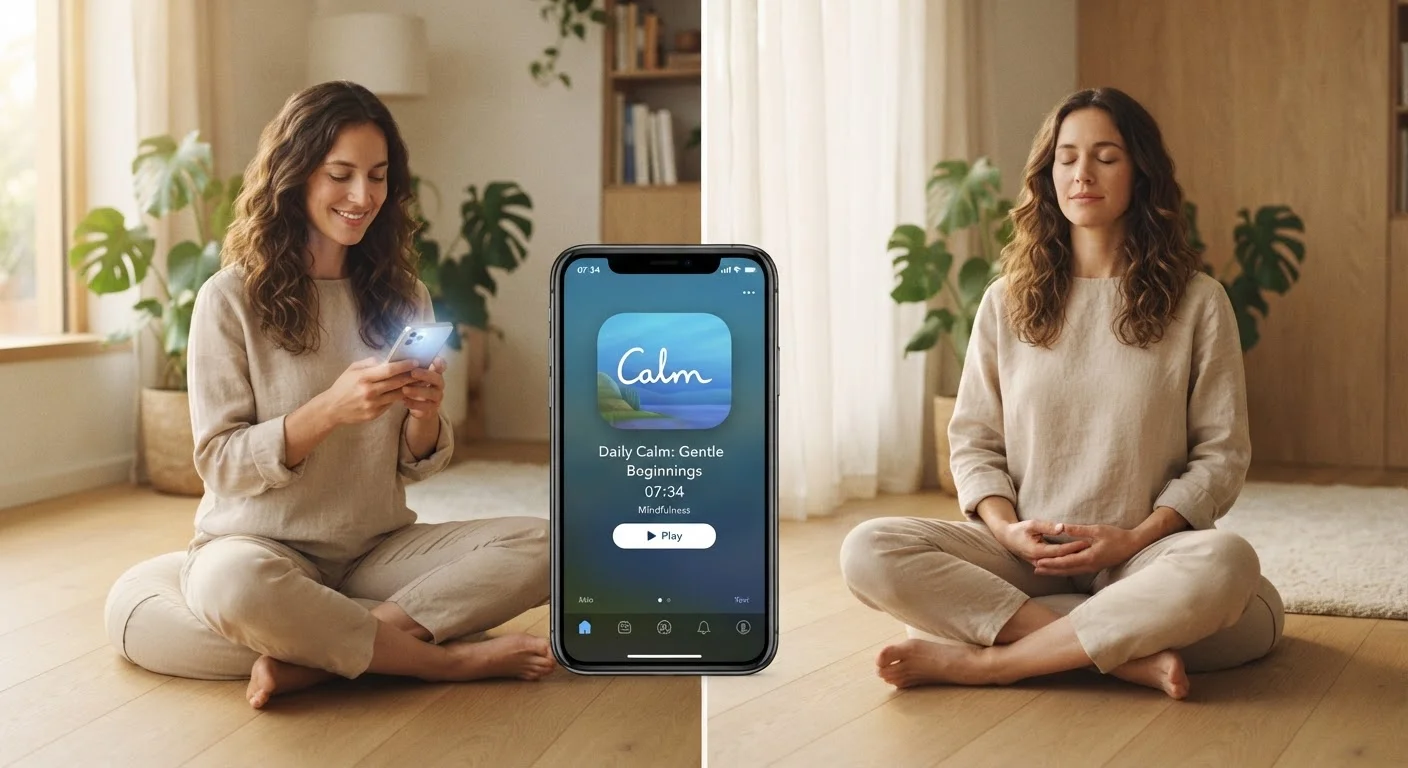
Guided meditation apps work by providing a teacher's voice, timed sessions, themed programs, and often streak-tracking to keep you consistent. For many women, this structure is the difference between meaning to meditate and actually doing it.
Low barrier to entry for complete beginners
A teacher's voice removes the uncertainty of 'am I doing this right,' making it far easier to start and return to the practice consistently.
Built-in accountability through streaks and reminders
Habit-tracking features leverage behavioral science principles around consistency, helping women who struggle to prioritize self-care actually show up.
Access to varied techniques and teachers
Apps expose you to body scans, loving-kindness, breath-focused, and visualization practices — broadening your toolkit without requiring in-person instruction.
Helpful on high-stress days when self-direction fails
An external calm voice can interrupt the inner critic cycle in ways that willpower alone often cannot, making guided sessions particularly valuable during difficult periods.
Research published in journals studying mindfulness-based interventions generally supports the effectiveness of guided audio meditation for reducing perceived stress and improving sleep quality, particularly among people who are new to the practice. Apps lower the activation energy required — you don't need to know what to do with your mind, because someone is telling you.
There's also something worth naming: on a high-stress day when your inner critic is loud, a calm, external voice can interrupt that noise in a way that sheer willpower often cannot.
App-Guided Meditation: The Trade-Offs
The same structure that makes apps accessible can also become a ceiling. When you always have a voice directing your attention, you may never fully develop the capacity to anchor yourself without it — which is arguably the deeper skill meditation builds.
Can prevent development of self-directed awareness
Relying on guidance long-term may mean you never fully learn to anchor your own attention — a skill that becomes essential when stillness is needed without a device nearby.
Screen association undermines the transition to calm
Opening a meditation app on the same device used for email and social media creates a cognitive conflict that can make settling into stillness harder, not easier.
Subscription costs and gamification can distort motivation
Streak anxiety and paywalls can shift the focus from genuine inner inquiry to performance and completion, subtly working against the practice's core purpose.
There's also the question of technology itself. Reaching for your phone to meditate means navigating the same device loaded with notifications, social media, and email. Even with airplane mode, the association can undermine the transition into stillness. Some practitioners find app dependency subtly reinforces a consumer relationship with meditation rather than an intrinsic one.
It's worth considering how journalling compares to meditation as a reflective practice — both have structure trade-offs worth understanding.
Unguided Sitting: What the Silence Offers
Unguided meditation — simply sitting with a timer, a chosen anchor such as the breath or a mantra, and no external instruction — is the older of the two approaches by millennia. Contemplative traditions across cultures have long held that the capacity to be still and self-directed is itself the practice, not just a vehicle for it.
8 weeks
Time for measurable brain changes in mindfulness studies
Research on Mindfulness-Based Stress Reduction (MBSR) programs consistently finds structural and functional brain changes after approximately eight weeks of regular practice, regardless of format.
~14 min
Average daily meditation session length globally
Analysis of aggregated app usage data suggests most users meditate for roughly 10–15 minutes per session, indicating short, consistent sessions are the norm rather than long retreats.
From a neuroscience perspective, studies on long-term meditators (those with thousands of hours of practice) tend to feature unguided or minimally guided practitioners. The evidence suggests that self-directed practice may produce more durable changes in default mode network activity — the brain circuitry associated with mind-wandering and rumination — though this remains an active area of research rather than settled consensus.
For women navigating chronic overwhelm, the ability to return to stillness without any external prop can feel genuinely empowering. It's a skill that travels: into a tense meeting, a sleepless night, a moment of anxiety that strikes without warning.
If you're drawn to embedding this kind of stillness more broadly into daily life, slow living practices offer a complementary framework worth exploring.
How to Choose — Or Combine Both
The honest answer is that most sustained practitioners don't choose one permanently. They use apps when motivation is low, routines are disrupted, or they're learning a new technique. They sit in silence when they're more settled and want depth over direction.
A few practical considerations can help you start:
- If you're a beginner: A guided app removes the overwhelm of not knowing what to do. Start there without guilt.
- If you're experienced but stuck: Try dropping the guidance for just five minutes at the end of a guided session. Notice what happens.
- If your mind races: Structure tends to help. Body-scan or breath-counting guidance gives a restless mind something to do.
- If apps make you feel dependent or distracted: That signal matters. Experiment with a simple kitchen timer and your breath.
It also helps to clarify your intention. Are you building a calming habit, developing concentration, or processing emotion? Understanding the distinction between meditation and mindfulness can sharpen that clarity further.
This article is for informational purposes only and does not constitute medical or psychological advice. If you are experiencing significant anxiety, depression, or other mental health concerns, please consult a qualified healthcare professional.