
Scent, Sound, and Temperature: The Overlooked Dimensions of a Comfortable Home

Key Takeaways
- Visual decor is only one layer of comfort — scent, acoustics, and temperature shape how a home actually feels to be in.
- Scent is processed by the brain's limbic system, making it one of the fastest routes to a sense of calm or alertness.
- Hard surfaces amplify sound and increase stress; soft materials like rugs and curtains absorb it naturally.
- Thermal comfort depends on more than a thermostat setting — airflow, humidity, and radiant heat all play a role.
- Small, low-cost adjustments to these sensory layers can meaningfully improve daily wellbeing at home.
Sensory Home Design
Sensory home design is the practice of intentionally shaping how a space feels — not just how it looks. It considers the non-visual dimensions of a room: what it smells like, how sound moves through it, and whether the temperature supports comfort and ease. These factors work together beneath conscious awareness to determine whether a home genuinely feels like a refuge.
Environmental psychologists refer to these dimensions as 'ambient conditions' — background factors that influence mood, cognition, and behavior without people explicitly noticing them, distinct from the visual and tactile qualities that dominate most interior design conversations.
Why Comfort Is Never Just Visual
Spend enough time decorating a room — selecting paint colors, sourcing the right furniture, arranging objects with care — and it's easy to assume that what you can see is what determines how a space feels. But walk into a beautifully styled room with a stale smell, a hard echo, and a chill that no throw blanket quite fixes, and the illusion collapses fast.
The way a home actually feels to be in is shaped by a cluster of sensory inputs that most interior design advice barely touches. Scent, acoustics, and thermal comfort operate largely below conscious attention — which is exactly why they're so powerful. When they're working, you don't notice them. When they're off, something feels wrong and you can't quite name it.
If you've ever walked into a room that felt inexplicably unwelcoming despite looking fine, the reasons often lie beyond the visual. These are the dimensions worth learning to design intentionally.
~90%
Time Americans spend indoors daily
According to the U.S. Environmental Protection Agency, Americans spend approximately 90% of their time indoors — making indoor sensory conditions a significant factor in daily wellbeing.
40–60%
Recommended indoor relative humidity range
The American Society of Heating, Refrigerating and Air-Conditioning Engineers (ASHRAE) identifies this range as generally comfortable for occupants and supportive of indoor air quality.
60–67°F
Ideal bedroom temperature range for sleep
Sleep researchers widely cite this range as supportive of the body's natural core temperature drop during sleep onset, though individual variation exists.
Scent: The Fastest Route to Atmosphere
Of all the senses, smell has the most direct neural pathway to the limbic system — the part of the brain most closely associated with emotion and memory. This is why a particular fragrance can instantly summon a feeling of safety, or unease, before you've had time to consciously process it.
In the home, scent functions as an invisible layer of atmosphere. A consistently pleasant, familiar scent in a bedroom or living room signals to the nervous system that this is a safe, known place. Over time, that association deepens. The scent becomes inseparable from the room's identity.
Practical approaches vary. Diffusers using essential oils, beeswax candles, dried botanicals, and simply keeping windows open for airflow all contribute. What matters most is consistency and appropriateness to the space — lighter, fresher scents tend to suit kitchens and bathrooms, while warmer or woodier notes often work better in living and sleeping areas.
One important caveat: some synthetic fragrance products release volatile organic compounds that can affect indoor air quality, particularly in poorly ventilated rooms. Natural ventilation and thoughtful sourcing matter. Our piece on what's actually in your home's air explores this in fuller detail.
Acoustics: The Sensory Layer Nobody Designs For
Most people don't think about sound until something is bothering them — a neighbor's music, street noise, the hard echo of a room with too many hard surfaces. But acoustic comfort is as foundational to how a space feels as its lighting or layout.
Hard surfaces — concrete floors, plaster walls, glass, bare wood — reflect sound waves, causing them to bounce and build. The result is a room that feels slightly agitating, even when nothing is obviously loud. Soft materials do the opposite: they absorb sound energy, damping echo and making a space feel quieter and more intimate than its actual noise level might suggest.
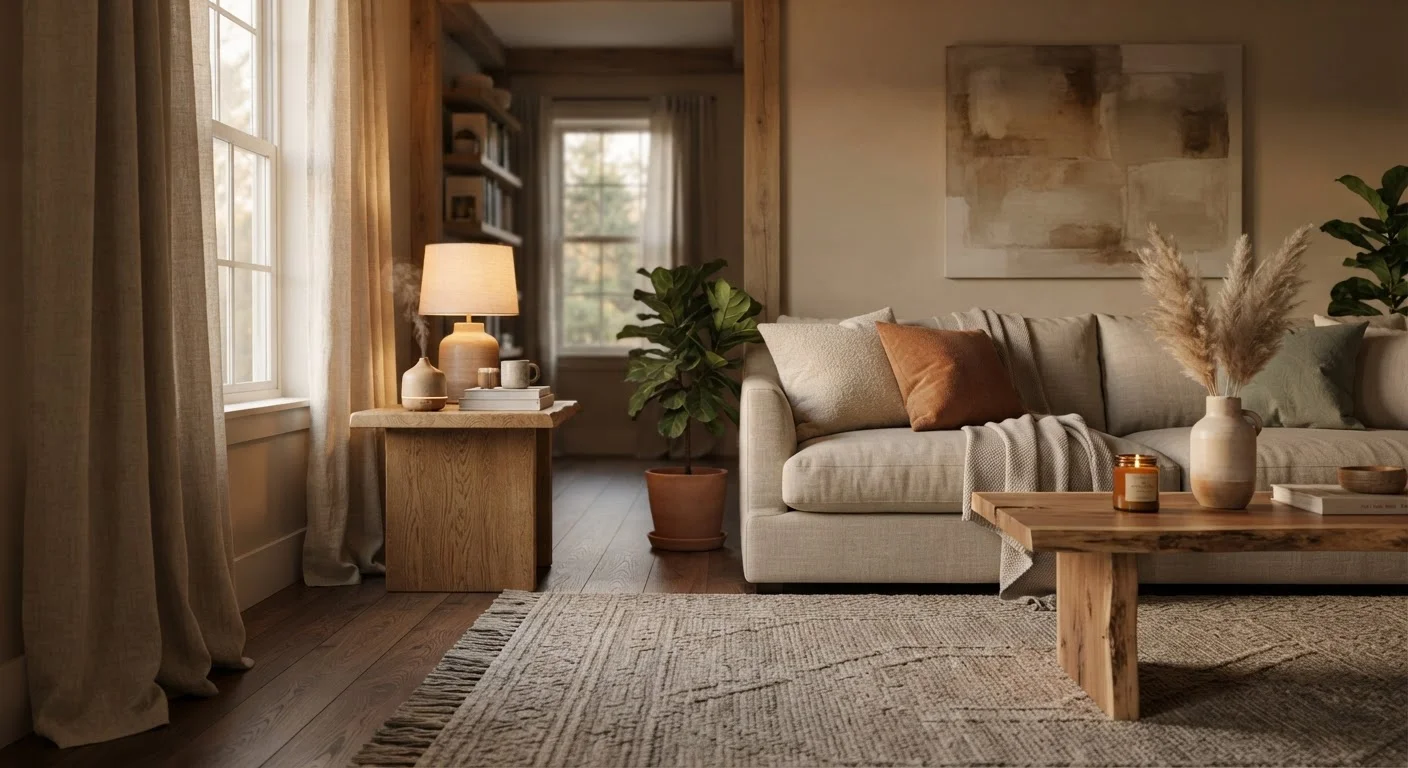
This is why a living room with a large area rug, upholstered seating, and heavy curtains tends to feel calmer than a minimalist space with polished floors and bare walls — even when both rooms have identical furniture arrangements. Bookshelves stacked with books are surprisingly effective sound absorbers. So are wall-hung textiles, which double as both acoustic treatment and visual warmth.
For shared homes, acoustic thoughtfulness becomes even more pressing. The dynamics of shared space often hinge on sound management — who can hear whom, and where quiet is reliably available.
Thermal Comfort: More Nuanced Than a Thermostat
Temperature is the most obviously physical dimension of comfort, yet it's also widely misunderstood. A thermostat reading of 70°F doesn't tell you much about how a room actually feels — because perceived warmth is shaped by humidity, airflow, the materials surrounding you, and radiant heat from walls and floors, not just air temperature alone.
Radiant heat is particularly underappreciated. A room with warm-colored walls, wool rugs, and upholstered furniture will feel warmer at a given temperature than a room with stone floors and white walls — because radiant heat exchange between the body and surrounding surfaces matters as much as ambient air temperature. This is one reason well-layered interiors tend to feel cozier without requiring higher heating costs.
Humidity is the other major variable. Very dry air — common in heated interiors in winter — makes spaces feel colder and contributes to dry skin and respiratory discomfort. Very humid air makes warmth feel oppressive. A moderate humidity level (roughly 40–60% is often cited as comfortable for most people) tends to make temperature feel more neutral and livable.
Bedroom temperature deserves particular attention. Sleep researchers generally suggest that a cooler sleeping environment — around 60–67°F (15–19°C) for most adults — supports the body's natural nighttime drop in core temperature. Layered bedding that can be adjusted gives sleepers more agency than relying on a fixed room temperature alone.
Lighting quality also intersects here — cooler, bluer light can make a space feel marginally colder, while warmer lamp light reinforces a sense of thermal comfort. The relationship between light and perceived warmth is worth understanding alongside thermal design.
Designing Intentionally Across All Three Dimensions
None of these three sensory layers requires a renovation or a significant budget. What they require is attention — the habit of noticing how a space actually feels rather than only how it looks, and making deliberate adjustments in response.
A useful starting point is to enter each room of your home as if for the first time, with your eyes closed for a moment before opening them. What do you smell? What do you hear? Is the air temperature comfortable, or slightly wrong in a way you've stopped noticing? These questions tend to surface issues that visual assessment misses entirely.
The principles behind rooms that feel genuinely calm consistently involve this kind of multi-sensory thinking — not just arranging objects beautifully, but attending to the invisible qualities that determine whether a space truly supports rest, focus, and ease.
Start With a Sensory Walk-Through
Set aside ten minutes to move through your home with intention: close your eyes briefly in each room and notice smell, sound, and temperature before you look at anything. Jot down what feels off. This kind of non-visual audit often surfaces the real source of discomfort that visual rearranging has never fixed.
Sensory design, ultimately, is about closing the gap between how a home looks and how it feels. That gap is where most discomfort quietly lives.