

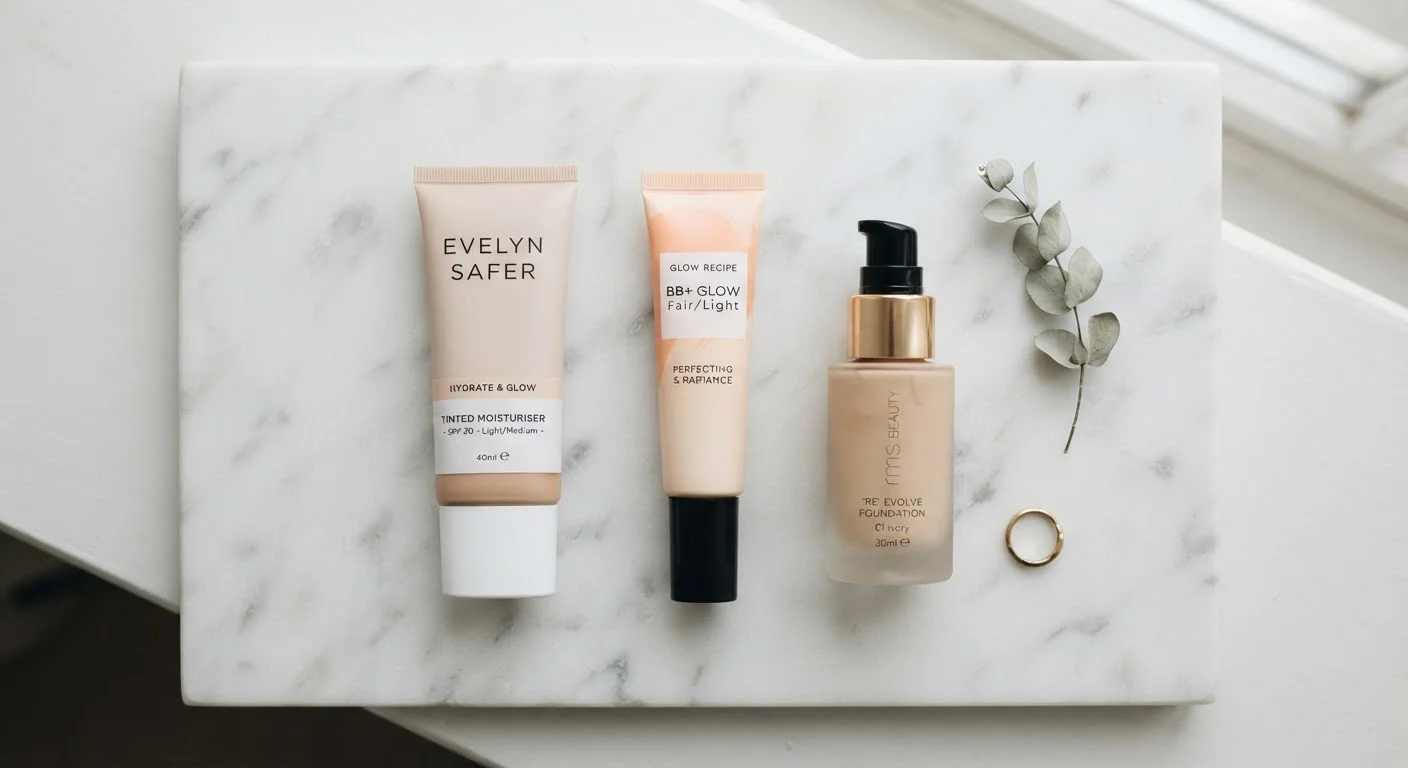
Key Takeaways
- Tinted moisturisers prioritise skin hydration with minimal, sheer coverage — ideal for healthy, even skin.
- BB creams sit between tinted moisturisers and foundations, often including SPF, skincare actives, and light-to-medium coverage.
- Foundation is designed primarily to deliver consistent, buildable coverage — skincare benefits are secondary.
- Your skin type and the occasion matter more than trends when choosing between these three formats.
- All three can be layered with or without additional skincare, but the order and compatibility matter.
Our Verdict
No single formula is universally superior — the right choice depends on what your skin needs on a given day. Tinted moisturisers reward skin that needs little correction; BB creams offer a practical middle ground for daily wear; foundation remains the tool of choice when consistent or buildable coverage is the priority.
| Best for | Recommended |
|---|---|
| Low-maintenance, hydration-first skin days | Tinted Moisturiser |
| Everyday wear with built-in sun protection | BB Cream |
| Occasions requiring reliable, adjustable coverage | Foundation |
| Combination or oily skin seeking a lightweight finish | BB Cream or Lightweight Foundation |
What Each Product Is Actually Designed to Do
The confusion between these three is understandable — all of them go on your face, improve skin tone, and come in similar packaging. But their formulation priorities are completely different, and that shapes everything about how they perform.
Tinted moisturiser is, at its core, a moisturiser with pigment added. The formulation objective is hydration first; coverage is incidental. Because the pigment-to-base ratio skews heavily toward the base, you get a wash of colour rather than a mask. This makes tinted moisturisers excellent for skin that is already in good condition and needs more of a tone-polish than a correction.
BB cream (short for beauty balm or blemish balm) originated in German dermatology as a post-procedure skin soother and was later reformulated for the mass market. Modern BB creams are engineered as hybrid products: they aim to moisturise, provide light-to-medium coverage, and often include SPF and additional skincare actives in one step. Think of them as a more purposeful, multi-tasking middle ground. For a broader look at how formulas interact with skin type, see matching product formulas to your skin type.
Foundation is purpose-built for coverage. While modern foundations often contain hydrating or skin-conditioning ingredients, their primary engineering goal is pigment distribution — achieving even, consistent colour across the face. The texture, finish, and wear-time are all optimised around that objective, not around skincare delivery.
Coverage, Finish, and Wear: The Real Differences
| Tinted Moisturiser | BB Cream | Foundation | |
|---|---|---|---|
| Primary purpose | Hydration with colour | Multi-tasking hybrid | Consistent coverage |
| Coverage level | Sheer | Light to medium | Sheer to full (varies) |
| Typical finish | Dewy, skin-like | Natural to satin | Matte, satin, or radiant |
| Skincare actives | Moisturising ingredients | Often SPF + actives | Minimal to moderate |
| Wear time | Shorter | Moderate | Longest |
| Best suited for | Even, healthy skin | Everyday versatility | Coverage-focused occasions |
| Buildability | Low | Low to moderate | High |
Coverage level is the most functional distinction. Tinted moisturisers typically offer sheer coverage, meaning skin texture, freckles, and minor discolouration remain visible — which many people prefer for a natural look. BB creams deliver light-to-medium coverage, enough to unify tone without appearing heavy. Foundations span the full range from sheer to full coverage depending on their formulation; they are also the most buildable of the three.
Finish matters too. Tinted moisturisers tend to leave a dewy, skin-like finish because of their high moisture content. BB creams vary — many aim for a natural or satin finish. Foundations are formulated to specific finishes (matte, satin, radiant) as part of their design, giving you more deliberate control. If you want to understand what coverage labels on packaging actually mean, this breakdown of coverage levels explains each category clearly.
Wear time also differs. Because foundation formulas are engineered for longevity, they generally outlast tinted moisturisers on the skin, particularly for those with oily skin types. BB creams typically fall in between.
How Skin Type Should Steer Your Choice
Your skin's baseline behaviour is one of the most reliable guides here. A full breakdown of how to build a routine around your skin type is available at building a routine around your skin type, but for base product selection, these principles generally hold:
- Dry skin tends to do well with tinted moisturisers and hydrating BB creams, both of which add moisture rather than absorb it. Matte foundations can settle into dry patches and emphasise texture.
- Oily or combination skin may find that tinted moisturisers add unwanted shine and slip. A BB cream with a more balanced formula, or a lightweight foundation with a satin or matte finish, typically performs better through the day.
- Sensitive skin benefits from short ingredient lists and fragrance-free formulations — a consideration that applies equally to all three formats. Check ingredient panels carefully rather than relying on category alone.
- Skin with significant discolouration, redness, or scarring will generally require foundation's higher pigment load to achieve even tone, or a strategic combination of concealer and a lighter base. See also how concealer and foundation serve different purposes.
Test Coverage in Natural Light
Store lighting is rarely an accurate environment for judging how a base product looks on skin. Before committing to any formula, apply a small amount to your jaw or cheekbone and step outside or near a window. This reveals the true finish, how it interacts with your skin tone, and whether coverage meets your needs — information that's much harder to assess under artificial retail lighting.
Layering These Products into Your Routine
All three sit at the same stage in a makeup routine — after skincare, before any powder or setting products. The sequencing principle is consistent: apply skincare first, let it absorb adequately, then apply your base product. Layering skincare effectively affects how smoothly any base product applies over the top.
One practical note on BB creams: if yours contains SPF, it is worth knowing that the SPF protection in makeup and hybrid products is generally considered less reliable than a dedicated sunscreen applied beneath — coverage is rarely even enough for the SPF rating to hold. If UV protection is a priority, apply a standalone SPF as part of your skincare step and treat the BB cream's SPF as a secondary layer.
For those building a minimal everyday look, a tinted moisturiser or BB cream often means fewer steps overall. If you're interested in a minimal but versatile approach to makeup more broadly, these five foundational makeup products provide a useful framework.
This article is for general informational and educational purposes only. Individual skin concerns or reactions should be discussed with a qualified dermatologist or skincare professional.