

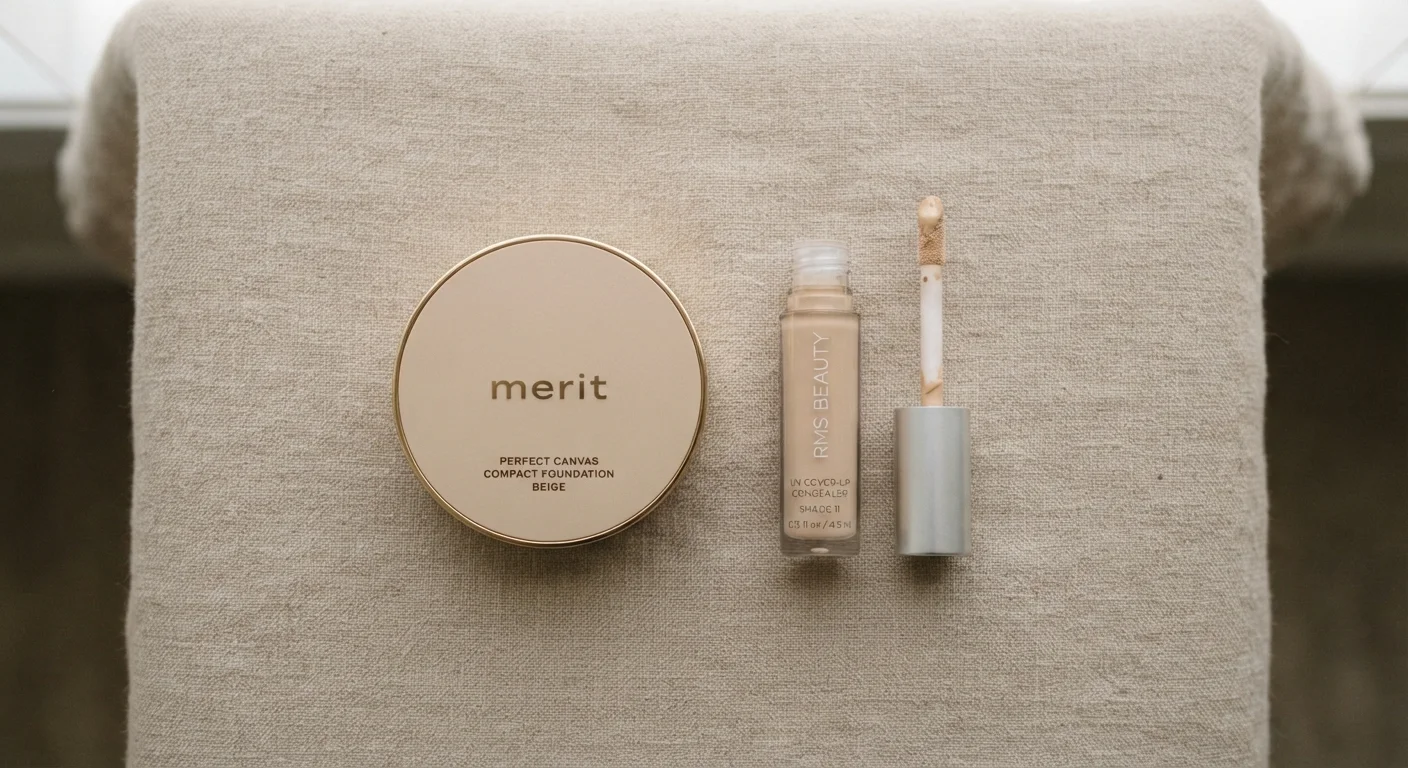
Key Takeaways
- Foundation covers the whole face; concealer targets specific problem areas with more concentrated pigment.
- Applying concealer before foundation is a valid technique, but the reverse works equally well depending on your goals.
- Using concealer alone on bare skin is effective for minimal-coverage days — no foundation required.
- Matching concealer shade to your skin tone is different from matching foundation — the purpose determines the shade.
- Neither product is universally necessary; understanding each one helps you reach for exactly what the situation calls for.
Option A
Foundation
The all-over canvas setter.
Best for: Creating an even, uniform skin tone across the entire face before any targeted corrections.
Option B
Concealer
The precision spot corrector.
Best for: Targeting specific areas — dark circles, blemishes, redness — with higher pigment concentration.
If you want quick, low-effort coverage on most days
Concealer
A well-matched concealer on dark circles and any visible blemishes is often all that's needed for a polished look — no full-face application required.
If you want your skin tone to look consistent and even overall
Foundation
Foundation is designed to create a uniform base across the entire face — something concealer, used sparingly, cannot replicate at scale.
If you have significant redness or discoloration across large areas
Foundation
Broad coverage across cheeks or forehead is foundation's core job; concealer used this way would apply unevenly and feel heavy.
If you want to reduce how much product sits on your skin
Concealer
Selectively applying concealer only where needed means less overall product — lighter feel, more breathable finish, and a more natural result.
If you're building a minimal starter makeup kit
Concealer
Concealer is more versatile as a first purchase — it can spot-correct, set under eyes, and in some formulas double as a subtle base on bare skin.
What Each Product Is Actually Formulated to Do
Foundation and concealer are both pigmented face products, which is likely why they get conflated — but their formulations reflect completely different intentions.
Foundation is engineered for broad coverage. It's designed to be spread across the entire face in a thin, blendable layer that evens out general skin tone variation. The pigment load is calibrated to be buildable but light enough to feel wearable everywhere. It comes in a wide range of finishes — matte, satin, dewy — because it's meant to set the overall character of your skin's appearance.
Concealer carries significantly higher pigment concentration in a smaller, denser formula. That density is what allows it to neutralize specific issues — the deep blue-purple of under-eye shadows, the red inflammation of a blemish, a patch of post-breakout discoloration — without requiring multiple layers. Applied all over the face, that same density would look cakey and sit heavily in fine lines.
In short: foundation covers broadly and lightly; concealer covers narrowly and deeply. Knowing this distinction immediately clarifies why using one in place of the other produces disappointing results.
| Criterion | Foundation | Concealer |
|---|---|---|
| Coverage area | Entire face | Targeted spots only |
| Pigment concentration | Moderate — blendable | High — dense and opaque |
| Typical finish | Matte, satin, or dewy | Usually natural to satin |
| Shade matching | Exact skin tone match | Varies by purpose |
| Can use alone | Yes — for even base | Yes — for spot coverage |
| Best for | Overall tone evening | Dark circles, blemishes, redness |
The Sequencing Question: Which Goes First?
There's genuine debate here, and the answer depends on what you're trying to achieve — not on a single correct rule.
Foundation first, then concealer is the most common approach. You apply your base layer all over, then assess what still needs attention. Any darkness or redness that the foundation doesn't fully neutralize gets a targeted pass of concealer on top. This minimizes how much concealer you use, since foundation has already done the broad work.
Concealer first, then foundation works particularly well for under-eye coverage. Applying concealer to the under-eye before foundation means the foundation layer can be blended lightly over it, sheering it out slightly and integrating it into the overall look more seamlessly. Some people find this produces a more natural finish under the eyes specifically.
Neither sequence is wrong. The important thing is that you treat them as separate tools doing separate jobs — not one covering for the other.
A Note on Setting Both Products
Whether you use foundation, concealer, or both, setting your application with a light dusting of translucent powder can extend wear and prevent creasing — particularly under the eyes where concealer tends to settle into fine lines. This step is optional and depends on your skin type; those with drier skin may prefer to skip it or use a setting spray instead.
When to Use One, the Other, or Both
Understanding the purpose of each product lets you build a more intentional routine rather than a default one.
Concealer only is a completely valid choice for days when your skin is generally even but you have a specific concern — a blemish, a sleepless night, a patch of redness. Applying a small amount where needed over moisturized skin, then blending well, is a faster and lighter alternative to a full base.
For more on how to read coverage levels across face products, the guide to what 'coverage' really means provides useful framing for interpreting product labels.
Foundation only suits those whose skin tone is already relatively consistent and who want a general evening effect without targeted corrections. Many people find that foundation alone handles most of their concerns.
Both together gives you the most flexibility — a uniform base followed by precise spot-correction. This is where sheer foundations paired with full-coverage concealers work particularly well as a system.
If you've ever wondered whether you're buying products you don't actually need, the breakdown of common makeup myths is worth reading alongside this piece.
The Shade Matching Difference
This is one of the most common points of confusion. Foundation shade should match your skin tone exactly — the goal is invisibility, a seamless blend into your natural complexion.
Concealer shade matching depends on what you're using it for. To correct dark circles — which often carry blue, purple, or brown undertones — many people find a concealer one or two shades lighter than their skin tone is more effective. To cover blemishes, an exact match or even slightly deeper shade integrates more naturally. This is why some people own two concealers at once, which can feel excessive until you understand the logic.
For a broader comparison of products that occupy similar territory — tinted moisturizers, BB creams, and foundations — the practical breakdown of tinted moisturiser vs. BB cream vs. foundation puts foundation in useful context alongside its lighter-coverage alternatives.
This article is for general informational purposes only. Individual skin types and concerns vary; if you have a skin condition affecting your makeup choices, consider consulting a dermatologist.