

Key Takeaways
- Skin type guides ingredient and texture choices — it doesn't prescribe a fixed product list.
- Oily skin still needs moisturiser; skipping it can trigger more sebum production.
- Dry skin benefits most from barrier-repair ingredients like ceramides and occlusives.
- Combination skin responds better to zone-targeted application than blanket coverage.
- Sensitive skin requires fewer actives, not no actives — introduce gradually.
- Most skin types shift with age, season, and health; routines should shift with them.
Why Skin Type Is a Starting Point, Not a Life Sentence
Skin type is a useful diagnostic framework — it tells you about your skin's default behavior under stable conditions. But it's not a fixed identity. Sebum production, hydration levels, and sensitivity can all shift with hormonal changes, climate, medication, and age. Understanding this distinction helps you build a routine that responds to your skin rather than rigidly following a label.
The four most commonly used categories — oily, dry, combination, and sensitive — describe patterns of oil production and reactivity. They don't account for everything. Dehydration (lack of water) can affect all types. Sensitivity can overlay any type. And the ways skin changes across decades mean a routine that worked in your twenties may not serve you well at forty.
Before adjusting anything, observe your skin on a day when you've used only a gentle cleanser and nothing else. After about an hour, check which areas look shiny, which feel tight or flaky, and which seem balanced. That observation — not a quiz — is your real baseline.
Oily Skin: Regulating Without Over-Stripping
Oily skin produces excess sebum — often visible as shine across the forehead, nose, and chin — and is prone to enlarged pores and breakouts. The instinctive response is to dry it out, but this tends to backfire. Over-cleansing or using harsh, alcohol-heavy toners strips the skin's natural lipids, which can signal the sebaceous glands to produce even more oil to compensate.
The functional goal for oily skin is regulation, not elimination. This means using a gentle, non-stripping foaming or gel cleanser twice daily, incorporating a niacinamide serum (which research supports for sebum regulation), and — critically — not skipping moisturiser. Lightweight, oil-free, or gel-format moisturisers provide the hydration oily skin still needs without adding occlusive weight. See common mistakes that may be working against your skin for more on why skipping moisturiser is counterproductive.
For oily skin, try applying your moisturiser to slightly damp skin — it helps lock in water content so the skin doesn't compensate by overproducing oil.
Sebaceous glands can upregulate sebum production when the skin's surface hydration signals depletion; keeping surface moisture consistent helps moderate this feedback loop.
If you're unsure whether a reaction is sensitivity or purging (a temporary increase in breakouts when starting an active), sensitivity typically presents as redness, stinging, or hives — purging looks like accelerated breakouts in areas you already break out.
Conflating purging with a genuine adverse reaction leads people to abandon effective actives unnecessarily, while mistaking a real reaction for purging can mean continuing to use something that's causing harm.
Exfoliation with a low-concentration BHA (beta-hydroxy acid, such as salicylic acid) once or twice a week can help keep pores clear because BHAs are oil-soluble and penetrate follicles. Daily sun protection with a non-comedogenic SPF is non-negotiable regardless of skin type.
Dry Skin: Restoring Barrier Function First
Dry skin underproduces sebum, which means the skin's lipid barrier is thinner and less effective at retaining moisture. This shows up as tightness, flaking, dullness, and sometimes fine lines becoming more pronounced. The priority is barrier repair before anything else — actives, exfoliants, and treatments should wait until the skin is adequately supported.
The core of a dry skin routine is a cream or balm cleanser that doesn't remove more than necessary, followed by a hydrating toner or essence (containing humectants like hyaluronic acid or glycerin to draw water into the skin), a richer moisturiser containing ceramides and fatty acids to rebuild the lipid barrier, and if needed, an occlusive layer at night — ingredients like petrolatum or squalane that physically prevent transepidermal water loss.
Avoid alcohol-based products, harsh physical scrubs, and over-use of retinoids without adequate buffer moisturisation, as all three can further compromise the barrier. Layering products effectively becomes especially important here — applying occlusives too early in the routine, for instance, can block subsequent products from absorbing.
Combination Skin: Treating Zones, Not the Whole Face
Combination skin is characterised by oiliness in the T-zone (forehead, nose, chin) and dryness or normal behavior on the cheeks and around the eyes. The mistake most people make is choosing one product for the entire face and hoping it meets both needs. It rarely does.
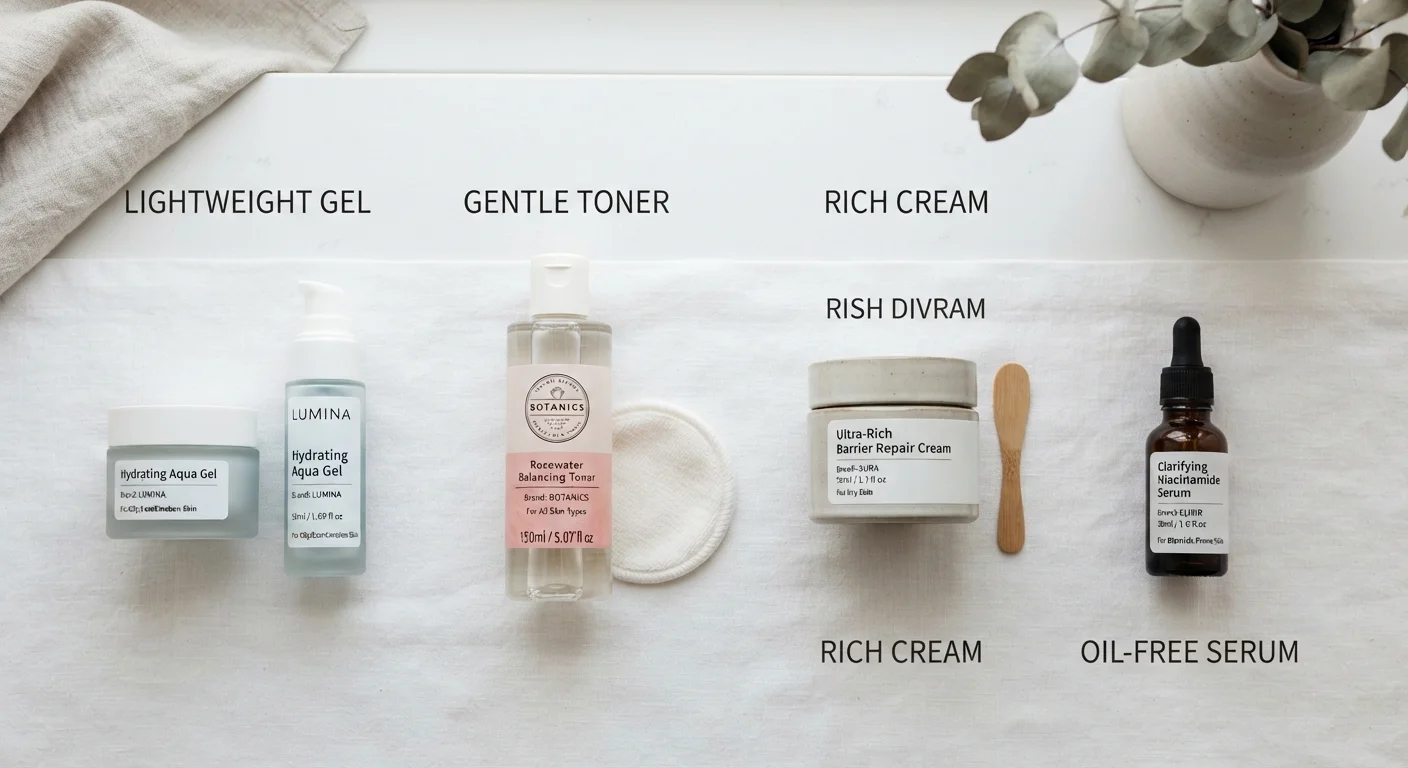
A more effective approach is multi-masking and zone-targeted application: applying a lighter gel moisturiser across oilier areas and a richer cream on drier zones. Likewise, a BHA can be applied to the T-zone without needing to extend to the cheeks. Cleansing should be gentle enough not to strip the drier areas.
Zone Application for Combination Skin
Keep two moisturisers on hand — a lightweight gel for your T-zone and a richer cream for cheeks and eye area. Applying them to separate zones takes only seconds longer but delivers noticeably better results than a single compromise formula. This approach also makes it easier to adjust one zone seasonally without changing your entire routine.
For foundation and base products, texture choice becomes particularly important for combination skin. The relationship between formula textures and skin type explains why a matte powder over dry areas and a satin-finish liquid over the T-zone can produce better results than using one product uniformly.
Sensitive Skin: Minimising Reactivity Without Minimising Care
Sensitive skin is not a production type — it's a reactivity pattern. It can coexist with oily, dry, or combination skin. It's characterised by a tendency to react to topical ingredients, environmental triggers, or both with redness, stinging, itching, or flushing. Rosacea and eczema are specific skin conditions that produce sensitivity but warrant consultation with a dermatologist rather than self-managed routine changes alone.
For generally reactive skin, the guiding principle is reduce variables first, then build gradually. Start with the absolute minimum — a mild, fragrance-free cleanser, a simple moisturiser, and SPF. Introduce one new product at a time, waiting at least two weeks between additions. This makes it possible to identify what triggers a reaction rather than guessing among five new products introduced at once.
Fragrance — including 'natural' fragrance from essential oils — is one of the most common causes of contact irritation in skincare. Opting for fragrance-free formulations removes one of the highest-risk variables. Patch testing on the inner arm before full-face application is a practical precaution. For actives like retinoids or AHAs, a lower concentration introduced infrequently is more sustainable than skipping them entirely, as skin can often adapt over time.
This article is for general informational purposes only and is not a substitute for professional medical advice. If you experience persistent skin irritation, redness, or symptoms that may indicate a skin condition, consult a qualified dermatologist.
When Your Skin Doesn't Fit One Category
Most skin doesn't behave according to a single, consistent type year-round. Your skin may be oily in summer and dry in winter, or dehydrated on the surface despite being fundamentally oily underneath. The seasonal adjustments your routine may need are a practical example of this — formulas that serve you in humid months can feel heavy and pore-clogging when central heating strips winter air of moisture.
The solution isn't a new routine from scratch each season — it's understanding the functional role of each step so you can swap textures or concentrations intelligently. If the logic behind routine sequencing is clear, changing a moisturiser from a light gel to a richer cream in winter is a small, confident adjustment rather than a confusing overhaul.
When in doubt, return to the observational baseline: how does your skin look and feel one hour after gentle cleansing, with no other products? That's the signal. Build from what you actually see, not from what a single category implies you should need.