

Key Takeaways
- Coverage describes how much a base product visually conceals your skin's natural tone and texture.
- Sheer, medium, and full are the three main coverage levels — each suits different skin concerns and occasions.
- Skin type and skin prep both influence how much coverage a product actually delivers on your face.
- You can layer sheer or medium formulas to build coverage without the heavy feel of a full-coverage product.
- Coverage level and finish (matte, satin, dewy) are separate attributes — one doesn't determine the other.
Foundation Coverage
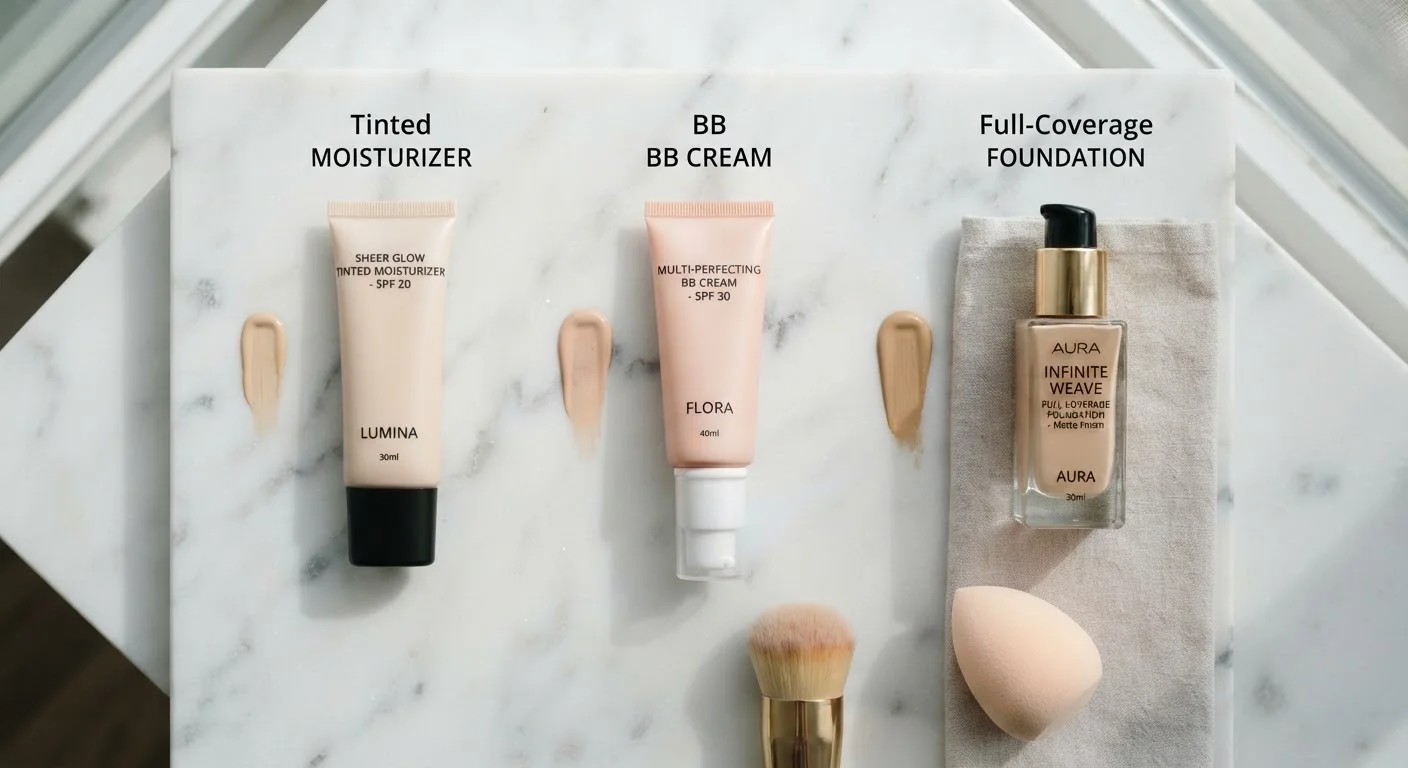
Coverage refers to how much of your skin's natural color, texture, and imperfections a base product visually obscures. A sheer-coverage product lets most of your skin show through; a full-coverage product conceals nearly all of it. The term appears on packaging for foundations, tinted moisturizers, BB creams, and concealers.
Coverage is determined by pigment concentration (the ratio of colorant to carrier formula) and the size of pigment particles — higher pigment load and finer particles generally produce more opaque results.
The Three Coverage Levels, Defined
The beauty industry uses three core coverage descriptors. Understanding what each one actually means — not just how it sounds — removes a lot of the guesswork from choosing a base product.
Sheer Coverage
Sheer coverage products contain a low concentration of pigment. They even out the skin's overall tone slightly and add a wash of color, but they don't hide individual spots, redness patches, or hyperpigmentation. Your skin is clearly visible underneath. Tinted moisturizers and many BB creams typically fall into this category. The result looks like your skin on a good day — unified but not masked.
Medium Coverage
Medium coverage is the most versatile level. It conceals mild redness, minor discoloration, and light texture while still looking like skin rather than a filter. Most everyday foundations are designed for medium coverage, and many are labeled 'buildable,' meaning an extra layer adds more opacity without becoming stiff or cakey. This is the range most people use as a daily starting point.
Full Coverage
Full-coverage formulas have a high pigment load and are designed to obscure significant discoloration, post-inflammatory marks, melasma, scars, or uneven texture. Done well, the result still reads as skin — just with very little of its original variation showing through. Done poorly (wrong shade, too much product), full coverage can look flat or mask-like. Precise shade matching and a light application hand matter more here than with lower-coverage options.
Coverage Terms Aren't Standardized
There is no industry-wide regulatory definition for 'sheer,' 'medium,' or 'full' coverage — these descriptors are set by each brand individually. A 'medium' coverage from one brand may perform closer to sheer compared to another's. Reading independent swatches and applying a test patch yourself remains the most reliable method for assessing real-world coverage.
Why Skin Type Changes What You Actually See
The coverage level printed on a label is a starting point, not a guarantee. What you see on your face depends on several variables — most importantly, your skin type and how you've prepped your skin.
On oily skin, foundation tends to thin out and move throughout the day. A formula marketed as medium coverage may perform closer to sheer by midday without a primer or setting powder underneath. On dry skin, the opposite can occur: product settles into fine lines or dry patches, concentrating pigment and making coverage appear heavier in those areas. This is why understanding your skin type is a foundational step before selecting any base product.
Skin prep — specifically moisturizing and priming — directly affects coverage performance. A well-hydrated, primed surface gives pigment something stable to adhere to, meaning the coverage you apply is closer to the coverage you'll keep. Skipping prep doesn't just affect longevity; it affects how the product sits and blends from the start.
Prep Your Skin Before Judging Coverage
Always apply foundation to moisturized, settled skin before deciding a formula isn't giving you enough coverage. Dry or unprepped skin absorbs product unevenly, making formulas appear patchier and lighter than their labeled level. Give moisturizer at least five minutes to absorb before applying your base.
Building Coverage vs. Piling It On
One of the most useful techniques in makeup is learning to build coverage incrementally rather than applying one heavy layer. Thin, layered applications of a medium-coverage formula give you more control and a more natural result than a single thick coat of full-coverage product.
Start with a light, even layer across the entire face. Let it settle for 30 seconds. Then assess: which areas need more? Apply a second thin layer only there — typically the center of the face, around the nose, or over any pronounced discoloration. A concealer (which is a separate product with its own coverage range — see why concealer and foundation aren't interchangeable) can then address individual spots without disturbing the foundation underneath.
This layered approach also makes it easier to match coverage to context. The same foundation used lightly for a daytime look can be layered more deliberately for an evening application — no separate product needed.
Coverage vs. Finish: Two Separate Decisions
Coverage and finish are commonly conflated, but they describe completely different things. Coverage is about opacity — how much skin shows through. Finish is about light reflection — whether the result looks matte, satin, or dewy once set.
A full-coverage foundation can have a luminous, skin-like finish. A sheer tinted moisturizer can be completely matte. These are independent attributes set by different aspects of the formula. When reading packaging or researching options, evaluate both separately: what level of opacity do I want, and what kind of light reflection suits my skin and the occasion?
For a more structured look at how formulas — powder, liquid, cream — interact with different skin types and finishes, the article on matching product formulas to your skin type covers the mechanics in detail. And if you're deciding whether a tinted moisturizer, BB cream, or foundation best suits your routine, this practical breakdown lays out the key differences clearly.
This article is for informational purposes only. Individual skin concerns, conditions, or sensitivities should be discussed with a qualified dermatologist or skincare professional.