

Key Takeaways
- Editing possessions down is more effective than buying more storage products.
- Multifunctional furniture reduces clutter without sacrificing comfort or style.
- Defined zones — not walls — create psychological separation between activities.
- Consistent daily resets prevent small spaces from tipping into chaos.
- Vertical surfaces and layered lighting make rooms feel larger at no structural cost.
- Shared compact spaces require explicit agreements, not just good intentions.
Why Small-Space Living Is a Skill, Not a Sacrifice
The persistent myth about small homes is that they're a compromise — something to endure until you can afford more. In practice, people who live well in compact spaces tend to make deliberate choices about what surrounds them, maintain tidier habits out of necessity, and report less time spent managing possessions. That's not accidental.
Research on environmental psychology consistently points to clutter — not square footage — as the primary driver of home-related stress. A 2016 study published in Personality and Social Psychology Bulletin found that women who described their homes as cluttered had higher cortisol levels throughout the day than those who described their spaces as restful. The size of the home was a secondary variable.
This guide is built around that premise: what makes a home work is less about how much space you have and more about how intentionally you use it. Whether you're in a studio apartment, a compact city flat, or a rented room, the principles here apply equally. For inspiration on how a broader intentional-living philosophy can reinforce these habits, see the Slow Living hub.
65%
Americans report clutter causes them stress
According to surveys cited by the American Psychological Association, a majority of adults identify home disorganization as a meaningful source of daily stress.
38%
U.S. new homes under 1,500 sq ft
U.S. Census Bureau data shows a growing proportion of newly built homes fall into the compact category, reflecting urban density and shifting buyer priorities.
10–15 min
Daily reset time to maintain order
Home organization researchers generally agree that brief, consistent daily tidying outperforms infrequent deep cleans for sustained livability.
The Foundation: Edit Before You Organize
The single most common mistake in small-space living is buying storage solutions before reducing what needs to be stored. Baskets, bins, and organizers are useful — but they are a second step, not the first.
Start with a genuine audit. Go room by room and ask one question per item: does this earn its place in this home, or is it here by default? Default possessions — things that arrived, were never used, and stayed — are the primary source of visual and physical congestion in compact spaces. The concept of a capsule home offers a useful framework: curate your space the way you'd curate a wardrobe, keeping only what genuinely supports daily life.
Once the editing is done, storage decisions become clearer. The question shifts from where do I put this? to what does this room actually need to function? That reframe prevents over-purchasing and keeps surfaces cleaner longer.
Do your edit in stages rather than all at once — a first pass removes the obvious, and a second pass two weeks later catches what you reflexively defended the first time.
Decision fatigue sets in quickly during decluttering sessions. A staged approach leads to more honest assessments because the emotional attachment to borderline items diminishes with a short waiting period.
Assign every item a home before you decide whether to keep it — if you genuinely can't figure out where it would live, that's useful information about whether it belongs in yours.
Items without designated homes migrate to surfaces and floors, which is the primary mechanism behind clutter accumulation in small spaces.
Furniture That Earns Its Place
In a compact home, furniture that serves one purpose is a luxury you may not be able to afford spatially. The goal is pieces that do double — or triple — duty without looking like they're trying too hard.
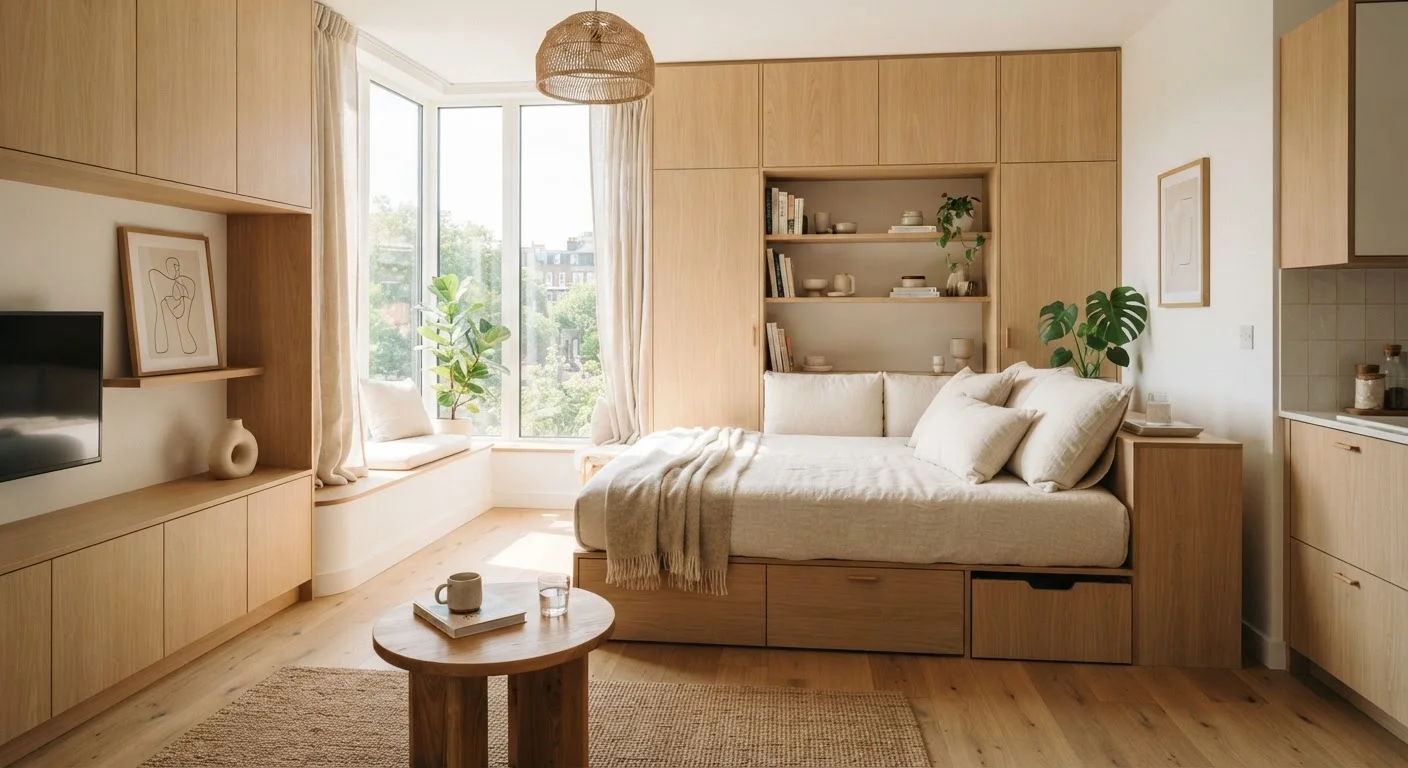
Practical examples: an ottoman with internal storage that also seats guests; a dining table that folds flat against the wall when not in use; a bed with deep under-frame drawers that replace a dresser. These aren't novelties — they're load-bearing decisions that free up floor space, which in turn makes the room feel larger and more navigable.
Scale matters as much as function. Oversized sofas or bulky wardrobes disproportionate to the room create a crowding effect even when the space technically accommodates them. Choosing furniture with exposed legs rather than solid bases lets light travel under pieces, which creates the visual impression of more floor area. For specific guidance on living room arrangements, the article on styling a small living room without it feeling cramped covers this in depth.
Zones Without Walls
Open-plan small spaces — studios and one-bedroom apartments especially — present a specific challenge: every activity competes for the same visual and physical real estate. Work bleeds into sleep. Eating happens where relaxing happens. Without some form of separation, the home stops feeling like a sanctuary and starts feeling like a single, ambiguous room.
Zoning solves this without construction. A rug defines a seating area. A bookshelf positioned perpendicular to a wall creates a visual divider between a sleeping area and a living space. A pendant light hung low over a table signals a dedicated dining zone. These cues are enough for the brain to register distinct areas, which supports the psychological separation between activities — particularly important when the home also functions as a workspace. The article on designing a home that works for remote work and real rest goes further on boundary-setting strategies.
When deciding between open or concealed storage within zones, the choice has a real effect on how a room reads. See open shelving vs. closed cabinets for an honest comparison.
Daily Habits That Keep Small Spaces Livable
In a large home, mess spreads but stays contained. In a small one, disorder becomes visible immediately and compounds quickly. This makes consistent habits — not deep-cleaning sessions — the most important maintenance tool.
A short daily reset of 10 to 15 minutes is more effective than a weekly overhaul. The reset isn't cleaning in the traditional sense; it's returning items to their designated places, clearing surfaces, and closing loops on the day. This habit is low-effort when done daily and becomes difficult when skipped for several days in a row.
One-in-one-out is a useful companion habit for anyone in a compact space: when something new enters the home, something comparable leaves. Applied consistently, it prevents gradual accumulation without requiring regular purges. It also builds a sharper instinct for what's worth bringing in at all.
Make the Reset Non-Negotiable
Treat the daily 10-minute reset like brushing your teeth — a non-optional closing ritual, not something you do when you feel like it. The mornings after you skip it will remind you why consistency matters. Pair it with something you already do, like making tea or winding down for bed, so it becomes automatic rather than effortful.
Light, Vertical Space, and Visual Breathing Room
Two underused dimensions in compact homes: height and light. Most people furnish and decorate at eye level and below, leaving the upper third of rooms empty while floor space is maxed out.
Tall, narrow shelving draws the eye upward and provides storage without consuming significant floor area. Curtains hung near the ceiling — rather than just above the window frame — make ceilings appear higher. Mirrors placed to reflect natural light sources amplify brightness and create a sense of depth that extends the apparent boundaries of a room.
Layered lighting also plays a significant role. Relying on a single overhead fixture leaves corners dark and makes spaces feel smaller and flatter. Adding floor lamps, table lamps, or under-cabinet lighting creates warmth and dimension. A small plant on a windowsill or shelf adds life without consuming meaningful space — for guidance on low-maintenance options, see plants that are actually forgiving.
When You Share the Space
Small spaces shared between two or more people require an additional layer of intentionality. Differences in tolerance for clutter, preferences for temperature or noise, and competing needs for personal space become harder to navigate when square footage is limited.
Explicit agreements work better than assumed compatibility. Who is responsible for which daily resets? Are there areas that belong to one person and shouldn't be reorganized by the other? Where does each person go when they need quiet or privacy? These conversations feel administrative but prevent recurring friction. The article on shared spaces and different needs provides a practical framework for exactly this dynamic.
If you're renting, small-space personalization has its own constraints — but fewer than most tenants assume. Renting and still making it yours walks through what's typically within reach without risking your lease.
This article provides general home organization and lifestyle information. It is not a substitute for professional advice specific to your housing situation or needs.