

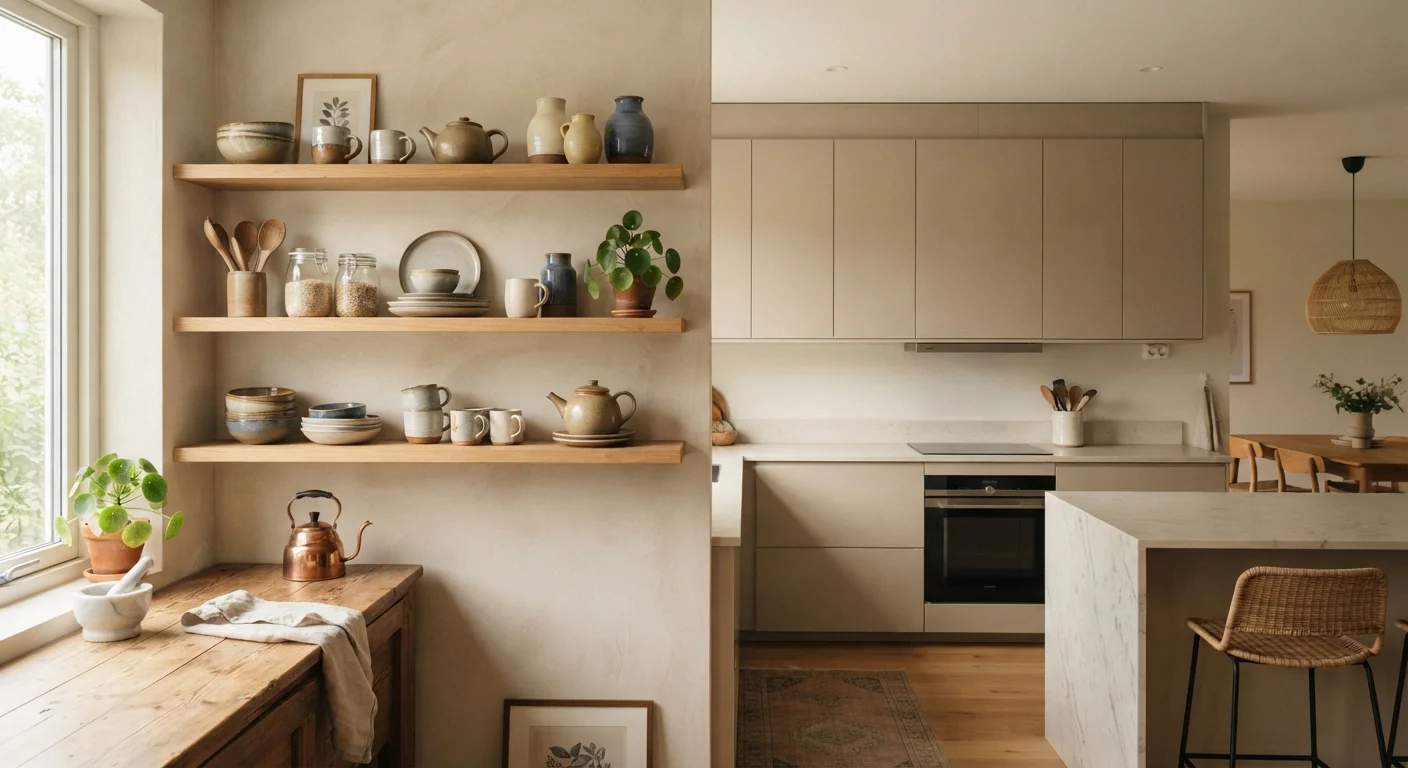
Key Takeaways
- Open shelving makes a room feel larger and more personal but requires consistent styling and regular dusting.
- Closed cabinets create visual calm and are more forgiving of everyday clutter and mixed storage.
- The right choice often comes down to your tolerance for maintenance and how you actually use the space.
- Many well-designed rooms successfully combine both approaches for balance between display and concealment.
- Room size, lighting, and household habits all influence which option will serve you better long term.
Option A
Open Shelving
The expressive, display-forward approach.
Best for: People who enjoy curating a visual story and are willing to maintain a consistently tidy, styled arrangement.
Option B
Closed Cabinets
The clean-lined, clutter-concealing choice.
Best for: People who prioritize visual calm, easy maintenance, and flexible storage without worrying about what's on display.
If you love curating styled displays and find organization genuinely satisfying
Open Shelving
Open shelves reward people who enjoy arranging objects and keeping surfaces intentional. The visual payoff is high when the styling is consistent.
If a busy household means you can't always control what gets left out
Closed Cabinets
Closed cabinetry absorbs daily disorder quietly — close the door and the room looks composed regardless of what's inside.
If you're working with a small or narrow room and want it to feel more open
Open Shelving
Floating open shelves avoid the visual weight of solid cabinet fronts, helping compact spaces feel less enclosed and more breathable.
If you share your home with others who have different tidiness standards
Closed Cabinets
When multiple people use a space, closed storage prevents friction over what's visible and makes shared organization far more manageable.
If you want the flexibility to change your space frequently without a renovation
Open Shelving
Rearranging objects on open shelves transforms the feel of a room instantly — no hardware changes or repainting required.
How Each Approach Changes the Feel of a Room
Storage is rarely just storage. The moment you choose open shelves over closed cabinets — or vice versa — you're making a decision about how the room breathes, what it communicates, and how much visual work it asks of the people living in it.
Open shelving draws the eye outward and upward. Because there's no solid front interrupting sightlines, the wall behind reads as part of the room rather than a barrier. This can make a kitchen or living area feel less enclosed, particularly in rooms with limited natural light. The tradeoff is that everything becomes part of the composition. A mismatched mug or a half-used packet of pasta doesn't disappear — it's on stage.
Closed cabinets work on the opposite principle. A uniform run of cabinet fronts creates a kind of visual silence: the eye moves across without snagging. Rooms with closed storage tend to feel more resolved, even when they're stuffed full behind closed doors. That's a meaningful advantage in a household where daily life doesn't always leave time for curating a perfect tableau.
| Criterion | Open Shelving | Closed Cabinets |
|---|---|---|
| Visual effect | Airy, expansive, decorative | Calm, uniform, resolved |
| Maintenance demand | High — visible dust and styling upkeep | Lower — mess stays hidden |
| Storage flexibility | Limited by what looks presentable | High — any item can be stored |
| Room size impact | Opens up smaller rooms | Can feel heavier in small spaces |
| Personalization | High — objects become décor | Low — fronts are the feature |
| Best household fit | Organized, display-minded households | Busy, mixed-use households |
If you're navigating a smaller footprint, this decision carries even more weight. Our guide to styling a small living room without it feeling cramped explores how storage choices compound the spatial experience in compact rooms.
The Real Maintenance Difference
Interior design photography has a tendency to show open shelves at their best: a linen-toned kitchen with artfully spaced ceramics and not a crumb in sight. Real life is different, and the maintenance gap between these two approaches is one of the most underestimated factors in the decision.
Open shelves collect dust — and do so visibly. Grease, in particular, becomes an issue in kitchens where open storage sits near the stove. Objects need regular wiping down, and the arrangement itself requires periodic re-styling to stay looking intentional rather than accumulated. For people who genuinely enjoy this kind of domestic ritual, it's a non-issue. For others, it quietly becomes a source of low-level stress.
The Dust Factor Is Worth Taking Seriously
In kitchens especially, open shelves near cooking zones accumulate grease particles that adhere to surfaces and objects. This isn't a reason to avoid open shelving entirely, but it is worth factoring into where you place it. Shelves in a living room or hallway face far less of this challenge than those directly adjacent to a cooktop or range.
Closed cabinets require cleaning too, but their demands are less frequent and less visible. Fingerprints on high-gloss fronts aside, the interior can be as chaotic as needed without affecting how the room reads from across the kitchen or hallway. This matters especially in shared living situations, where tidiness standards don't always align.
For a fuller picture of what open shelving actually demands day to day, it's worth reading what no one tells you before committing to open shelves — the honest version of what the aesthetic requires in practice.
Combining Both: Where the Real Opportunity Lives
The most livable rooms rarely commit entirely to one approach. A kitchen with closed lower cabinets and open upper shelves keeps clutter at counter level while gaining airiness at eye line. A home office with a closed credenza and open wall shelves above it separates functional storage from the curated, personality-led display.
This hybrid logic applies to small-space living too — where every storage decision doubles as a spatial design choice. Using open shelving selectively in a compact room creates breathing room without sacrificing the capacity that closed storage provides.
The principle is essentially the same one behind intentional dressing: deciding what you want to put on display, and what you'd rather keep private. Much like the thinking behind a capsule wardrobe versus a curated closet, the most effective home storage strategy reflects how you actually live rather than how a room is supposed to look.
Start by asking which surfaces in your home genuinely make you feel calm when they're clear, and which feel flat or impersonal without something on them. Those answers — more than any trend — will tell you where open shelving earns its place and where a cabinet door is simply the more honest solution.
62%
Homeowners who cite storage as a top renovation priority
According to the National Association of Home Builders' 'What Home Buyers Really Want' report, storage ranks consistently among the highest priorities for homeowners making design decisions.
~30%
Visual space gain with open upper shelving in small kitchens
Interior design research broadly suggests that removing upper cabinet doors in compact kitchens can meaningfully increase perceived room depth, though the exact effect depends on room dimensions and colour palette.