

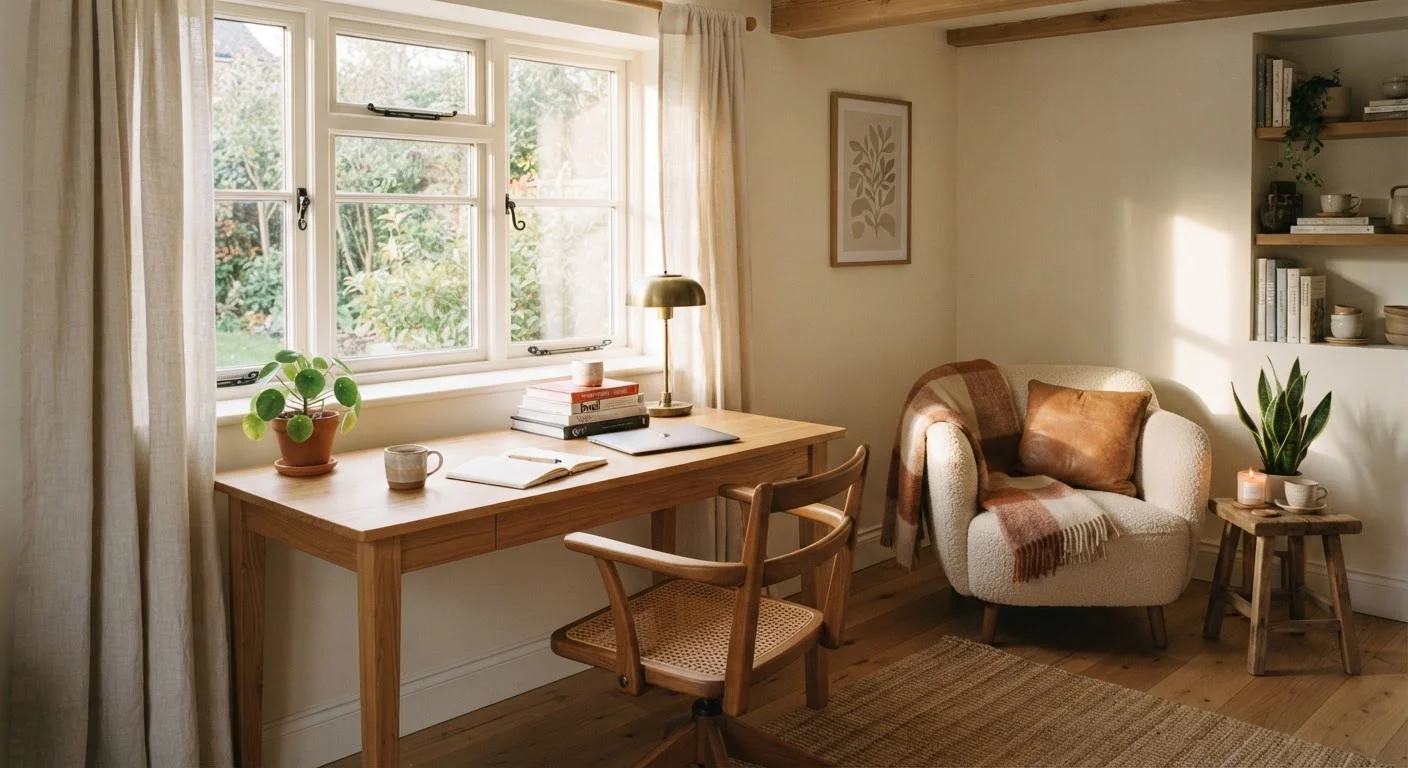
Key Takeaways
- Visual and physical boundaries between work and rest zones matter more than square footage.
- Ritual cues — lighting changes, object swaps, closing a door — signal your brain to shift modes.
- Sensory design elements like scent, texture, and sound can reinforce the work-to-rest transition.
- Shared homes require explicit spatial negotiation to protect both focus and recovery.
- Small, consistent habits compound into a home that genuinely supports your wellbeing.
Why the Overlap Feels So Hard
Working from home promised flexibility. What it often delivered instead was a home that never quite stops feeling like an office. When the same couch hosts your 9 a.m. video call and your 9 p.m. attempt to decompress, your brain has little reason to believe the day is ever really over.
This isn't a discipline problem — it's a design problem. Spatial and sensory environments send constant signals to the nervous system about which mode you're in. When those signals are mixed or absent, the mind defaults to alert and available, which is exhausting. The solution isn't more willpower; it's more intentional design.
57%
Remote workers who report difficulty disconnecting at home
According to a Buffer State of Remote Work survey, more than half of remote workers cite inability to unplug as their top challenge.
3x
Greater burnout risk when work and rest spaces overlap
Workplace wellbeing researchers have found that consistent spatial overlap between work and recovery is associated with meaningfully elevated burnout risk.
The Core Practices: Structuring Space for Focus and Recovery
These principles work across home sizes — from a studio apartment to a multi-room house. The through-line is the same: clarity of purpose for each zone, and rituals that signal transitions between them. For smaller homes where every inch serves multiple functions, our guide to small-space living offers complementary strategies for making the most of a compact footprint.
Establish a dedicated work zone, even if it's just a defined corner.
The brain associates locations with behavior. Working from the same spot consistently trains your nervous system to enter focus mode there — and, crucially, to leave that mode when you physically move away. You don't need a separate room; you need a consistent place.
Use lighting intentionally to mark mode transitions.
Light is one of the most powerful environmental cues available to you. Cooler, brighter light supports alertness and task focus; warmer, dimmer light signals the body toward rest. Switching your lamp or bulb temperature when the workday ends isn't just aesthetic — it's a physiological prompt.
Remove or conceal work materials at the end of each day.
Visual reminders of unfinished work — a laptop open on the coffee table, a notebook splayed across the bed — keep the mental load active even during downtime. Out of sight genuinely does help move toward out of mind, especially in smaller homes.
Build in at least one room or corner that is never used for work.
Having at least one space your brain purely associates with rest protects recovery. If every surface in your home carries dual-purpose stress, there's nowhere to truly decompress. Even a single armchair or a window seat can serve this function if it's consistently protected.
Use scent and sound as sensory bookmarks for each mode.
Olfactory and auditory cues can quickly shift mental state because they bypass conscious reasoning and trigger associative memory. A consistent scent or playlist used only during work hours becomes a focus anchor; a different one used only in the evenings becomes a rest signal.
Design your rest zones to be genuinely inviting, not just work-free.
Removing work cues helps, but actively designing for comfort and pleasure makes rest feel worth protecting. Texture, warmth, and personal meaning — a soft throw, a bookshelf, a piece of art that makes you feel something — turn a zone into a place you actually want to be.
When You Share the Space
If your home holds more than one schedule, the stakes of spatial design multiply. Work zones that bleed into shared living areas can create friction around noise, visual clutter, and competing focus needs. Our guide to shared-space negotiation offers practical principles for finding workable common ground without anyone sacrificing too much.
Starting Small: Quick Wins You Can Implement Today
Redesigning your home doesn't require a renovation or a large budget. The most effective changes are often behavioral and sensory — small, repeatable acts that accumulate into new associations over time. The principles behind rooms that feel calm and lived-in offer a deeper design lens, but these immediate actions require nothing more than a decision.
Technology Boundaries Reinforce Spatial Ones
Even the most beautifully designed home workspace will bleed into rest time if notifications follow you room to room. Pairing spatial rituals with intentional tech boundaries amplifies both. Our piece on intentional technology boundaries covers sustainable strategies for reclaiming mental space once the spatial setup is in place.
Rest is not a reward for finished work — it's a prerequisite for doing the next day's work well. Protecting it through thoughtful design is one of the more lasting investments you can make in your own wellbeing. See also: slow living practices that support a more intentional daily rhythm.
“The environment shapes behavior more powerfully than most people realize. When we design a space, we are also designing the habits and states of mind of the people who inhabit it.”
— Esther Sternberg, Researcher and author on the science of place, healing, and wellbeing