

Key Takeaways
- Open shelving creates visual openness but demands daily tidiness to avoid feeling chaotic.
- Dust accumulates on open shelves faster than inside closed cabinets — maintenance is non-negotiable.
- Your personality and organizational habits matter more than aesthetics when choosing this setup.
- Open shelving works best in rooms where displayed items are used regularly.
- Closed cabinetry may be the more practical choice for shared homes or high-traffic kitchens.
Creates visual openness in smaller rooms
Removing solid cabinet fronts allows sight lines to extend further into a space, making rooms feel less boxed-in. This effect is especially useful in compact kitchens or narrow living areas.
Lower installation cost than full cabinetry
Floating shelves and bracket systems are generally far less expensive than fitted cabinet runs, making them a practical option for renters or those working within a tight renovation budget.
Makes frequently used items genuinely accessible
When everyday dishes, glasses, or books are on open shelves, there's no door to open — grab-and-go use is faster, which can streamline daily routines in a meaningful way.
Encourages intentional curation of possessions
Because everything is visible, open shelving naturally prompts people to keep only what they actually want on display, which can reinforce broader decluttering habits over time.
Flexible and easy to reconfigure
Unlike fixed cabinetry, most shelf systems can be adjusted, added to, or removed without significant renovation work, which suits renters or those who move frequently.
Dust and grease accumulate rapidly
Open surfaces collect dust continuously, and kitchen shelves also gather cooking grease. Keeping them genuinely clean — not just presentable — requires consistent weekly attention.
Visual clutter is always fully visible
A single out-of-place item on an open shelf is immediately apparent in a way that a closed cabinet conceals entirely. Disorder reads louder without a door to close on it.
Requires ongoing maintenance discipline
The aesthetic payoff of open shelving depends entirely on regular upkeep. People whose current habits don't naturally include frequent surface tidying often find the commitment unsustainable.
Not ideal for mismatched or utilitarian items
Open shelves work best when displayed items are cohesive in color, material, or style. Practical but visually mixed objects — cleaning supplies, stacked containers — can undermine the intended effect.
Can amplify conflict in shared homes
When people with different tidiness standards share a space, open shelves make those differences constantly visible, which can create ongoing low-level tension around how the space looks.
Our Verdict
Open shelving delivers on its visual promise only when backed by genuine organizational discipline. For people who naturally keep things tidy, use their displayed items regularly, and find the curation process satisfying, open shelves can make a home feel more alive and personal. For everyone else, the daily upkeep tends to outweigh the aesthetic payoff.
Best suited to naturally organized individuals in lower-traffic spaces who enjoy the ongoing process of curation and styling.
Why Open Shelving Keeps Tempting Us
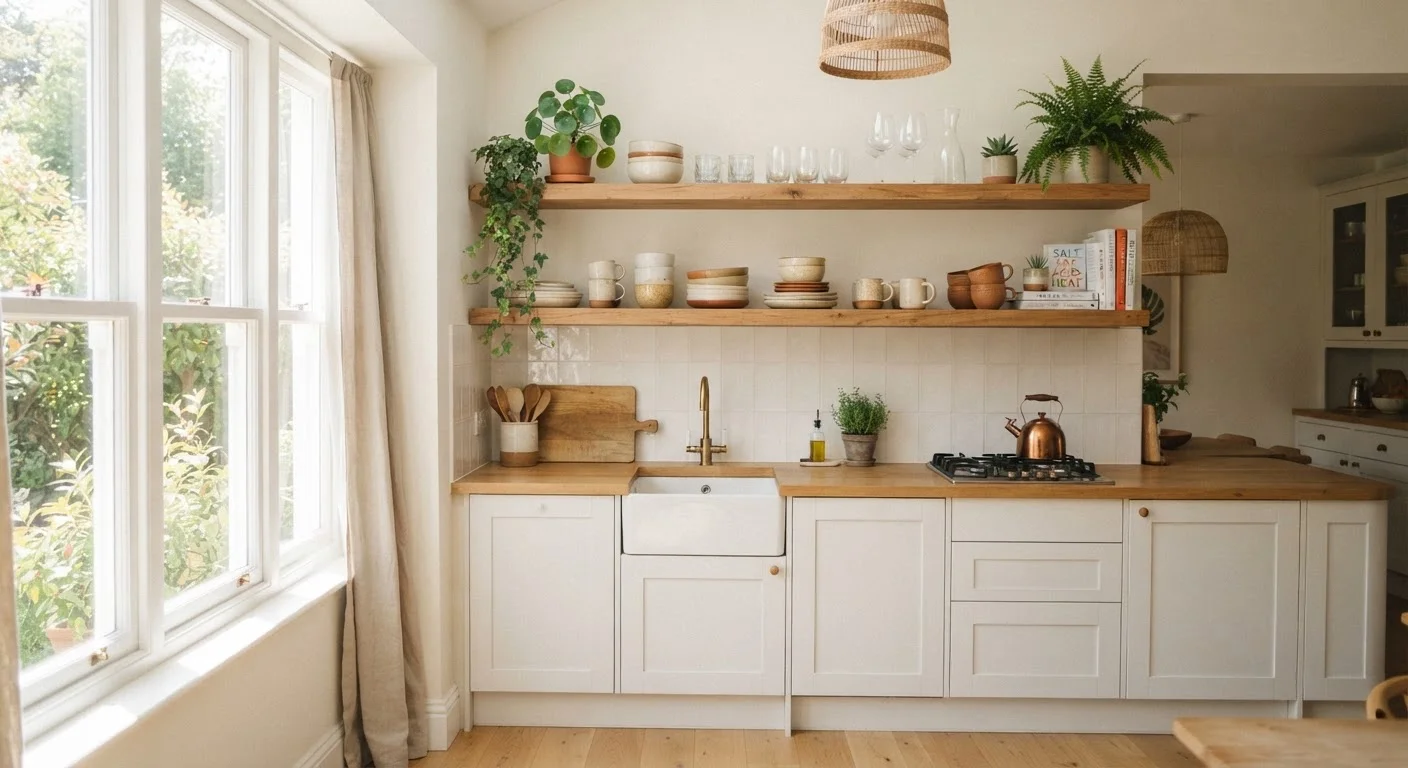
Scroll through any home design feed and open shelving dominates — carefully arranged ceramics, trailing plants, and cookbooks standing at attention. The appeal is real: open shelves can make a space feel larger, more personal, and less closed-off than a wall of cabinet doors. They also tend to cost less to install than full cabinetry, which explains why renters and first-time homeowners frequently reach for them.
But there's a significant gap between a styled shelf and a lived-in one. Understanding that gap honestly is what this breakdown is about. If you're weighing the decision, the full comparison of open shelving versus closed cabinets covers how each approach reshapes both the look and function of a room.
Creates visual openness in smaller rooms
Removing solid cabinet fronts allows sight lines to extend further into a space, making rooms feel less boxed-in. This effect is especially useful in compact kitchens or narrow living areas.
Lower installation cost than full cabinetry
Floating shelves and bracket systems are generally far less expensive than fitted cabinet runs, making them a practical option for renters or those working within a tight renovation budget.
Makes frequently used items genuinely accessible
When everyday dishes, glasses, or books are on open shelves, there's no door to open — grab-and-go use is faster, which can streamline daily routines in a meaningful way.
Encourages intentional curation of possessions
Because everything is visible, open shelving naturally prompts people to keep only what they actually want on display, which can reinforce broader decluttering habits over time.
Flexible and easy to reconfigure
Unlike fixed cabinetry, most shelf systems can be adjusted, added to, or removed without significant renovation work, which suits renters or those who move frequently.
The Maintenance Reality Nobody Highlights
Dust does not discriminate. Everything on an open shelf — every bowl, jar, book spine, and decorative object — collects particulate matter continuously. In a kitchen, add cooking grease to that equation. Interior design professionals often note that open kitchen shelves require wiping down weekly to stay genuinely clean, not just presentable. That's a real time commitment most design content skips entirely.
Beyond dust, open shelving exposes your things to fading from sunlight, accidental knocks, and the visual weight of anything that doesn't belong. One misplaced item reads differently on an open shelf than it does tucked behind a cabinet door. This connects directly to why some otherwise tidy homes still feel overwhelming — visual clutter operates on a different level than physical mess.
Dust and grease accumulate rapidly
Open surfaces collect dust continuously, and kitchen shelves also gather cooking grease. Keeping them genuinely clean — not just presentable — requires consistent weekly attention.
Visual clutter is always fully visible
A single out-of-place item on an open shelf is immediately apparent in a way that a closed cabinet conceals entirely. Disorder reads louder without a door to close on it.
Requires ongoing maintenance discipline
The aesthetic payoff of open shelving depends entirely on regular upkeep. People whose current habits don't naturally include frequent surface tidying often find the commitment unsustainable.
Not ideal for mismatched or utilitarian items
Open shelves work best when displayed items are cohesive in color, material, or style. Practical but visually mixed objects — cleaning supplies, stacked containers — can undermine the intended effect.
Can amplify conflict in shared homes
When people with different tidiness standards share a space, open shelves make those differences constantly visible, which can create ongoing low-level tension around how the space looks.
Who Open Shelving Actually Works For
The honest answer is that open shelving suits a specific type of person in a specific type of space. It works well if you naturally return things to their place, if the items you'd display are things you genuinely use daily, and if you find the act of organizing and arranging genuinely satisfying rather than stressful.
It works less well in shared homes where multiple people have different standards for tidiness. When two or more people share a kitchen or living space with different organizational instincts, open shelves become a visible record of that friction. The challenge of shared spaces with different needs is real, and open shelving amplifies it.
A Note on Small-Space Decisions
In compact homes, open shelving can feel like an obvious solution for maximizing visual space — but the tradeoff in maintenance load becomes proportionally more significant when storage is limited. If you're navigating a small home, the broader principles in small-space living can help you weigh which storage approach genuinely serves your habits rather than just your floor plan.
Open shelving also performs better in lower-traffic zones — a reading nook, a home office wall, a bedroom alcove — where items are handled intentionally and less frequently. High-traffic kitchens are where most people underestimate the upkeep.
~30 min
Weekly cleaning time per open shelf run
Interior organization professionals commonly estimate 20–30 minutes per week to properly clean and restyle open kitchen shelves, accounting for dust and grease removal.
65%
Homeowners who underestimate shelf upkeep
Surveys by home organization platforms have found that a majority of homeowners who install open shelving report the maintenance demands were greater than they expected before committing.
Making the Decision Intentionally
Before committing, a useful exercise is to spend two weeks paying attention to how consistently you clear your current surfaces. If countertops tend to accumulate objects and you find yourself wiping them down only when guests visit, open shelving will likely amplify that pattern rather than motivate a change. Habits drive the shelf, not the other way around.
If you do decide to proceed, starting small — one wall, one room — gives you a realistic sample of the maintenance load before you extend the approach throughout your home. The same principle applies to surface management generally: starting with a single uncluttered surface is a lower-stakes way to test how intentional space habits feel for you in practice. Open shelving is a commitment to a certain kind of ongoing attention — and that attention, when it fits your natural rhythms, is genuinely worth it.