

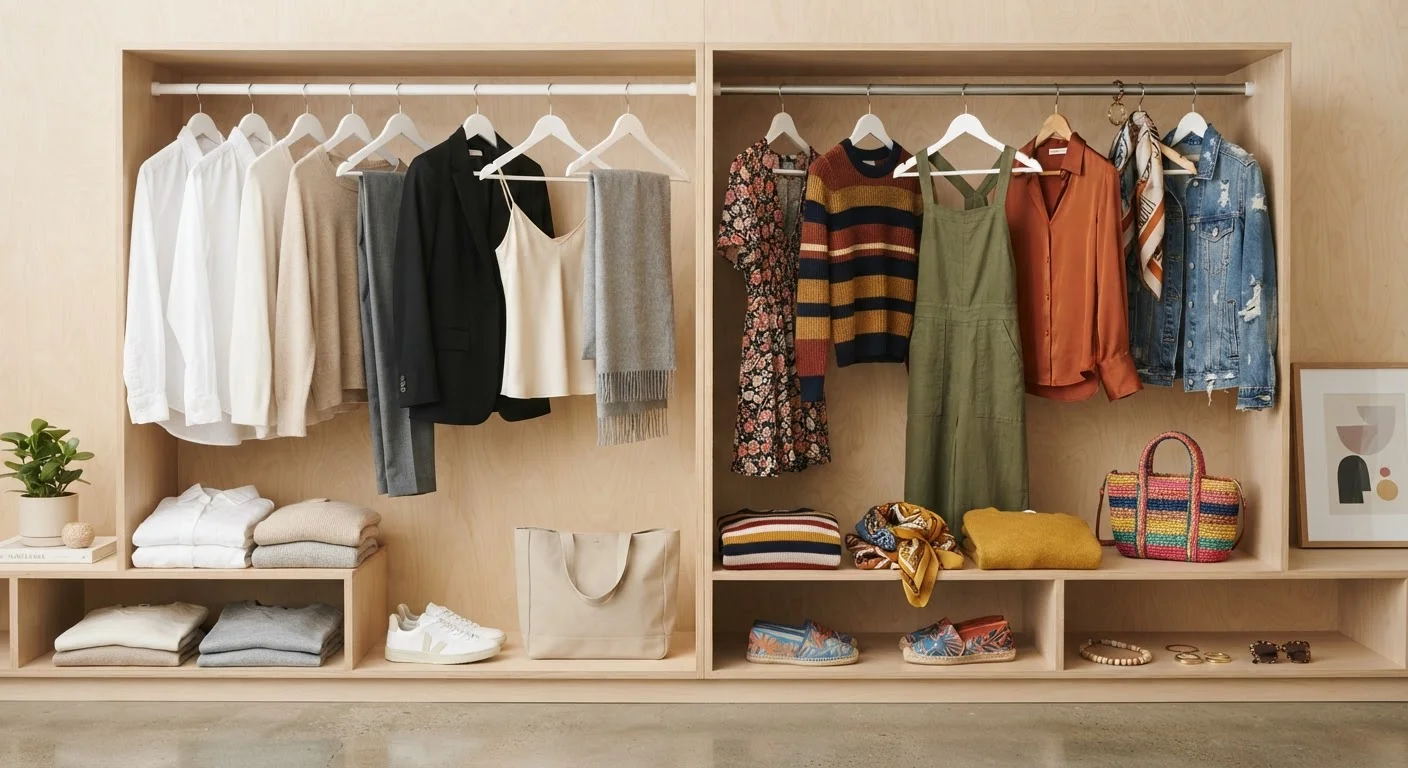
Key Takeaways
- A capsule wardrobe prioritizes interchangeability and restraint — typically 30–40 versatile pieces that mix and match seamlessly.
- A curated closet is defined by intentionality and personal style coherence, not necessarily by a low item count.
- Both approaches reject mindless consumption; they differ primarily in their relationship with variety and self-expression.
- Your lifestyle, dressing goals, and relationship with clothing should guide which framework fits — not aesthetic trends.
- The two approaches can be blended: a curated capsule balances versatility with personal voice.
Option A
Capsule Wardrobe
The streamlined, decision-minimizing approach to dressing.
Best for: Women who want effortless outfit-building and reduced decision fatigue through a tightly edited, highly interchangeable wardrobe.
Option B
Curated Closet
The personality-driven, intentionally expressive alternative.
Best for: Women who want a wardrobe that reflects their distinct aesthetic, allowing for variety and self-expression within clear personal boundaries.
If decision fatigue is your biggest morning obstacle
Capsule Wardrobe
The capsule's strict interchangeability means virtually any combination works, eliminating the paralysis of too many choices before 8 a.m.
If self-expression through clothing is central to your identity
Curated Closet
A curated closet lets you build a personal aesthetic vocabulary — one that communicates who you are without defaulting to trend cycles.
If you dress across multiple distinct contexts — work, creative, casual
Curated Closet
The curated approach accommodates stylistic range, allowing different facets of your personality to show up in different environments.
If you're rebuilding your wardrobe from scratch on a limited budget
Capsule Wardrobe
Starting with a small number of highly versatile foundational pieces is a financially sound strategy that delivers maximum outfit output.
If you want structure but feel constrained by minimalism's rigidity
Curated Closet
Curation applies intentional editing without imposing a strict item count, giving you creative freedom within a coherent personal framework.
The Core Philosophy Behind Each Approach
Both the capsule wardrobe and the curated closet reject the idea of accumulating clothes without purpose. But the goals they serve — and the logic driving each — are meaningfully different.
The capsule wardrobe concept, popularized in the 1970s and refined through decades of minimalist lifestyle writing, is built on restraint and interchangeability. Its defining feature is a small, deliberately limited number of pieces — classically 30 to 40 items per season — selected to work together in as many combinations as possible. The philosophy prioritizes function: a well-built capsule should make getting dressed nearly automatic. For a deeper look at the concept's origins and logic, explore what a capsule wardrobe actually means.
The curated closet, by contrast, is defined less by quantity and more by coherence. Curation means applying a consistent personal aesthetic lens to every purchasing and keeping decision — asking not just "does this work with everything?" but "does this feel like me?" A curated closet may hold more pieces than a strict capsule, but each one earns its place through alignment with a signature style identity rather than interchangeability alone.
| Criterion | Capsule Wardrobe | Curated Closet |
|---|---|---|
| Defining principle | Maximum interchangeability | Consistent personal aesthetic |
| Typical item count | 30–40 pieces per season | No fixed limit; quality over quantity |
| Primary constraint | Item count and versatility | Aesthetic coherence |
| Expressive range | Limited by design | Broad but intentional |
| Decision fatigue reduction | High — near-automatic outfit building | Moderate — requires aesthetic judgment |
| Best lifestyle fit | Consistent, predictable routines | Multi-context, expressive lifestyles |
| Risk of drift | Low if item count is enforced | Higher without clear style identity |
Where They Diverge: Versatility vs. Voice
The practical tension between these two systems surfaces most clearly in how each handles variety and self-expression.
Capsule wardrobes ask you to strip style down to its most functional core. The tradeoff is real: personality-driven pieces — the printed midi skirt, the statement blazer, the embroidered blouse — often don't survive a strict capsule edit because they resist blending. That's not a flaw in the system; it's the system working as intended. The capsule trades expressive range for frictionless dressing. Not every lifestyle benefits equally from that tradeoff, and it's worth understanding before committing.
Curated closets embrace expressive range — but demand a different kind of discipline. Without a clearly defined personal aesthetic, curation can drift into the same accumulation problem it's meant to solve. The constraint isn't item count; it's the clarity of your style identity. Women who thrive with a curated closet typically have a well-articulated sense of the silhouettes, palettes, and textures that feel authentically theirs. Understanding your wardrobe archetype is often the prerequisite work that makes curation sustainable.
~30–40
Pieces in a classic capsule wardrobe
The 30–40 item range has been widely cited in minimalist style literature as a functional threshold for true outfit interchangeability.
80%
Of wardrobe typically worn only 20% of the time
The 80/20 principle is frequently cited in wardrobe editing discussions to illustrate how most people habitually reach for a small fraction of their clothes.
Practical Considerations: Lifestyle, Budget, and Space
Neither approach exists in a vacuum — your real life shapes which system serves you better.
Women with straightforward, consistent lifestyles (a single workplace dress code, predictable weekend routines) often find the capsule model easier to implement and maintain. The low item count reduces storage demands, simplifies laundry cycles, and makes packing genuinely effortless. For outfit ideas that work within a capsule framework, the everyday outfits hub is a useful reference point.
Women whose lives span multiple stylistic contexts — a corporate office and a creative social life, for example — may find strict capsule rules artificially limiting. A curated closet accommodates that range without abandoning intentionality. The wardrobe essentials hub offers foundational guidance applicable to both systems.
Budget considerations apply differently too. A capsule's strength is focused investment: fewer, higher-quality pieces purchased deliberately. Curation can be equally considered on a budget, but requires stronger self-knowledge to avoid impulsive additions that dilute the collection's coherence. Understanding which cuts hold their value matters in both frameworks.
Can You Combine Both Approaches?
The most functional wardrobes often borrow from both philosophies. A curated capsule — a small, intentionally edited collection where every piece also reflects a defined personal aesthetic — is a genuinely workable synthesis. It applies the capsule's discipline to the curated closet's expressive ambition.
The key is sequencing: establish your personal aesthetic before setting a target item count. Curation without self-knowledge produces clutter. Restraint without aesthetic clarity produces a wardrobe that functions but doesn't feel like you. Both outcomes ultimately undermine the goal of intentional dressing.
The principles of intentional curation also extend beyond the wardrobe — applying them to your living space follows a similar logic of editing to what genuinely serves your daily life. For a practical comparison of how these two systems play out in real mornings, see how each approach shapes a day's worth of getting dressed.
Intentional dressing isn't a destination — it's a practice. Both systems offer a viable path. The right one is whichever helps you show up as yourself with less friction and more confidence.
A Note on Naming and Nuance
The terms "capsule wardrobe" and "curated closet" are used inconsistently across style media — some writers use them interchangeably, while others draw sharp distinctions. What matters more than labeling is understanding the underlying logic each system prioritizes: interchangeability versus aesthetic coherence. Use whichever framework's principles genuinely reflect how you think about clothing and getting dressed.