

Key Takeaways
- Scent, sound, and temperature shape a room's feel as powerfully as any visual design choice.
- Small, deliberate adjustments to each sensory layer can reduce stress and improve how long you stay comfortable in a space.
- Consistency across sensory cues — not perfection in any one — is what makes a home feel cohesive.
- Most sensory improvements require no renovation, just intentional habit-building.
- Layering non-visual elements works best when matched to a room's primary purpose.
The Sensory Gap in Most Decorated Homes
Most home styling advice stops at what the camera can capture: color palettes, furniture arrangements, decorative objects. But the experience of actually being in a room is largely non-visual. The way a space smells, how quiet or noisy it is, and whether the temperature feels right — these are the factors that determine whether you stay and relax or find yourself subtly uncomfortable without knowing why.
Research in environmental psychology consistently shows that sensory cues beyond sight — particularly smell, sound, and thermal comfort — influence mood, cognitive performance, and perceived safety. Yet most people never address them deliberately. If a room feels off even after you've decorated it, the disconnect is often sensory, not visual.
The following levers are practical, low-cost, and immediately actionable. They don't require renovation — just attention.
Anchor each room to a single, consistent scent
Scent is processed by the olfactory bulb, which has a direct neural pathway to the limbic system — the brain's emotional and memory center. This is why smell triggers mood responses faster than almost any other sense. A room that smells good doesn't just seem pleasant; it signals safety and belonging at a neurological level.
The practical move: pick one scent per room and use it consistently. A bedroom might use lavender or cedarwood, associated in behavioral research with reduced anxiety and improved sleep onset. A kitchen or entry might benefit from something citrus-forward, which tends to signal freshness and alertness. Consistency is key — rotating scents constantly prevents the association from forming.
Sources can be simple: a soy candle, an unscented diffuser with a few drops of essential oil, or even a dried botanical sachet. The goal isn't intensity — it's a reliable, low-level signature that your nervous system begins to associate with that room's purpose.
Consistency matters more than intensity — a reliable scent trains your nervous system to recognize a room's purpose.
Manage background noise, not just sound quality
Most people think about sound in terms of music or media. Fewer think about the acoustic texture of silence itself — the hum of appliances, street noise bleeding through windows, the echo of hard floors. These ambient sounds register even when you're not consciously listening, and research on noise exposure links chronic low-level sound pollution to elevated cortisol and reduced concentration.
Soft furnishings absorb sound. Rugs, upholstered chairs, curtains, and even bookshelves filled with books all reduce reverberation. If a room feels subtly stressful or hard to focus in, adding layered textiles and materials may solve an acoustic problem you've been attributing to something visual.
For spaces where silence is the goal — a bedroom, a reading corner — low-frequency background sound like a fan or a white noise machine can mask irregular intrusions more effectively than hoping for quiet.
Soft furnishings don't just change how a room looks — they change how it sounds, and that changes how it feels.
Use intentional sound as an active layer, not just background noise
Beyond managing unwanted noise, deliberately chosen sound shapes a room's energy. Consistent low-tempo music (around 60–70 beats per minute) is associated in behavioral research with reduced heart rate and lower perceived stress — useful for winding-down spaces. Slightly faster, more complex arrangements support focus and creative work.
The key is treating sound as a deliberate environmental setting rather than something you happen to put on. Designate audio behaviors by room or time of day: mornings might get something energizing in the kitchen; evenings in the living room shift to something slower. Over time, these cues become behavioral anchors that help regulate transitions between activity modes — useful if you work from home and struggle to mentally shift out of work mode.
Designating audio behaviors by room trains your nervous system to shift modes — no willpower required.
Stop guessing at room temperature — measure and adjust
Thermal comfort is one of the most underestimated factors in how a room feels. Research in environmental science suggests that most people are most cognitively alert and comfortable in environments between roughly 68°F and 72°F (20°C–22°C), though individual variation is real. What matters is consistency: frequent swings between too warm and too cold are more disruptive than a stable temperature that's slightly outside the optimal range.
A simple room thermometer — inexpensive and widely available — tells you what you're actually working with rather than what the thermostat dial suggests. Rooms with poor insulation or south-facing windows can run significantly hotter than the rest of the house, affecting sleep or concentration without the occupant ever identifying temperature as the variable.
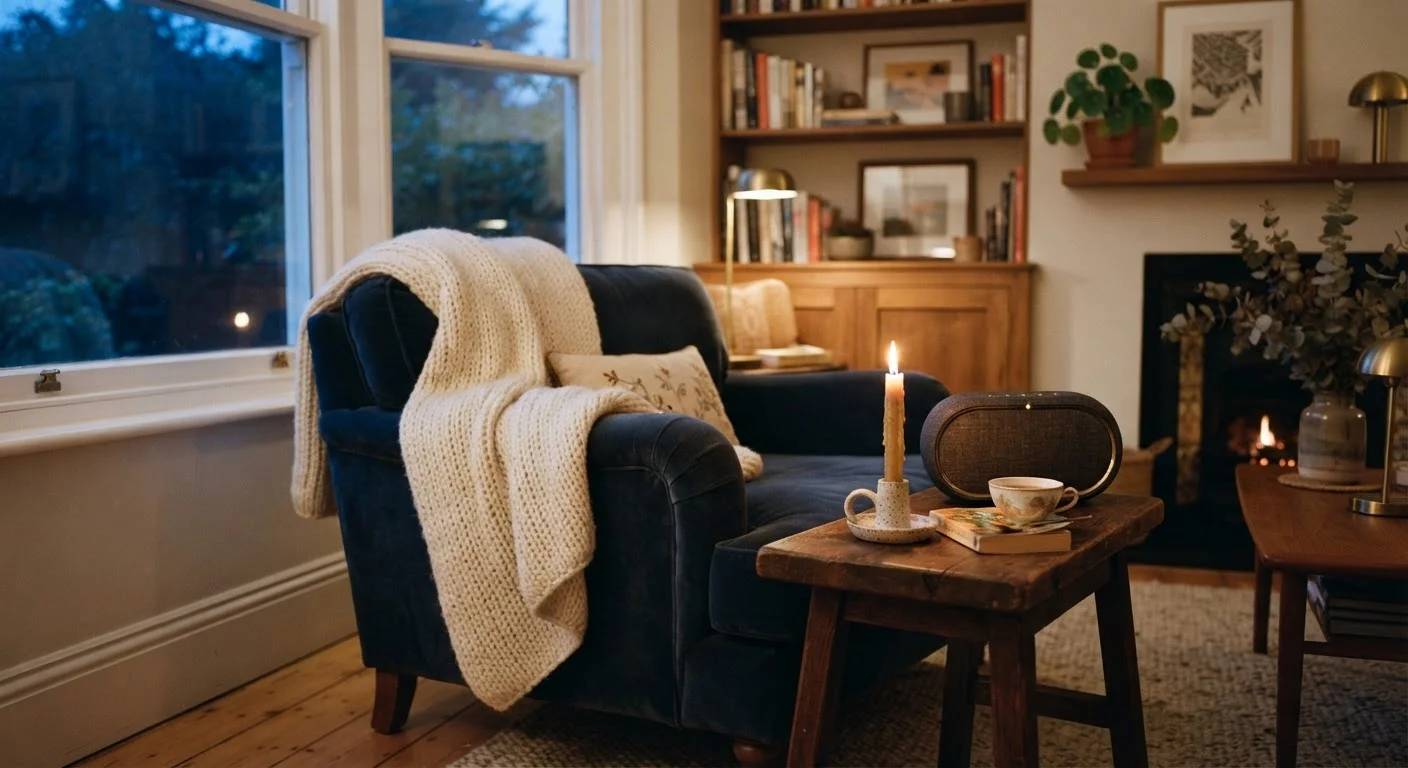
Textiles help modulate perceived warmth. Layering a knit throw on a chair allows occupants to self-regulate without adjusting the thermostat. For bedrooms specifically, cooler temperatures generally support deeper sleep — something worth testing if sleep quality is an issue.
A simple room thermometer gives you real data — the gap between dial setting and actual room temperature is often larger than expected.
Connect your sensory choices to the room's function
The most effective sensory environments are coherent — each element supports the same behavioral intention. A bedroom designed for rest should have a calming scent, low ambient noise, soft textiles that absorb sound and add thermal comfort, and a cool temperature. A home office should lean toward neutral or energizing scent notes, moderate sound (or managed silence), and slightly cooler air than a relaxation space.
This alignment between sensory cues and functional purpose is what separates a space that works from one that just looks good. It also works alongside the visual elements of a room — light quality and color temperature are the visual equivalent of these non-visual layers, and they interact. A warm-toned candle in a bedroom doesn't just smell nice — it also signals to your circadian system that the day is winding down.
Sensory coherence — every cue pointing toward the same behavioral goal — is what makes a room actually work.
Building a Sensory-Intentional Home Over Time
None of these adjustments need to happen at once. Sensory design works best when you treat it as an ongoing habit rather than a one-time project. Start with the room where you spend the most time and the sense that feels most neglected. Notice what shifts.
Start with the room that frustrates you most
Rather than overhauling your whole home, pick the one room that consistently feels uncomfortable or hard to relax in. Spend a few minutes noticing it with your eyes closed — what do you smell, hear, and feel on your skin? That audit usually reveals the missing layer faster than any visual assessment can.
For a broader look at how non-visual elements interact with your room's overall mood, the principles behind calm, lived-in rooms offer useful framing. And if you're also working on your lighting, a plain-language primer on colour temperature is worth reading alongside this guide.
A home that feels genuinely good to be in isn't just well-decorated — it's well-calibrated across every sense you bring into it.