

Key Takeaways
- Minimalism is about intentionality, not an absence of personality or warmth.
- Maximalism is defined by curated abundance, not clutter or chaos.
- Both philosophies share a core value: that every object in a space should earn its place.
- Most well-designed homes draw from both approaches simultaneously.
- Your space philosophy should serve your actual life, not an aspirational aesthetic.
The Framing Problem
The internet loves a binary. Maximalism versus minimalism has become one of interior design's most persistent false battles — two opposing camps, each accusing the other of getting it wrong. One is seen as cold and joyless; the other as overwhelming and indulgent. Neither characterization is accurate, and both get in the way of actually understanding what these philosophies are asking us to do with our spaces.
The real problem is that most people encounter these terms through their most extreme visual expressions — the stark all-white apartment or the floor-to-ceiling gallery wall — rather than through their underlying principles. Once you understand what each approach is actually oriented toward, the supposed opposition starts to dissolve. For a broader orientation to where these aesthetics fit within interior design more generally, the full reference to interior styles is a useful starting point.
Myth
Minimalism means living with as little as possible and stripping away anything decorative.
Fact
Minimalism is about deliberate selection — keeping what serves a clear purpose or holds genuine meaning, not achieving a numerical low count of objects.
The word "minimal" misleads people into thinking the goal is deprivation. In practice, minimalist design is a disciplined editing process. A minimalist room can include art, textiles, and personal objects — the distinction is that each one has been consciously chosen rather than accumulated. The aesthetic outcome (sparse, calm, ordered) is a byproduct of that intention, not the goal itself.
Myth
Maximalism is just clutter with a better name — it means filling every surface and ignoring restraint.
Fact
Maximalism is defined by abundance that is intentionally composed. Pattern, color, and layering are used with deliberate effect, not indiscriminately.
The defining characteristic of successful maximalist spaces is curation. A well-executed maximalist room involves considered decisions about color relationships, visual rhythm, and scale — often more complex decisions than a minimalist space requires. Clutter is the absence of curation; maximalism is the presence of it, applied generously.
Myth
You have to choose one — you're either a minimalist or a maximalist.
Fact
Most well-designed homes apply both approaches in different zones or layers, based on function and feeling.
Treating these as mutually exclusive identities rather than flexible tools is where most design frustration begins. A person who keeps their workspace rigorously clear may also fill their bedroom with layered textiles and meaningful objects. These choices aren't contradictions — they reflect different needs in different spaces. Thinking in binaries limits how creatively you can approach your home.
Myth
Minimalist spaces feel cold and impersonal — they sacrifice warmth for aesthetics.
Fact
Warmth in a space comes from material choice, light, and human scale — not from the quantity of objects present.
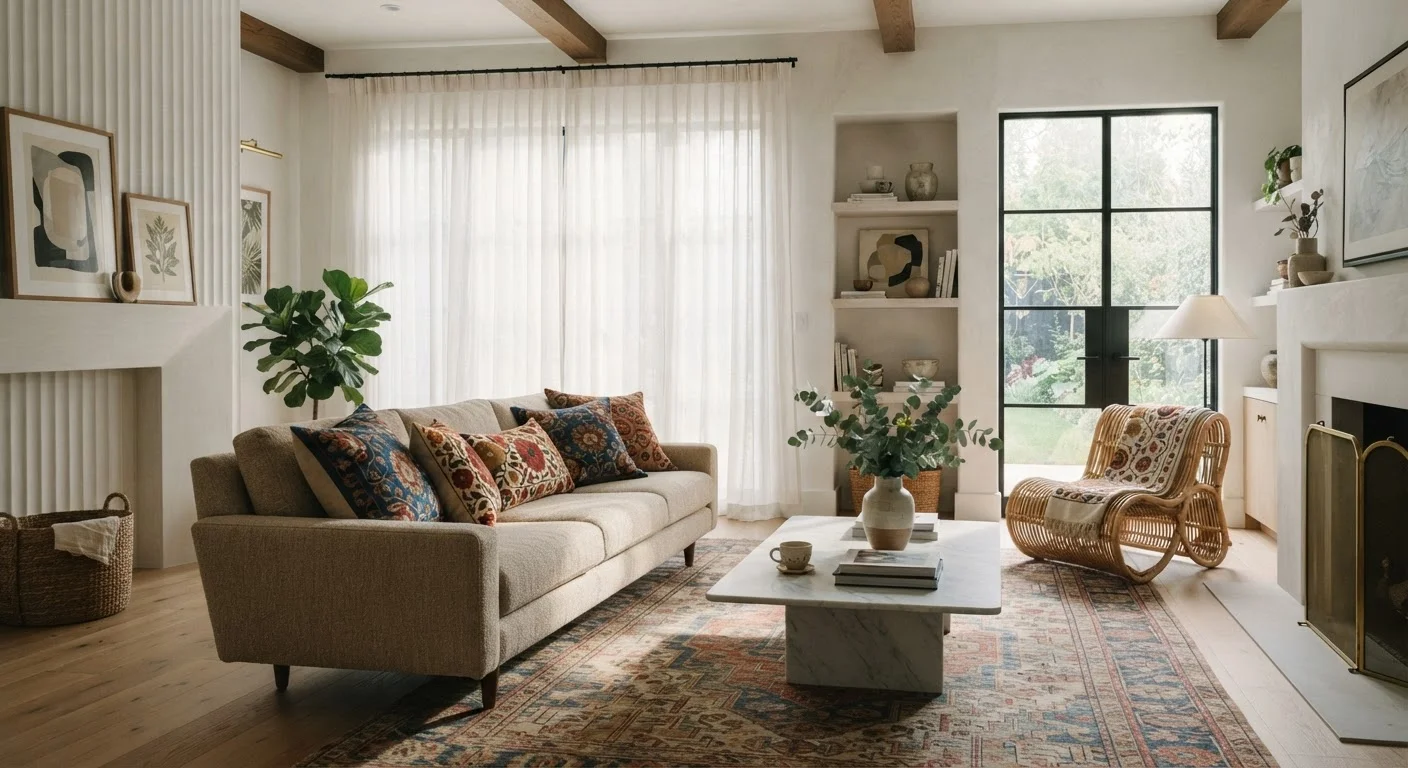
A room with stone floors, linen upholstery, aged wood furniture, and a single large plant can feel deeply welcoming while containing very few objects. Coldness is a function of hard materials, poor lighting, and inhuman scale — not of restraint. Many of the most inviting rooms in the world are also among the most edited.
Myth
Maximalism is only suited to large spaces with room to absorb the visual weight.
Fact
Maximalist principles can be applied effectively in small spaces when scale, proportion, and color are carefully managed.
Small rooms often benefit from the visual richness that maximalist thinking introduces — a bold wallpaper, layered lighting, and stacked bookshelves can make a compact room feel more immersive and intentional than a sparsely furnished one that simply reads as empty. The constraint is not square footage but coherence: does the abundance feel deliberate?
What Both Philosophies Actually Share
Strip away the visual language and both minimalism and maximalism are asking the same foundational question: does this object belong here? Minimalism answers that question by editing ruthlessly until only what is essential or deeply meaningful remains. Maximalism answers it by curating abundantly — but curating nonetheless. A maximalist room that works is composed, not chaotic. Every piece is chosen. The difference is in how much a designer or homeowner considers "enough."
This is why neither approach is a personality type — they are methodologies. You can apply minimalist thinking to a very warm, layered space by being rigorous about what you bring in. You can apply maximalist thinking to a spare room by making every object count twice as hard.
82%
Of people report their home environment affects their mood
According to a survey by the American Institute of Architects, the overwhelming majority of respondents said their home's design had a direct impact on their daily wellbeing.
1 in 3
Adults feel their home doesn't reflect their personality
Research published by interior design associations has consistently found a gap between how people live and how they want to live, often attributed to defaulting to trend rather than personal philosophy.
The same logic extends beyond interiors. The way you approach a living space often mirrors how you approach a wardrobe — and wardrobe archetypes follow strikingly similar philosophical lines. Understanding your instincts in one domain can clarify your instincts in the other.
Designing a Space That's Actually Yours
The most livable spaces tend to borrow deliberately from both philosophies. A kitchen might prioritize clean surfaces and efficient storage — functionally minimalist — while a reading corner is stacked with books, layered rugs, and collected objects that tell a story. Neither zone is in conflict with the other. They are calibrated to how each space is actually used and what kind of attention it asks of you.
If you share your home, this calibration becomes a negotiation. The principles you each prioritize — openness, warmth, order, personality — will likely differ, and making a shared home work often means finding where those principles can coexist rather than compete.
Function Must Come Before Philosophy
No design approach — however coherent its aesthetic logic — should override how a space actually needs to work for the people living in it. Before asking whether a room is minimalist or maximalist, ask whether it supports rest, connection, focus, or whatever its primary purpose is. Philosophy is a tool for better decisions, not a brief to follow at the expense of livability.
It's also worth separating aesthetic from lifestyle. Minimalist interiors are frequently conflated with slow living, but as slow living is not defined by its visual trappings, neither is any interior philosophy defined by the Instagram version of itself. Your space should reflect how you actually live — not how a particular aesthetic says you should.