
Wardrobe Archetypes: Understanding the Different Approaches Women Take to Getting Dressed

Key Takeaways
- Every woman's approach to getting dressed reflects a distinct set of values, not just aesthetic preferences.
- No single wardrobe archetype is superior — each involves real trade-offs worth understanding.
- Recognising your archetype helps you shop more intentionally and reduce outfit paralysis.
- Most women blend elements of multiple archetypes, and that flexibility is a strength.
- Foundational pieces tend to serve every archetype, making them the most universally valuable investment.
Our Verdict
There is no universally correct way to build a wardrobe — only approaches that are more or less aligned with how you actually live. Understanding which archetype governs your instincts allows you to lean into your strengths, address your blind spots, and stop shopping against yourself.
| Best for | Recommended |
|---|---|
| Those who want low daily decision fatigue | The Minimalist |
| Those who use clothing as creative self-expression | The Expressive Dresser |
| Those who need maximum versatility across contexts | The Pragmatist |
| Those who dress primarily around occasion and image | The Contextualist |
Why Archetypes Matter More Than Aesthetics
Most style conversations start with aesthetics — what colours you like, whether you prefer tailoring or ease, how you feel about pattern. But underneath those surface preferences sits something more structurally significant: the philosophy guiding how you make decisions about clothing at all.
A wardrobe archetype isn't a mood board or a personality type quiz result. It's a framework for understanding what you're actually optimising for when you open your closet. Two women can love the same linen blazer and wear it in ways that reflect completely different priorities — one as an interchangeable capsule piece, the other as the anchor for an intentional statement look.
Understanding your archetype helps explain why certain shopping habits keep recurring, why some wardrobes feel effortless and others feel cluttered despite good pieces, and why advice that works brilliantly for one woman falls flat for another. For a deeper look at how unconscious habits shape your existing closet, a wardrobe audit can surface patterns you may not have consciously noticed.
The Four Core Wardrobe Archetypes
While real wardrobes rarely fit a single category cleanly, four broad archetypes capture most approaches women take to getting dressed.
| The Minimalist | The Expressive Dresser | The Pragmatist | The Contextualist | |
|---|---|---|---|---|
| Core priority | Reduction and versatility | Creativity and identity | Function and comfort | Occasion-appropriateness |
| Wardrobe size tendency | Small and curated | Large and varied | Moderate, purpose-driven | Large, compartmentalised |
| Shopping habit | Deliberate, infrequent | Frequent, emotion-led | Need-driven only | Context-triggered purchasing |
| Key strength | Low daily friction | Self-expression and joy | Durability and ease | Contextual confidence |
| Core trade-off | Less spontaneity | Lower wearability ratio | Limited intentionality | Poor cross-pollination |
| Benefits most from | Allowing more flexibility | Stronger foundational pieces | Small styling upgrades | Versatile bridge pieces |
The Minimalist
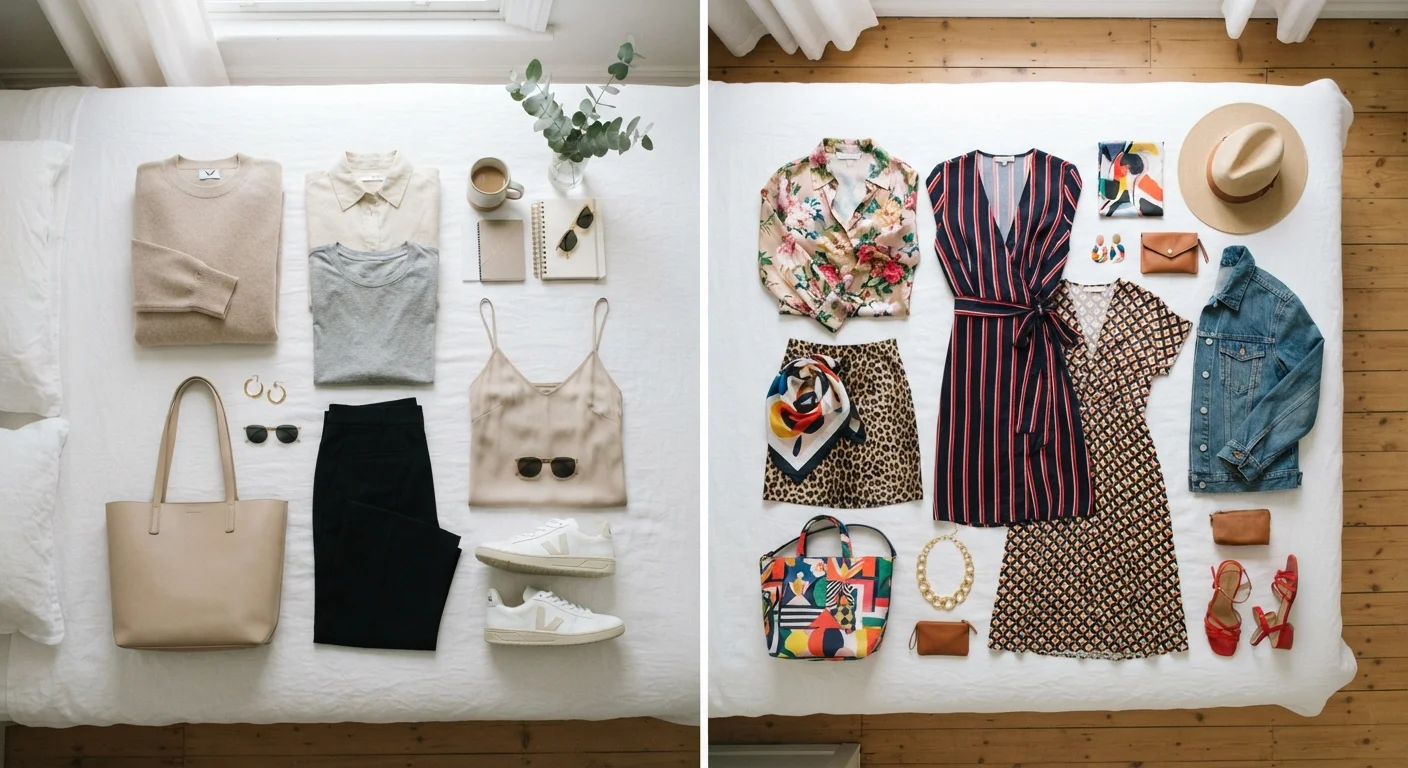
The minimalist optimises for reduction. She wants fewer, better pieces that rotate without friction — a capsule logic where every item earns its place through versatility. The payoff is genuine: low decision fatigue, a coherent visual identity, and lower long-term spend when done well. The cost is equally real: less spontaneity, limited ability to dress for mood, and a tendency toward monotony that can feel restrictive over time. Minimalism also requires a high upfront investment in quality pieces that genuinely do the work expected of them.
The Expressive Dresser
Clothing is a medium for this archetype — a daily act of communication and creativity. She accumulates intentionally or impulsively depending on her resources, but the through-line is emotional engagement with what she wears. The wardrobe tends toward volume and variety. The risk is outfit paralysis and underused pieces; the reward is genuine joy and a wardrobe that reflects a living, shifting identity. The tension between expression and proportion rules is often most acutely felt here.
The Pragmatist
Function drives every decision. The pragmatist asks whether something is comfortable, durable, and appropriate before anything else. Her wardrobe works hard and rarely wastes space, but may lack the intentionality that makes getting dressed feel considered rather than merely adequate. This archetype often underestimates how much ease and confidence a small styling upgrade can add without sacrificing practicality.
The Contextualist
Occasion is the organising principle. The contextualist builds her wardrobe in compartments — work clothes, weekend clothes, event clothes — and excels at dressing appropriately for varied settings. The weakness is poor cross-pollination: pieces bought for one context rarely migrate to another, leading to a large wardrobe with deceptively few real options on ordinary days.
What Each Archetype Tends to Sacrifice
Every approach to dressing involves trade-offs that are worth naming directly rather than glossing over.
Identify Your Dominant Instinct First
Before trying to fix a wardrobe problem, identify which archetype drives most of your decisions — not aspirationally, but honestly. Look at what you actually reach for, what you avoid, and what you consistently over-buy. That pattern is more informative than any quiz. Once you know your dominant instinct, you can address its specific trade-offs rather than applying generic advice that was designed for a different approach entirely.
- The Minimalist often sacrifices adaptability. A tightly curated wardrobe can struggle when life circumstances shift — a new job, a change in social context, a different climate. Rigid systems also leave little room for the playfulness that makes dressing enjoyable.
- The Expressive Dresser frequently sacrifices wearability ratios. A wardrobe filled with statement pieces and few foundational items becomes difficult to navigate day-to-day. Many items get worn once and forgotten.
- The Pragmatist can sacrifice confidence. Dressing purely for function can quietly erode the sense of intention and self-presentation that contributes to how a woman is perceived — and how she perceives herself.
- The Contextualist most commonly sacrifices efficiency. Compartmentalised wardrobes tend to be expensive to maintain and difficult to edit, because the logic of "I might need it for X" justifies almost everything.
The feeling of having nothing to wear is rarely random — it tends to map directly onto whichever trade-off your archetype makes. Understanding what actually drives outfit paralysis can clarify which gap in your wardrobe logic to address first.
Foundational Pieces: The One Investment Every Archetype Shares
Despite their differences, all four archetypes benefit from the same underlying asset: a working set of foundational pieces that create outfit combinations without effort. These aren't boring basics — they're structural elements that make the rest of a wardrobe more functional regardless of its size or character.
For the minimalist, they are the wardrobe. For the expressive dresser, they are the backbone that lets statement pieces land properly rather than compete. For the pragmatist, they provide the quiet upgrade that makes practical dressing feel considered. For the contextualist, they are the cross-context pieces that finally allow compartments to talk to each other.
If you're working out what those pieces actually are for your life, a practical guide to wardrobe essentials walks through how to identify them before shopping — not after. And if you're starting more or less from scratch, building outfits from the ground up offers a structured starting point grounded in real-life wearability.
Understanding your archetype is ultimately a diagnostic tool, not a prescription. Most women operate as a blend — a minimalist-leaning pragmatist, a contextualist with expressive tendencies. Knowing which instincts dominate lets you shop with those instincts rather than against them, which is where lasting wardrobe satisfaction actually begins. For further exploration of how named style identities connect to these broader philosophies, style archetypes from classic to eclectic offers useful context.