

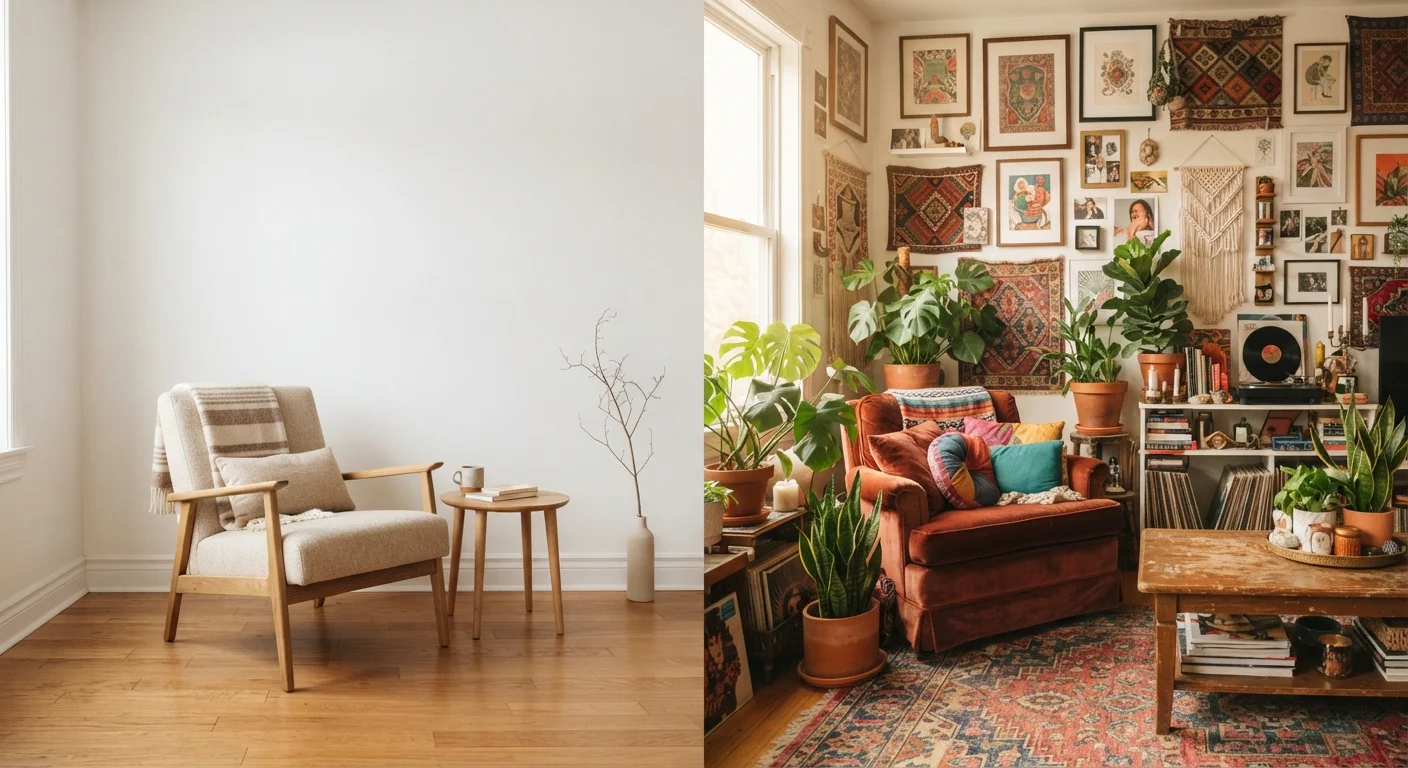
Key Takeaways
- Minimalism reduces decision fatigue and maintenance burden, but can feel sterile if imposed without genuine preference.
- Maximalism supports self-expression and sensory richness, but requires active curation to avoid dysfunction.
- Neither style is inherently superior — functionality and honest self-knowledge matter more than aesthetic identity.
- Most people live effectively somewhere between the two extremes, mixing principles intentionally.
- The goal of any home style should be supporting daily life, not performing a personality.
Our Verdict
Minimalism and maximalism each offer genuine benefits, but both carry real trade-offs that trendy framing tends to obscure. The most functional homes aren't committed to either camp — they borrow principles from both based on how the space is actually used and by whom. Choosing an approach because it aligns with how you genuinely live, rather than how you want to be perceived, is where intentional home design actually starts.
| Best for | Recommended |
|---|---|
| Those who find clutter cognitively draining and prefer low-maintenance upkeep | Minimalism |
| Those who draw energy from surrounding themselves with objects, art, and personal history | Maximalism |
| Shared households where different people have different needs for order and stimulation | A hybrid, zone-based approach |
| Anyone who wants a home that genuinely supports daily routines over aesthetic performance | Intentional design regardless of label |
The Problem With Treating Either as an Identity
Somewhere along the way, home design preferences became personality declarations. Minimalism got repackaged as discipline and clarity of mind. Maximalism became shorthand for bold, creative confidence. Both framings are a distraction from a more useful question: does your home actually work for your life?
The trend-driven versions of both aesthetics have a habit of prioritizing the visual result over the functional one. A rigidly spare home can be just as dysfunctional as an overcrowded one if neither reflects how the people inside it actually live. For a fuller look at what these terms genuinely mean beyond their aesthetic reputation, see what minimalism and maximalism actually mean.
This comparison isn't about which looks better in photographs. It's about what each approach honestly demands of you, and what it gives back.
Minimalism: What It Delivers and What It Costs
Minimalism, in a genuine functional sense, is about reducing the number of things competing for your attention and maintenance bandwidth. Research in environmental psychology suggests that visually cluttered spaces can increase cortisol levels and make it harder to focus — so there's a real cognitive case for paring back, not just an aesthetic one.
Where minimalism delivers: lower cleaning time, fewer decisions about storage, and spaces that are easier to reset after daily use. For people who find disorder mentally taxing, a simpler environment isn't cold — it's genuinely restorative.
The real costs are less discussed. Minimalist homes often require higher-quality foundational pieces to avoid looking sparse and bleak rather than calm and intentional. They can also suppress the accumulation of objects that carry genuine meaning — gifts, inherited pieces, mementos — in favor of visual tidiness. Taken to an extreme, this becomes a form of deprivation dressed up as virtue.
Audit Function Before Aesthetics
Before choosing a design direction, spend one week noting which spaces in your home cause friction — things hard to find, surfaces that accumulate mess, rooms you avoid. Let functional pain points guide your approach rather than starting from a visual ideal. A style that solves real problems in your daily routine will always outlast one chosen for its look.
The wardrobe parallel is instructive here. Different approaches to getting dressed reveal that minimalist wardrobe philosophies carry the same tension: simplicity requires upfront investment and honest self-knowledge to work.
Maximalism: What It Delivers and What It Costs
Maximalism — real maximalism, not just accumulation — is an active editorial practice. It involves layering objects, patterns, and collections in a way that creates visual richness and reflects personal history. Done with intention, it can make a home feel genuinely alive and specific to the people in it.
The benefits are real: maximalist spaces tend to feel warmer and more personalized, and they tolerate the natural entropy of daily life better. A room full of texture and pattern doesn't show a throw blanket out of place the way a minimalist room does.
The costs are equally real. Maximalism without curation tips quickly into clutter that becomes harder to clean around, harder to find things within, and harder to mentally decompress in. The distinction between a curated maximalist space and a chaotic one is ongoing editorial effort — things still need to earn their place, just by a different set of criteria.
| Minimalism | Maximalism | |
|---|---|---|
| Cognitive effect | Reduces visual noise and decision fatigue | Provides sensory richness and stimulation |
| Maintenance demand | Low day-to-day, high initial curation | Ongoing editorial effort required |
| Tolerance for daily entropy | Low — disorder shows immediately | High — layering absorbs minor chaos |
| Upfront investment | High — quality of fewer pieces matters | Variable — collections can build gradually |
| Personalization potential | Limited by design | High — space reflects personal history |
| Risk if poorly executed | Sterile, unwelcoming, or impractical | Cluttered, hard to clean, overwhelming |
For a grounded reference on how these and other interior styles are actually defined, every interior style briefly explained is a useful starting point before committing to any label.
How to Choose Based on How You Actually Live
The honest diagnostic isn't "which aesthetic do I prefer?" It's a set of more functional questions: How much maintenance time are you realistically willing to spend? Do you find visual stimulation energizing or depleting? Do you share your space, and do your cohabitants have different needs? For shared households, making a home work for more than one person addresses exactly this tension.
Most people, when honest, don't sit at either extreme. They need one room that stays genuinely calm (a bedroom, a workspace) and one that can hold more personality and warmth (a living room, a kitchen). Zoning by function rather than committing to a whole-home aesthetic tends to produce spaces that are both livable and meaningful.
The broader lifestyle principle applies beyond interiors too. Slow living separated from its aesthetic makes the same point: the way you actually use your time and space matters far more than how it photographs.
This article is for informational and general lifestyle guidance purposes only. Individual needs and circumstances vary; nothing here constitutes professional interior design, psychological, or medical advice.