

| Definition | A piece that stabilizes outfits and pairs easily with the majority of what you own |
| Typical anchor categories | Trousers, denim, blazers, shirts, neutral knits |
| Key anchor trait | Occasion flexibility — works across at least two dress codes |
| Color range | Neutrals: black, navy, camel, ivory, charcoal, mid-grey |
| Distinguishing feature vs. basics | Anchors multiply outfit combinations; basics simply exist without demanding occasion |
| How to identify yours | Track what you've worn most in the past three weeks — high-frequency, high-versatility pieces are your current anchors |
What Is a Wardrobe Anchor?
A wardrobe anchor is a piece that reliably grounds an outfit — something you reach for repeatedly because it works with almost everything else you own. Unlike statement pieces, which demand attention, anchors absorb attention. They create visual stability, establish proportion, and give your outfit a coherent structure to build around.
| Definition | A piece that stabilizes outfits and pairs easily with the majority of what you own |
| Typical anchor categories | Trousers, denim, blazers, shirts, neutral knits |
| Key anchor trait | Occasion flexibility — works across at least two dress codes |
| Color range | Neutrals: black, navy, camel, ivory, charcoal, mid-grey |
| Distinguishing feature vs. basics | Anchors multiply outfit combinations; basics simply exist without demanding occasion |
| How to identify yours | Track what you've worn most in the past three weeks — high-frequency, high-versatility pieces are your current anchors |
Anchors are not the same as basics. A basic is simply a simple item; an anchor is a simple item that functions — it earns its place by multiplying outfit possibilities rather than just occupying closet space. If you've ever felt your wardrobe is full but outfit options feel scarce, missing anchors are often the root cause. See why a full wardrobe can still leave you stuck for the structural reasons behind that frustration.
Understanding this distinction is the first step toward building a wardrobe with genuine longevity rather than accumulating pieces that don't connect.
The Core Characteristics of an Anchor Piece
Not every versatile item qualifies as an anchor. True anchors share several defining traits:
- Neutral or low-competition color. Navy, charcoal, camel, ivory, and true black tend to anchor most easily because they don't compete with other colors in an outfit.
- Reliable fit across body changes. Anchors are typically cut with enough structure or ease to remain flattering across minor weight fluctuations or seasonal layering needs.
- Occasion flexibility. A genuine anchor moves between at least two contexts — casual and smart-casual, or smart-casual and formal — without requiring significant restyling.
- Textural neutrality. Smooth or subtly textured fabrics integrate more naturally into different outfit combinations than highly distinctive textures like broderie anglaise or heavily distressed denim.
Wardrobe Anchor
A piece of clothing that reliably grounds and stabilizes outfits by pairing easily with many other items. Anchors provide visual structure rather than visual interest.
Outfit Formula
A repeatable combination of garment types (e.g., trouser + knit + blazer) that produces a complete, cohesive look. Formulas reduce decision fatigue and work across multiple occasions.
Textural Neutrality
A fabric quality where the texture is subtle enough not to clash with other textures in the same outfit, making the piece easier to layer and combine.
Occasion Flexibility
The ability of a single garment to be worn appropriately in more than one social or professional context without requiring a complete outfit change around it.
Wardrobe Audit
A deliberate review of one's current clothing — typically by examining what gets worn and what doesn't — to identify gaps, redundancies, and underperforming pieces.
For a broader look at how anchors fit into the structure of a complete outfit, understanding each piece's role helps clarify where anchors sit relative to base layers and statement elements.
Common Anchor Categories (and What Makes Them Work)
While anchors are personal — what grounds your wardrobe depends on your lifestyle and color palette — certain categories appear consistently across well-functioning wardrobes:
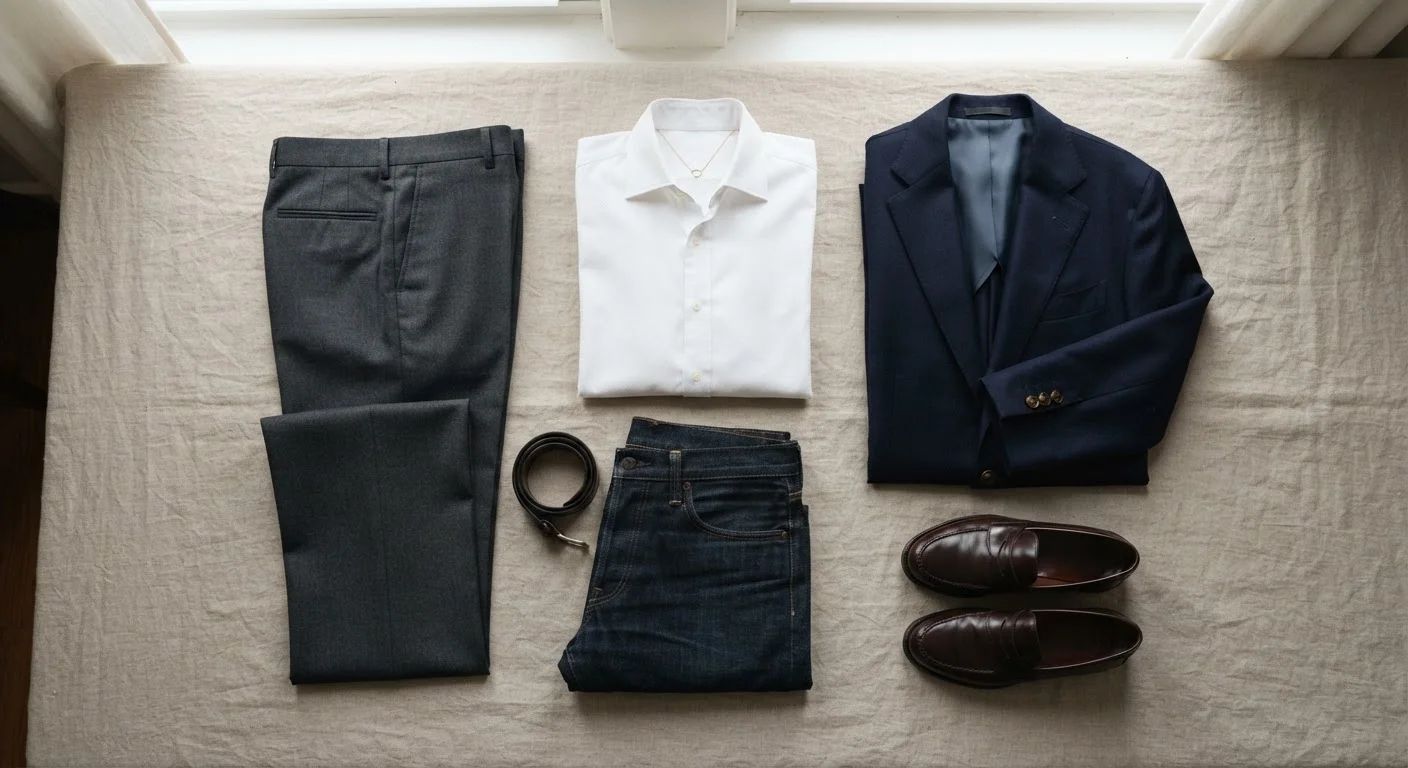
- Well-fitted trousers in a neutral
- Structured trousers in black, navy, or camel provide a reliable lower half that pairs with almost any top, from a relaxed knit to a crisp button-down.
- Dark or mid-wash straight-leg denim
- The most universally functional denim cut — straight-leg sits between casual and polished, works tucked or untucked, and doesn't trend out as quickly as tapered or wide-leg extremes.
- A single-breasted blazer
- Adds instant structure to any outfit underneath. Works over dresses, denim, and tailored separates alike, moving from office to evening with a simple shoe swap.
- A crisp shirt in white or pale blue
- Functions as both a base layer and a top in its own right. Tucked in or knotted, open over a tee or worn alone — the shirt's adaptability is what makes it an anchor.
- A knit in a tonal neutral
- A fine-gauge or mid-weight knit in camel, ivory, oatmeal, or grey layers under blazers, over shirts, and anchors casual outfits without visual noise.
Foundational pieces that earn their closet space offers a complementary perspective on which items consistently do the heaviest lifting across seasons.
How to Identify Your Personal Anchors
The pieces you already reach for most — the ones that get worn in photos you actually like — are your current anchors. A practical audit: pull out every item you've worn in the past three weeks. The items that appeared most often, paired with the widest variety of other pieces, are functioning as your anchors whether you labeled them that way or not.
From there, look for gaps. If your top-half anchors are strong but your bottom-half options are limited, you'll feel outfit fatigue faster. If you own anchor tops but no anchor outer layers, your outfits may feel unfinished in cooler months.
The goal is not to own more anchors — it's to make sure the anchors you have are actually working. Fit is often the barrier: a trouser in the right color that doesn't fit well won't function as an anchor because you'll avoid it. Proper fit, care, and storage are what protect that investment. Wardrobe care practices that extend piece lifespan is worth consulting once you've identified which pieces you want working hardest for you.
If you're starting from scratch, building wearable outfits from the ground up walks through how to sequence wardrobe decisions practically and without overwhelm.