

Key Takeaways
- A wardrobe full of statement pieces and trend items often lacks the neutral foundations needed to connect them.
- Shopping without a color strategy creates a closet of orphaned items that don't work together.
- Pieces bought for imagined occasions rather than real life are the primary source of wardrobe paralysis.
- Fixing a disjointed wardrobe starts with identifying gaps in versatile basics, not buying more.
- A smaller, cohesive wardrobe consistently produces more outfit combinations than a large, disconnected one.
The Real Reason More Clothes Means Fewer Options
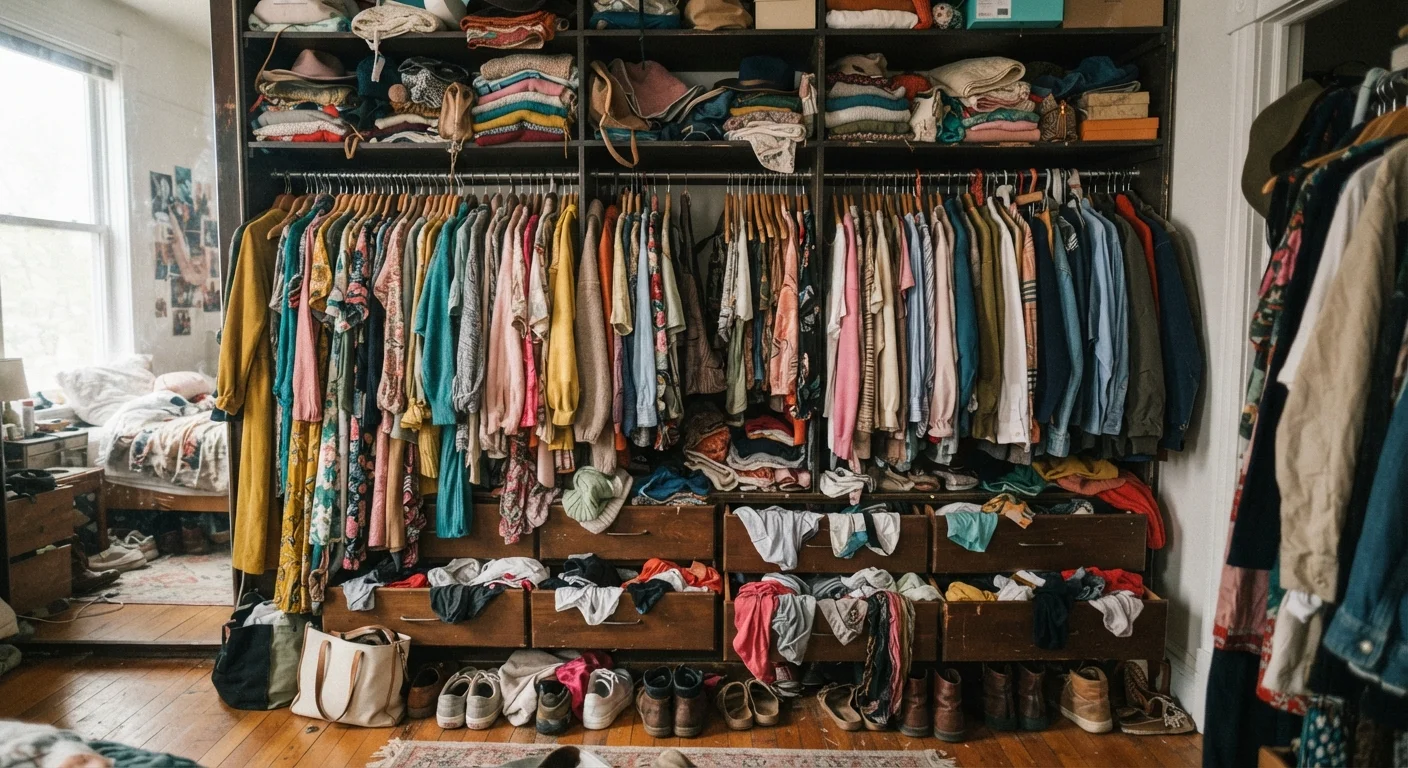
The "full closet, nothing to wear" paradox is one of the most common frustrations in everyday dressing — and it's almost never about volume. It's a structural problem. When a wardrobe lacks the right connective tissue — the neutral foundations, the versatile mid-layers, the shoes that work across contexts — individual pieces become stranded. They have nowhere to go.
Understanding why this happens is the first step toward fixing it. The mistakes below aren't about having bad taste. They're predictable patterns that emerge from the way most of us shop: reactively, aspirationally, and without a systems view of what we already own. If outfit paralysis is a recurring experience, the emotional side of that frustration is worth examining too.
Shopping for a fantasy version of your life rather than your actual daily routine.
Why it happens: Retail environments — and social media — present clothing in aspirational contexts that don't reflect how most people spend their time. It's easy to buy for the occasion you wish you had.
Accumulating statement and trend pieces without building neutral foundations first.
Why it happens: Bold, trend-led items are more exciting to shop. Basics feel unglamorous to spend money on, so they get deprioritized until the wardrobe is full of statement pieces with nothing to anchor them.
Shopping without a defined color palette, resulting in pieces that share no common thread.
Why it happens: Shoppers are drawn to individual items in isolation, often responding to what looks good on a hanger or in a display rather than what integrates with an existing wardrobe.
Keeping items that don't fit properly with the intention of altering them "someday."
Why it happens: Sunk-cost thinking makes it difficult to let go of expensive or sentimental pieces, even when they're unwearable in their current state. The intention to alter is genuine but rarely acted on.
Ignoring proportion and silhouette fit between items, so tops and bottoms don't balance visually.
Why it happens: Pieces are typically tried on individually or with a limited selection in a fitting room — not tested against the full range of what's already at home.
Building a Wardrobe That Actually Works
Correcting a disjointed wardrobe doesn't require a full purge or a large budget. It requires a shift in purchasing logic. Before adding anything new, identify what role it plays in your existing rotation. Ask: what does this work with right now, specifically? If you can name three distinct outfits without buying anything else, it earns its place.
80%
Of wardrobe items worn only occasionally
Research in consumer behavior and wardrobe studies consistently suggests that most people regularly wear only around 20% of what they own, leaving the majority underutilized.
3–5
Core neutrals needed for a cohesive wardrobe
Styling professionals generally recommend anchoring a functional wardrobe around no more than three to five interchangeable neutral tones to maximize mix-and-match potential.
The goal is a wardrobe where the majority of pieces are interchangeable — a framework sometimes called a capsule approach — built around a tight color palette with consistent proportions. Foundational pieces that do the heaviest lifting are what make this possible: a well-cut trouser, a clean white shirt, a mid-layer that bridges seasons. These are the connectors that make statement pieces actually wearable.
Once your foundations are in place, the math of outfit combinations changes dramatically. And on the days the wardrobe still feels uninspiring despite all of this, practical outfit resets can help bridge the gap. For a broader framework on developing a personal style that serves your real life, the personal style tips hub is a useful starting point.