

Key Takeaways
- Foundational pieces earn their closet space by working across multiple occasions, seasons, and outfit formulas.
- Versatility and longevity — not trend relevance — are the true measures of a wardrobe investment.
- A small number of well-chosen basics can generate far more outfit combinations than a crowded closet of trend pieces.
- Fabric choice and fit quality directly determine how long a foundational piece stays in rotation.
- Building outward from a strong foundation removes the daily friction of 'having nothing to wear.'
Why Foundations Change How You Get Dressed
The most common wardrobe frustration — standing in front of a full closet and feeling like nothing works — rarely comes from having too little clothing. It typically comes from having the wrong ratio of foundational pieces to everything else. When the base layer of a wardrobe is thin, even a rack of interesting items feels unworkable, because there's nothing reliable to build from.
Foundational pieces are not the same as boring pieces. They're the items that operate as connective tissue — the ones that make a statement jacket wearable on a Tuesday, or that turn a printed skirt from a single-use item into a wardrobe workhorse. Understanding which pieces carry this structural weight is the single most efficient upgrade you can make to how you dress every day. For a broader framework on approaching this, building a foundational wardrobe starts with knowing what you're actually building toward.
Below are the specific categories that do the heaviest lifting — and why each one earns its place.
A Well-Fitted Straight-Leg Trouser
The straight-leg trouser is perhaps the single most combinable bottom in a functional wardrobe. It bridges the gap between casual and professional with minimal effort, pairs equally well with tucked blouses, oversized knitwear, and fitted tops, and reads as intentional rather than effortless in a way that jeans alone cannot.
Fit at the waist and hip is the critical variable. A pair that fits well at these points — and can be hemmed to the right length if needed — will translate across more occasions than almost any other piece you own. Mid-tones like camel, slate, or olive extend the wearability beyond a strict neutral palette while remaining genuinely versatile.
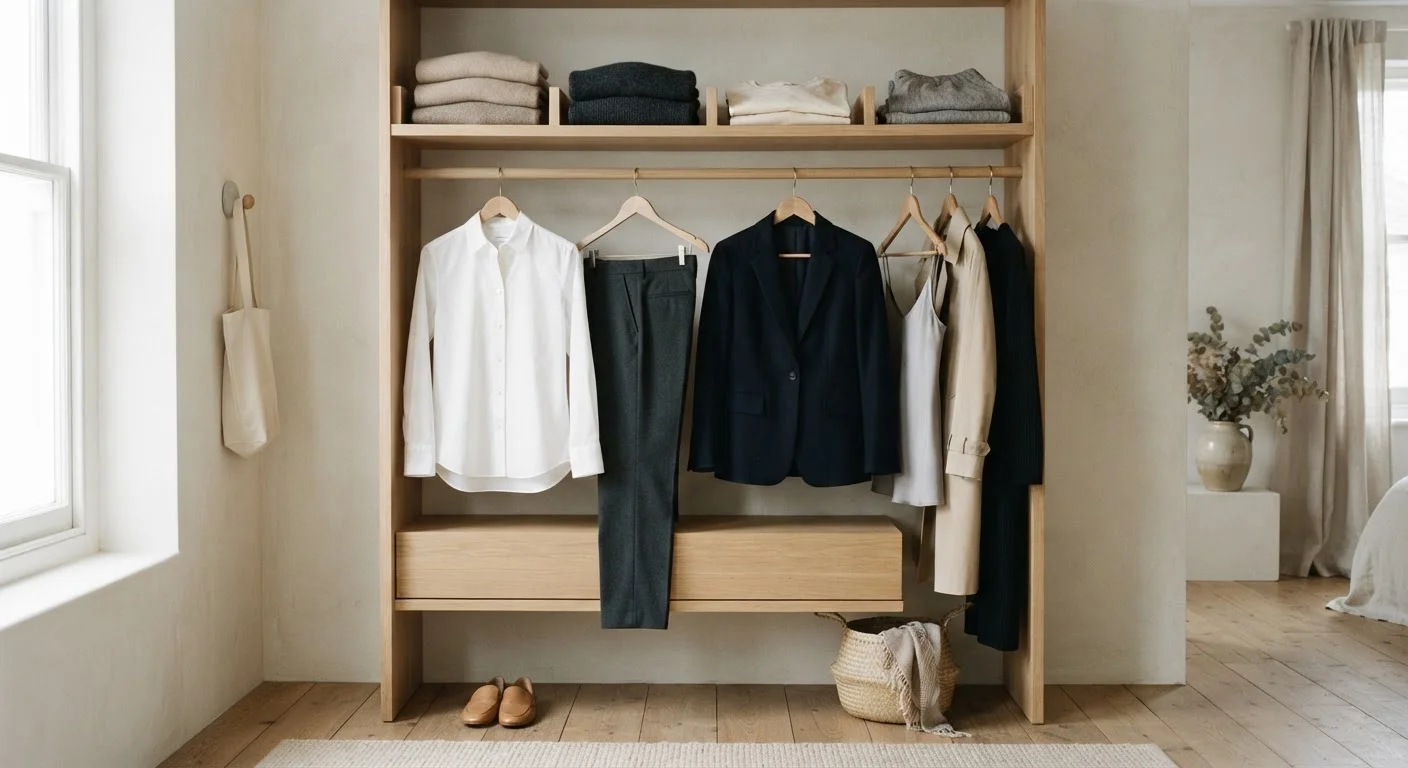
A straight-leg trouser that fits well at the waist bridges casual and professional with no effort.
A Crisp White or Off-White Shirt
The white shirt is a genuine outfit reset button. Worn open over a tank as a light layer, tucked into high-waisted trousers for a polished finish, or half-tucked with denim for something more relaxed — it functions across contexts in a way that colored or printed tops rarely match.
The key is finding a cut that works for your proportions: slightly oversized works broadly, while a more fitted version suits those who prefer defined silhouettes. Fabric matters considerably here — a shirt in a quality poplin or Oxford cloth holds its structure and appearance wash after wash, whereas thinner materials lose their crispness quickly. How each piece functions in an outfit explains why a shirt at this layer carries so much of an outfit's visual logic.
The white shirt is an outfit reset button that functions across more contexts than almost any colored top.
A Structured Mid-Layer — Blazer or Cardigan
A mid-layer that adds structure elevates any outfit underneath it. The blazer has long held this role because it provides silhouette definition, a degree of formality, and a finishing quality that casual outerwear doesn't replicate. A well-proportioned cardigan fills a similar function in more relaxed contexts — it layers over dresses, completes simple jeans outfits, and transitions effortlessly from indoor to outdoor dressing.
The key word in both cases is structured. A blazer that sits cleanly at the shoulder and a cardigan with enough weight to hold its shape do more visual work than shapeless versions of the same item. Neutrals extend the use case; a textured neutral — think oatmeal, charcoal, or a warm navy — adds dimension without narrowing what it works with.
A structured mid-layer adds finishing quality and formality that casual outerwear simply cannot replicate.
Dark, Versatile Denim
Not all denim functions as a foundation. Heavily distressed, brightly colored, or very fashion-forward cuts tend to be harder to combine and shorter-lived in terms of outfit relevance. Dark-wash denim — in a straight, slim-straight, or barrel cut depending on preference — works as a neutral in the truest sense, pairing with everything from silk blouses to oversized sweaters to fitted tees without visual conflict.
Dark denim also transitions between contexts more smoothly than lighter washes: it reads as deliberately dressed in a way that can carry a meeting, a dinner, or a weekend errand run equally well. It's worth treating a well-fitting pair of dark denim with the same care consideration you'd give to trousers — proper care practices extend color depth and fabric integrity significantly.
Dark-wash denim functions as a true neutral, pairing with everything from silk blouses to oversized knitwear.
A Versatile Dress That Can Be Layered
A dress that exists only as a single silhouette is limited. A dress that can be worn alone in warmer months, layered under a blazer in fall, or worn over a turtleneck or fitted long-sleeve in winter is a foundational piece. Shirt dresses, wrap dresses, and simple slip-style dresses all lend themselves to this kind of layering flexibility.
The best choice here is one you can actually style three different ways without significant effort. Transitional dressing principles apply directly — a dress that moves through seasons reduces the need to re-shop each time the temperature shifts.
A dress you can layer under a blazer or over a turtleneck is worth three trend pieces you can't adapt.
Foundational Knitwear in a Neutral Tone
A quality knit — whether a crewneck, V-neck, or fitted turtleneck — serves as both a layering piece and a standalone. Worn tucked into trousers with a heel, or paired with denim and flat boots, it covers a wide range of real-life situations without requiring much decision-making. The fit should be comfortable without being shapeless; proportional knitwear looks deliberate, while overly baggy versions can read as unfinished unless the rest of the outfit is structured to balance it.
Natural fibers — wool, cashmere, merino, or blends — tend to maintain their shape and appearance through regular wear better than synthetics, though they require more careful laundering. Understanding what you're buying in terms of fiber content directly affects how long a piece stays in active rotation. For those building outfits from scratch, a quality neutral knit is one of the most reliable starting points available.
Proportional knitwear in a neutral tone covers a wide range of real situations without requiring much thought.
Making Foundations Work Harder Over Time
Identifying the right foundational pieces is only half the equation. How long they last, and how well they perform, depends significantly on fabric quality and care. A well-constructed piece in a natural or quality blended fabric will hold its shape and color through years of regular wear in a way that a lower-quality version of the same item simply won't. Understanding common clothing materials before you shop gives you a meaningful filter for what's worth the investment.
Care Extends Value as Much as Cost
A mid-priced piece cared for consistently — washed on gentle cycles, stored properly, and treated for stains promptly — will outlast an expensive piece laundered carelessly. The longevity of foundational items depends as much on how they're maintained as on their original quality. Before adding any new foundation to your wardrobe, check its care label and confirm the routine is one you'll realistically follow.
Once your foundations are in place, the daily work of getting dressed changes. Rather than scanning for something — anything — that feels right, you're selecting from a set of proven combinations. If that still feels elusive some mornings, practical resets for uninspiring wardrobe days can help you move forward without starting from scratch. And for those navigating shifting seasons without wanting to overhaul their wardrobe each time, building a wardrobe that works across seasons offers a deeper look at continuity across the year.
Ultimately, foundational dressing is a long-term practice rather than a one-time edit. The goal isn't a perfect capsule — it's a working wardrobe that grows more useful and more personal over time. Developing your personal style is what gradually transforms a functional wardrobe into one that feels genuinely like yours.