

Key Takeaways
- Outfit formulas give you a repeatable structure that works regardless of trends.
- Every effective outfit has a base layer, a defining piece, and a finishing element.
- Starting with what you already own is more productive than shopping first.
- One formula can be adjusted for casual, professional, and social occasions.
- Avoiding common early mistakes — like over-accessorising or ignoring fit — saves time and money.
Start here
Why Outfit Formulas Beat Trend-Chasing
Next
The Anatomy of a Repeatable Outfit
Build your base
Starting Points: What to Work With First
Apply it
Scaling One Formula Across Multiple Occasions
Avoid pitfalls
Common Mistakes When Building Outfits from Scratch
Why Outfit Formulas Beat Trend-Chasing
Trends move faster than wardrobes can keep up with — and for most people, chasing them produces a closet full of pieces that don't work together. Outfit formulas take the opposite approach: instead of asking "what's new?", they ask "what structure reliably produces an outfit I feel confident in?"
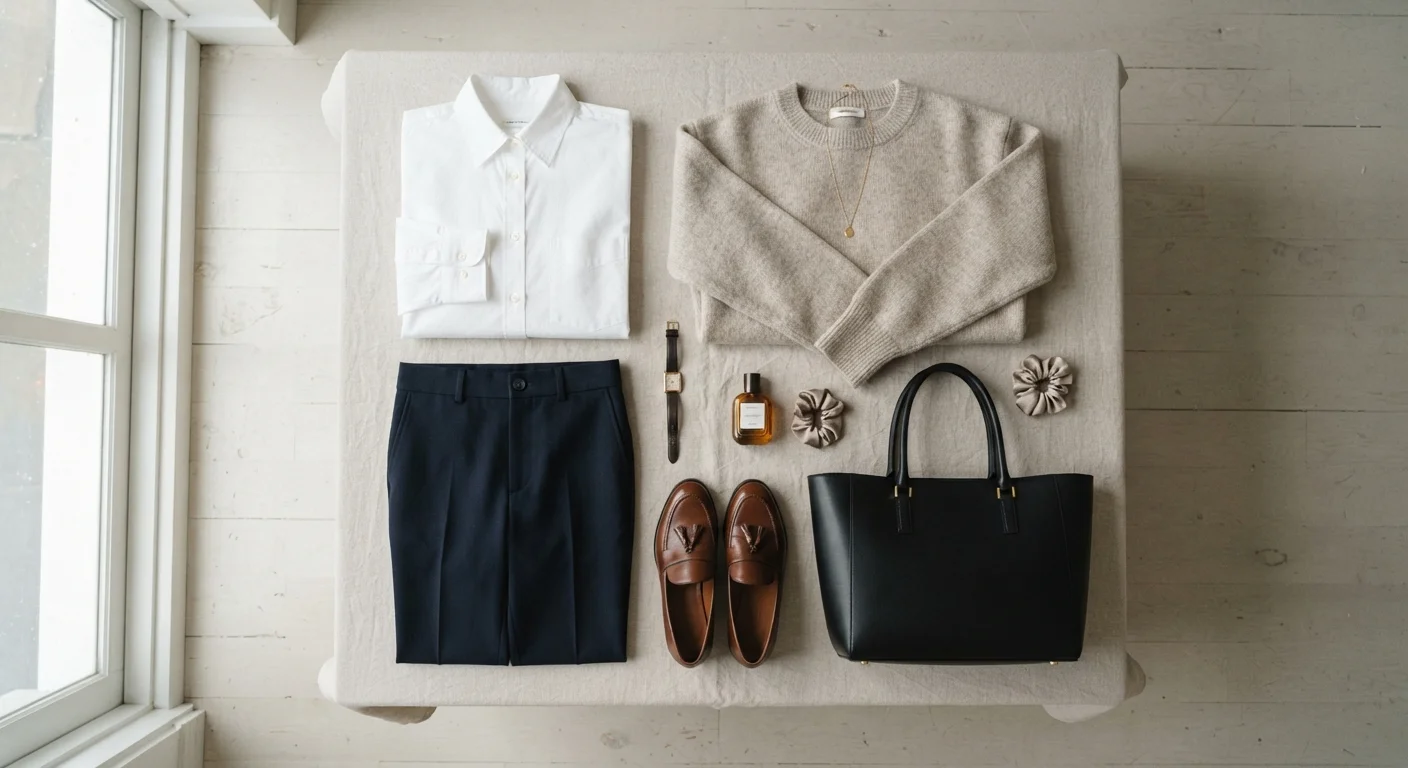
A formula is simply a repeatable combination pattern. Think fitted knit + tailored trouser + loafer, or shirt dress + denim jacket + ankle boot. The specific pieces can rotate; the underlying logic stays constant. This is how stylists and editors dress efficiently — not by buying more, but by applying proven structures to what they already own.
The practical benefit is real: when you have a formula that works, getting dressed becomes a 90-second decision rather than a 20-minute struggle. It also makes shopping more intentional, because you can evaluate any new piece against whether it slots into an existing formula rather than buying on impulse. For a deeper foundation, build your wardrobe knowledge before you shop.
Outfit formula
A repeatable combination structure — such as a fitted layer, a defining bottom, and a finishing piece — that you can apply with different garments each time to reliably produce a complete look.
Base layer
The foundational garment in an outfit, typically worn closest to the body, that establishes the overall silhouette and proportion.
Occasion register
The perceived formality level of an outfit — whether it reads as casual, smart-casual, business, or formal — which can be shifted through fabric, fit, and finishing choices.
Wardrobe anchor
A highly versatile piece that appears in many different outfits and serves as a reliable starting point when building combinations.
Combination count
The number of distinct, wearable outfits a given set of wardrobe pieces can generate when mixed and matched intentionally.
The Anatomy of a Repeatable Outfit
Most wearable outfits share the same three-part structure, regardless of style or occasion:
- A base layer — the piece that sits closest to the body and establishes the outfit's silhouette. This is usually a top, dress, or fitted knit.
- A defining piece — the item that gives the look its character: a trouser, skirt, or structured jacket. This piece typically carries the most visual weight.
- A finishing element — shoes, outerwear, or one accessory that closes the look. This is where register shifts happen; the same base and defining piece can dress up or down based solely on this element.
When an outfit isn't working, the issue almost always sits in one of these three layers — either the proportions are off, one piece is competing with another, or the finishing element is sending the wrong signal. Diagnosing by layer is faster than starting over. For a practical exploration of this building-block approach, see the outfit formula that works for almost every occasion.
Starting Points: What to Work With First
Before adding anything new to your wardrobe, do a brief audit of what you already own. Pull out every item you've worn in the past two months and lay them flat or hang them together. These are your active wardrobe — the real working set, not the aspirational one.
From that group, identify your highest-leverage pieces: items that appear in multiple outfit combinations, work across at least two occasions, and that you consistently feel good wearing. These become your formula anchors — the pieces you build around.
Start With Your Most-Worn Piece
Pick the single item you reach for most often and ask: what five things does it already work with? Those five combinations are the core of your working formula. Build outward from there rather than trying to organise your entire wardrobe at once.
Next, look for obvious gaps. If all your tops are casual but your bottoms skew smart, that imbalance is where outfit-building breaks down. A single mid-register piece — a fine-knit sweater, a relaxed blazer — can bridge that gap and immediately multiply your combination count.
Foundational pieces earn their closet space precisely because they work as anchors across seasons and occasions. Knowing which pieces already fill that role in your wardrobe tells you exactly what to prioritise adding next.
Scaling One Formula Across Multiple Occasions
One formula applied well can cover most of your dressing needs. Take a straightforward structure: straight-leg trousers + tucked top + layer. In its most casual form, that's dark jeans, a fitted T-shirt, and an oversized linen shirt worn open. Shift the trousers to tailored wool, the top to a silk shell, and the layer to a structured blazer — same formula, boardroom-appropriate.
The variables that shift occasion register most reliably are: fabric weight and finish (matte casual vs. structured or slightly lustrous for formal), shoe silhouette (sneaker to flat to heel), and whether items are tucked or layered loosely. Colour plays a smaller role than most people expect — a monochrome casual outfit can still read as polished with the right fabric and fit.
This is why dressing for your actual day matters so much: if you know your schedule runs from a desk to an evening dinner, you can build outfits that flex rather than requiring a full change. One formula, dialled up or down, handles both.
As your formula library grows, you'll find that a seasonally adaptable wardrobe becomes a natural next step — swapping fabric weights while keeping your proven structures intact.
Common Mistakes When Building Outfits from Scratch
A few patterns consistently derail outfit-building, especially early on:
- Shopping before auditing. Buying new pieces before understanding what your wardrobe already contains usually adds to the problem rather than solving it. Audit first; shop with a specific role in mind.
- Ignoring fit. A well-fitted basic outperforms an expensive piece that doesn't sit correctly. If something fits well in every other respect but needs minor adjustment, tailoring is almost always worth it.
- Over-accessorising to compensate. Adding more accessories to an outfit that isn't working rarely fixes it — it typically makes the problem harder to identify. Strip back to the three-layer structure and solve from there.
- Building for occasions you don't have. A wardrobe weighted toward event-wear when your life is primarily casual will leave you feeling like you have nothing to wear on regular days. Dress your real life first.
- Treating every purchase as an outfit. Individual pieces aren't outfits — combinations are. Before any purchase, ask: what three things do I already own that this works with?
Style confidence is built through repetition and refinement, not through volume. The goal is a small set of formulas you trust completely — and a personal style that feels like yours, not borrowed from a trend cycle.