

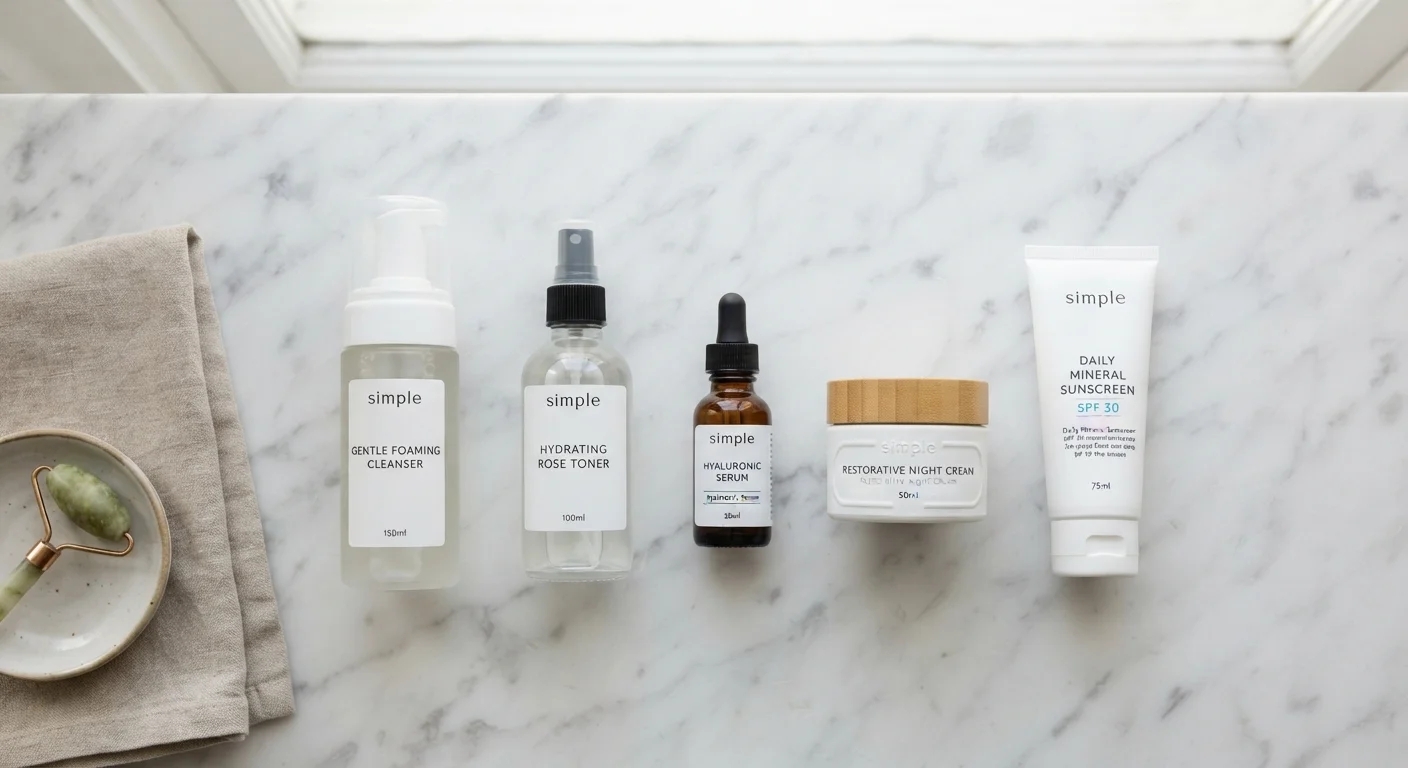
Key Takeaways
- Product order affects absorption — a rich moisturizer applied before a serum can block active ingredients from reaching skin cells.
- The foundational rule is thin-to-thick: lighter, water-based layers go on before heavier, oil-based ones.
- pH matters for actives: acid-based toners and vitamin C serums work best on skin that hasn't yet been buffered by other products.
- Sunscreen always goes on last in a morning routine — applying anything on top dilutes and disrupts its protective film.
- A simple routine applied correctly will outperform a complex one applied in the wrong order.
Skincare Routine Order
Skincare routine order refers to the specific sequence in which products are applied to the skin. The sequence matters because each product's texture, pH level, and molecular size affects whether subsequent products can penetrate effectively or are simply blocked. Applying products in the wrong order can reduce their efficacy — or in some cases, cause irritation.
The general principle is to move from lowest to highest pH, and from thinnest to thickest consistency — allowing water-based actives to reach the skin before occlusive or heavier formulas seal them off.
Why Sequence Is a Functional Principle, Not a Beauty Ritual
Most skincare guidance focuses on what to use. Far less attention goes to when — specifically, in what order products are applied. Yet sequence is one of the primary factors that determines whether your routine is actually working.
The skin is a selective barrier. Its outermost layer, the stratum corneum, regulates what passes through and what stays out. When you apply a product, it doesn't automatically penetrate — its ability to do so depends heavily on what's already on the skin surface. A dense, occlusive moisturizer applied before a serum essentially places a lid over the skin, restricting the serum's active ingredients from reaching their target. You've used the product, but the skin hasn't received its benefit.
This is why the thin-to-thick principle exists: lighter, water-based formulas are applied first to clean skin, followed by progressively heavier textures. It's not arbitrary — it reflects how the skin's barrier interacts with different molecular weights and film-forming properties.
If you're still building the foundations of a routine, this starting-point guide walks through the essential steps without the overwhelm.
The Role of pH in Routine Sequencing
Beyond texture, pH is a critical — and often overlooked — reason why order matters. The skin's natural surface sits at a mildly acidic pH, typically between 4.5 and 5.5. Many active ingredients are formulated to work specifically within that acidic range.
Vitamin C (ascorbic acid) is most stable and effective at a pH below 3.5. AHAs (alpha hydroxy acids) like glycolic acid work optimally between pH 3 and 4. If you apply an alkaline or neutral-pH product before these actives, you raise the skin's surface pH temporarily — and the acid-dependent ingredient is now working in a less hospitable environment.
The practical implication: acid-based toners and low-pH vitamin C serums should be applied to freshly cleansed skin before any product that would buffer or change the surface environment. After use, a brief wait of 1–2 minutes allows the skin to stabilize before layering the next step.
pH 4.5–5.5
Healthy skin surface pH range
Dermatological literature consistently identifies this mildly acidic range as the skin's optimal surface environment for barrier function and microbiome balance.
Below pH 3.5
Optimal pH for vitamin C (ascorbic acid) serums
Cosmetic chemistry research shows that L-ascorbic acid is most stable and bioavailable at pH levels below 3.5, making application order critical for efficacy.
30–60 seconds
Recommended wait time between most skincare steps
A brief absorption window between layers — commonly cited in skincare formulation guidance — helps prevent products from pilling and allows each layer to begin setting before the next is applied.
For a deeper look at how individual actives behave and interact, see our guide to retinoids, AHAs, BHAs, and vitamin C.
A Practical Framework: Morning vs. Evening
Routine sequencing also differs by time of day — not by convention, but because your skin has different needs in the morning versus at night.
Morning routine logic: The goal is protection. After cleansing, any toner or essence goes on first, followed by an antioxidant serum (such as vitamin C) which helps neutralize environmental oxidative stress throughout the day. Moisturizer comes next, and sunscreen is always the final step — applied after everything else so its UV-filtering film remains intact on the surface.
Evening routine logic: The goal is repair and renewal. Cleansing removes sunscreen, makeup, and accumulated debris. Treatments like retinoids — which increase cell turnover — are applied close to clean skin, after any toners but before heavier moisturizers. A richer overnight moisturizer can then seal in moisture without the layer needing to be lightweight for SPF compatibility.
The 60-Second Rule for Actives
After applying an acid toner or low-pH vitamin C serum, give your skin about 60 seconds before moving to the next step. This isn't about waiting for full absorption — it's about allowing the pH at the skin surface to stabilize so the next product isn't landing on a chemically mismatched environment. It's a small habit that meaningfully supports how your actives perform.
One common misstep is applying facial oil before a water-based moisturizer. Because oil is lipophilic (fat-attracting), it repels water-based products layered on top. Oil belongs after moisturizer — or, in the case of oil-based cleansers, at the very start as a first-cleanse step.
For habits that routinely undermine otherwise good routines, this rundown of common skincare missteps is worth reviewing.
When More Steps Complicate Rather Than Improve
Understanding routine order also reveals why more products don't automatically mean better skin. Each additional layer adds variables: new pH interactions, potential ingredient conflicts, and more opportunities to apply something at the wrong stage.
Two serums used simultaneously, for example, may compete for absorption rather than complement each other — particularly if they have different ideal pH ranges or if one contains ingredients that destabilize another. Layering products effectively requires knowing not just what works, but what works together and in sequence.
The goal of understanding routine logic isn't to memorize a rigid order — it's to develop enough reasoning to adapt. When you understand why thin goes before thick, or why your vitamin C serum belongs early in the sequence, you can troubleshoot confidently and make intentional choices rather than following steps by rote.
A focused, correctly sequenced routine of four or five products will reliably outperform a sprawling ten-step routine applied without structure. For more on that case, see when a minimal routine outperforms a complex one.
This article is for general informational purposes only and does not constitute medical or dermatological advice. If you have a skin condition or specific concerns, consult a qualified dermatologist or healthcare professional.