

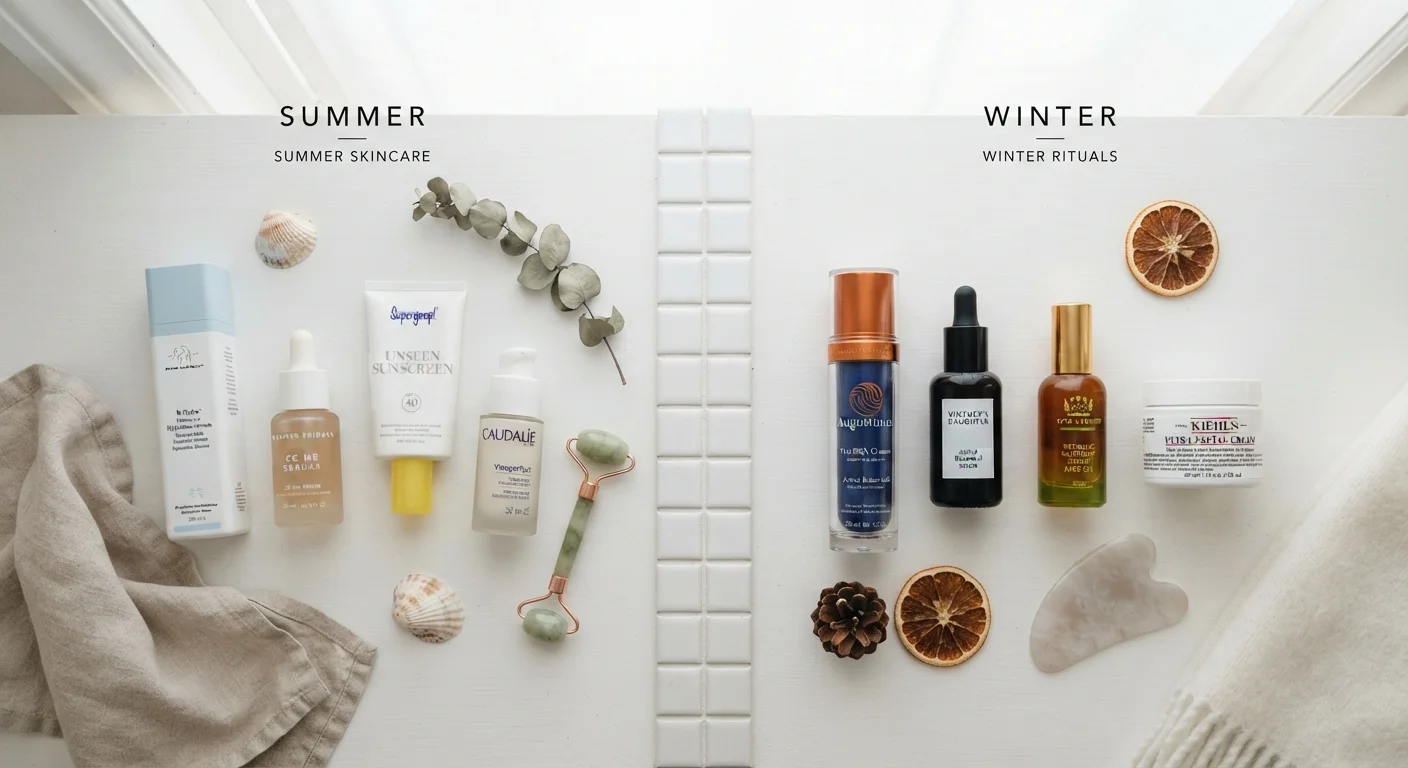
Key Takeaways
- Humidity, temperature, and UV intensity all directly affect how your skin behaves season to season.
- You rarely need a full product overhaul — targeted swaps in texture and SPF level are usually enough.
- Barrier function is the through-line: protecting it matters in every season, not just winter.
- Central heating in winter and air conditioning in summer both strip moisture from skin similarly.
- Sunscreen is a year-round non-negotiable, regardless of cloud cover or temperature.
What you will need
Why Seasons Disrupt Your Skin's Balance
Your skin is constantly negotiating with its environment. Temperature swings, shifts in relative humidity, changing UV index levels, and indoor climate control all influence how much water your skin retains, how active your sebaceous glands are, and how effectively your skin barrier functions.
The stratum corneum — the outermost layer of skin — is particularly sensitive to humidity. In dry winter air (or any climate with low relative humidity), it loses water more rapidly through a process called transepidermal water loss (TEWL). In hot, humid summers, the same skin may produce excess sebum and feel congested. Neither extreme is a problem with your skin type; it's a predictable physiological response to environmental conditions.
Understanding this means you can stop chasing a fixed routine and start thinking in terms of adjustable frameworks. Your skin type gives you your baseline; the season tells you how to modulate around it.
What You'll Need Before You Start
What you will need
Gentle, low-pH cleanser
Removes surface impurities without compromising the skin barrier — needed year-round, but especially critical in cold or windy conditions.
Lightweight, non-comedogenic moisturiser
Provides hydration in warmer, humid months without contributing to congestion.
Richer emollient moisturiser or barrier cream
Replaces lipids lost in cold, dry air and central-heated environments during autumn and winter.
Broad-spectrum SPF 30 or higher
Protects against UVA and UVB radiation in every season — UV exposure continues year-round, including through cloud cover.
Hydrating serum (hyaluronic acid or glycerin-based)
Adds a targeted hydration layer in low-humidity conditions when a moisturiser alone may not be sufficient.
Chemical exfoliant (AHA or BHA)
Helps manage texture and congestion in summer when humidity increases sebum production; used less frequently in winter.
Step-by-Step: Adjusting Your Routine Seasonally
Audit your current routine against the incoming season
Before changing anything, take stock of what you're currently using and note how your skin has been behaving. Is it tighter than usual? More congested? This baseline assessment tells you which category of adjustment is needed — hydration, oil control, or barrier repair — rather than prompting an unnecessary full product overhaul.
Consider keeping a brief notes habit for one week: morning and evening skin feel, any new reactions, and the ambient conditions (heating on, cold outdoors, etc.). This data is more reliable than general seasonal advice.
Adjust your cleanser texture first
Cleansing is where many seasonal routines go wrong. A foaming or gel cleanser appropriate for summer can over-strip in winter, undermining barrier function before you've even applied anything else. In colder, drier months, switch to a cream, milk, or oil-based cleanser that removes impurities without pulling lipids from the skin.
In warmer months, if your skin leans oily or you're wearing more SPF and sweat, a gentle foaming or micellar formula is reasonable — provided it doesn't leave skin feeling tight after rinsing.
Swap moisturiser weight, not your entire moisturiser category
The shift from a gel-cream to a richer emollient in autumn doesn't mean abandoning your preferred formulation entirely. Look for the same functional ingredients — ceramides, fatty acids, humectants — in a denser texture. This preserves familiarity for your skin while delivering the additional occlusion needed to reduce TEWL in dry conditions.
In humid summers, the reverse applies: a lighter-textured product with the same humectants (such as glycerin or hyaluronic acid) keeps skin comfortable without the heaviness that can contribute to milia or blocked pores.
Recalibrate your exfoliation frequency
Exfoliants — particularly chemical exfoliants like AHAs (alpha-hydroxy acids) and BHAs (beta-hydroxy acids) — need seasonal reconsideration. In winter, a compromised barrier is more susceptible to irritation; reduce application frequency and consider lower concentrations. In summer, increased sebum and cell turnover may allow for slightly more regular use, but this should be guided by how your skin responds, not by a formula.
AHAs also increase photosensitivity, making diligent SPF application even more important on days you exfoliate. This is year-round guidance, not seasonal — but summer sun intensity makes it especially worth remembering.
Reassess your SPF formula, not just your SPF habit
Sunscreen is non-negotiable in every season — UV radiation causes cumulative skin damage regardless of visible sunshine. What can legitimately change is the formula. A lightweight fluid or gel SPF that sits comfortably under makeup in summer may feel more appealing than a richer SPF moisturiser; in winter, a combined SPF-moisturiser with emollient properties can serve double duty without adding another layer to an already-compromised barrier.
The morning routine structure matters here: SPF always belongs as the final step in your AM routine, applied after moisturiser and before any colour products.
Account for indoor climate, not just outdoor weather
Central heating in winter and air conditioning in summer both reduce indoor humidity, creating a drying microenvironment regardless of the season. This is why skin can feel parched in summer if you work long hours in a heavily air-conditioned space. A humidifier in your immediate environment can help offset this, and it's worth applying a hydrating layer — even a simple glycerin-based mist — mid-day if you notice tightness.
This indoor-climate factor is especially relevant for those who travel frequently or move between very different climate zones — a useful consideration alongside seasonal living principles that account for environmental rhythms more broadly.
Simplicity Holds the Routine Together
A consistent four-step routine — cleanse, treat (if applicable), moisturise, protect — that you adjust seasonally outperforms a complex ten-step routine that gets abandoned when it stops feeling right. Fewer products, well chosen, make seasonal tweaks far easier to manage. For context on how routines shift across decades of skin change, see our guide on skin changes at 30, 40, and 50.
Troubleshooting Transition Periods
The most challenging moments aren't deep winter or peak summer — they're the weeks in between. During transitional periods, skin can display contradictory signals: dry patches alongside breakouts, or tightness in the morning and oiliness by afternoon. This is normal, and it's a common reason routines feel like they've stopped working.
Rather than switching everything at once, change one product at a time and give your skin one to two weeks to respond. If you're unsure whether a reaction is environmental or product-related, simplify down to a gentle cleanser, unfragranced moisturiser, and SPF — then reintroduce other actives gradually.
For a broader look at how routine missteps compound skin confusion, our common skincare habits worth reconsidering article covers the patterns most likely to work against you. And if you're noticing skin behavior that shifts monthly rather than seasonally, it may be worth reading about how hormonal cycles influence physical responses — a useful parallel framework.
Persistent Reactions Warrant Professional Assessment
If your skin consistently breaks out, becomes inflamed, or develops persistent dryness or redness that doesn't respond to routine adjustments, a dermatologist or qualified skin clinician is the appropriate next step. Seasonal variation is normal; ongoing distress is not. This article provides general educational information and is not a substitute for personalised professional advice.