

Key Takeaways
- Traditional proportion rules were designed as guidelines, not laws — they can be adapted or set aside entirely.
- Dressing for self-expression and dressing for proportion are not mutually exclusive approaches.
- Understanding proportion principles gives you more creative control, not less freedom.
- Your emotional relationship with clothing is a legitimate and important style consideration.
- A signature style identity emerges when you learn the rules well enough to apply them selectively.
Our Verdict
Neither proportion-focused dressing nor pure self-expression is the definitive right approach — the most functional personal style draws from both. Proportion awareness gives you a technical foundation; self-expression gives it meaning. The two frameworks become most powerful when used together, with you deciding which takes priority in any given outfit.
| Best for | Recommended |
|---|---|
| Those who want a reliable, confidence-building starting point | Proportion-led dressing |
| Those building a signature style identity rooted in who they are | Expression-led dressing |
| Those who want outfits that feel both intentional and deeply personal | A hybrid approach combining both frameworks |
Two Frameworks, One Wardrobe
Fashion advice has long operated on two distinct tracks. The first is rooted in proportion: balance your silhouette, elongate your frame, create visual harmony. The second is rooted in expression: wear what excites you, develop a visual language that's unmistakably yours, and dress as a form of identity rather than optimization.
For most women, these tracks don't feel like a choice — they feel like a tension. You may love a voluminous trouser but worry it will overwhelm your frame. You may be drawn to bold prints but get talked into neutrals because they're "more flattering." The result is a wardrobe that's technically correct but emotionally flat.
The better question isn't which approach to follow — it's understanding what each one actually offers, and where they genuinely conflict versus where they've been falsely positioned as opposites. As explored in style myths worth letting go of, many of the rules women follow most strictly are the ones least grounded in universal truth.
What Proportion-Led Dressing Actually Offers
Proportion rules — balancing volume above and below the waist, using vertical lines to create length, grounding a full silhouette with a defined waist — are not arbitrary. They draw on visual principles related to how the eye travels across a figure and how contrast creates or softens emphasis. Used well, they're a useful toolkit, not a moral standard.
The genuine value of proportion awareness is that it explains why something works visually. A wide-leg trouser paired with a tucked, fitted top reads as deliberate because it follows an understood visual logic. That knowledge doesn't restrict you — it gives you a framework for making intentional choices rather than hoping an outfit works.
| Proportion-Led Dressing | Expression-Led Dressing | |
|---|---|---|
| Primary goal | Visual balance and silhouette harmony | Communicating identity and personal voice |
| Decision framework | What flatters or balances the figure | What feels authentic and resonant |
| Risk if overused | Technically correct but emotionally flat outfits | Exciting pieces that don't cohere into a look |
| Greatest strength | Predictable, confidence-building results | Distinctive, memorable personal style |
| Works best when | Used as a flexible toolkit, not a rulebook | Grounded in some structural awareness |
| Common pitfall | Restricting choices based on body "type" rules | Accumulating impulse pieces without a through-line |
Where proportion-led dressing runs into trouble is when it becomes prescriptive rather than descriptive — when "this silhouette works for your body type" becomes a set of restrictions rather than a set of options. Proportion is one of three key outfit variables — and it works best when treated as one tool among several.
What Expression-Led Dressing Actually Offers
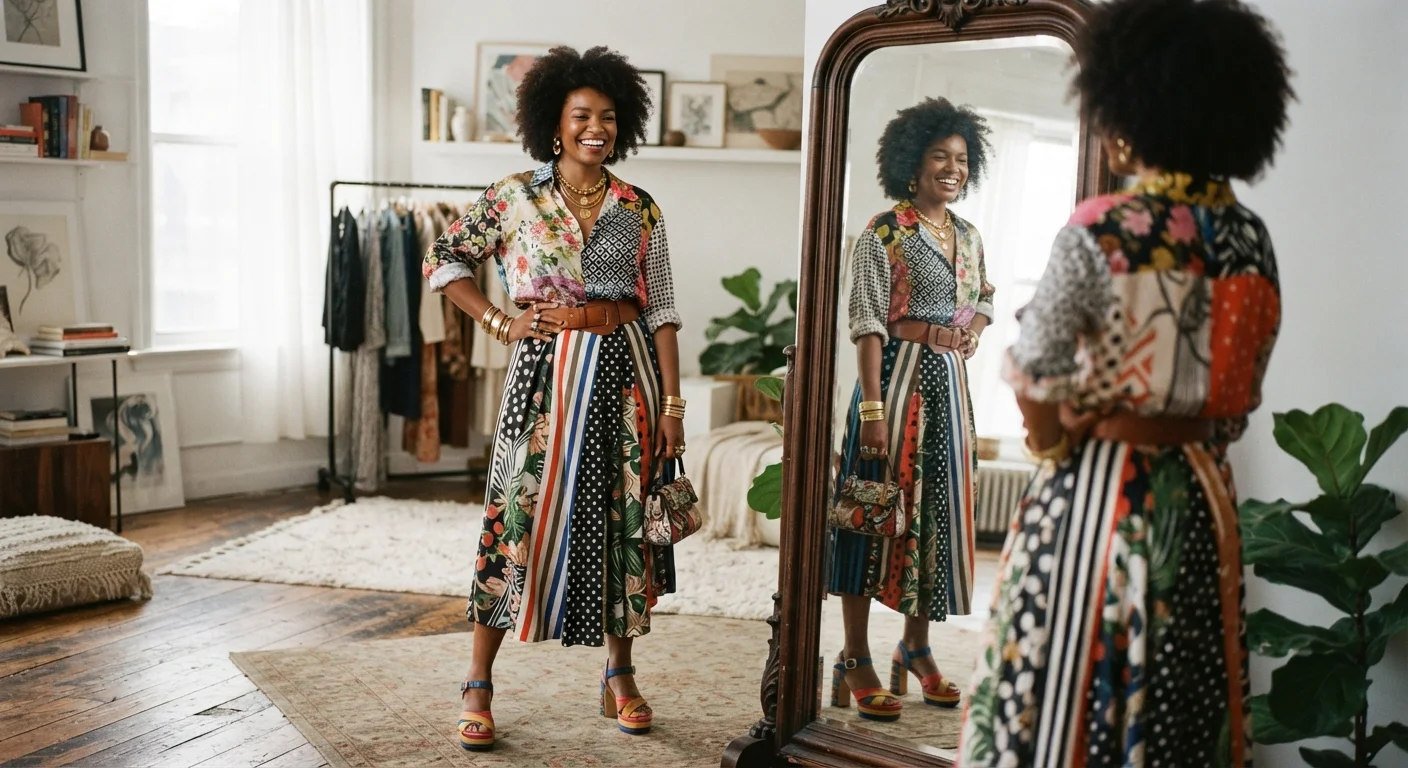
Dressing for self-expression starts from a different premise: clothing communicates identity, and that communication matters. The colors you gravitate toward, the silhouettes that make you feel like yourself, the textures that bring you pleasure — these are not frivolous preferences. They're data about who you are and how you want to move through the world.
Expression-led dressing can feel riskier because it removes the safety net of "flattering" as a benchmark. But it tends to produce more distinctive, memorable, and personally satisfying style outcomes. Women who dress from this orientation often develop a recognizable signature — something that becomes more cohesive over time rather than less, even if it doesn't follow classical proportion guidelines.
Use Pleasure as a Diagnostic Tool
When you put on an outfit and feel genuinely good — not just "acceptable" — take note of what specifically is working. Is it the color against your skin? The way the fabric moves? The silhouette's unexpectedness? Over time, these moments of instinctive pleasure reveal your actual aesthetic preferences far more reliably than any style quiz. That information is the raw material of a real signature style.
The challenge is that expression without any structural awareness can feel scattered — exciting in individual pieces but incoherent as a whole. This is where understanding your wardrobe archetype helps: knowing what you're instinctively drawn to makes it easier to build a coherent visual identity rather than an accumulation of impulses.
Finding Your Actual Working Balance
In practice, most women who dress with confidence aren't operating in either camp exclusively — they're applying proportion principles selectively, in service of an expressive goal. They might choose a voluminous skirt because they understand that anchoring it with a fitted top creates balance, not because they're minimizing their hips. The distinction matters: one approach uses the rule as a cage, the other uses it as scaffolding.
A useful exercise: identify the pieces in your wardrobe that make you feel most like yourself, regardless of whether they're conventionally flattering. Then look at what they have in common — in silhouette, color, texture, or mood. That pattern is the beginning of a genuine style identity. From there, proportion knowledge becomes a resource you draw on to make those pieces work harder, not a filter that edits your preferences away.
For more on translating this into actual outfit-building, building outfits from scratch offers a grounded starting point. And if the gap between your inspiration and your actual closet feels wide, dressing for your real life rather than an aspirational one addresses exactly that disconnect.