

| Number of core archetypes covered | 7 (Classic, Minimalist, Romantic, Bohemian, Edgy, Preppy, Eclectic) |
| Most common dressing pattern | A blend of 2–3 archetypes rather than a single one |
| Primary function of an archetype | To give your wardrobe a consistent gravitational center, not a rigid uniform |
| Best starting audit | The 10 pieces you've worn most — not what you bought hoping to change |
| Archetype vs. trend | Archetypes are durable and self-expressive; trends are seasonal and externally driven |
What Is a Style Archetype?
A style archetype is a recognizable pattern of dressing built around consistent silhouettes, color palettes, fabrics, and mood — not a rigid uniform, but a gravitational center that your outfit choices orbit. Think of it less as a label and more as a working language for your wardrobe. Understanding which archetype (or combination) describes your instincts helps you shop with intention, build outfits more efficiently, and stop second-guessing purchases that never quite fit your life.
This is not about trend categories or seasonal aesthetics. Archetypes are durable. They reflect how you want to feel when you get dressed — put-together, expressive, relaxed, commanding — and they remain consistent even when specific trends come and go. Developing a signature style often starts exactly here: with recognizing which archetype already shows up in your closet.
| Number of core archetypes covered | 7 (Classic, Minimalist, Romantic, Bohemian, Edgy, Preppy, Eclectic) |
| Most common dressing pattern | A blend of 2–3 archetypes rather than a single one |
| Primary function of an archetype | To give your wardrobe a consistent gravitational center, not a rigid uniform |
| Best starting audit | The 10 pieces you've worn most — not what you bought hoping to change |
| Archetype vs. trend | Archetypes are durable and self-expressive; trends are seasonal and externally driven |
The Core Style Archetypes
The Classic
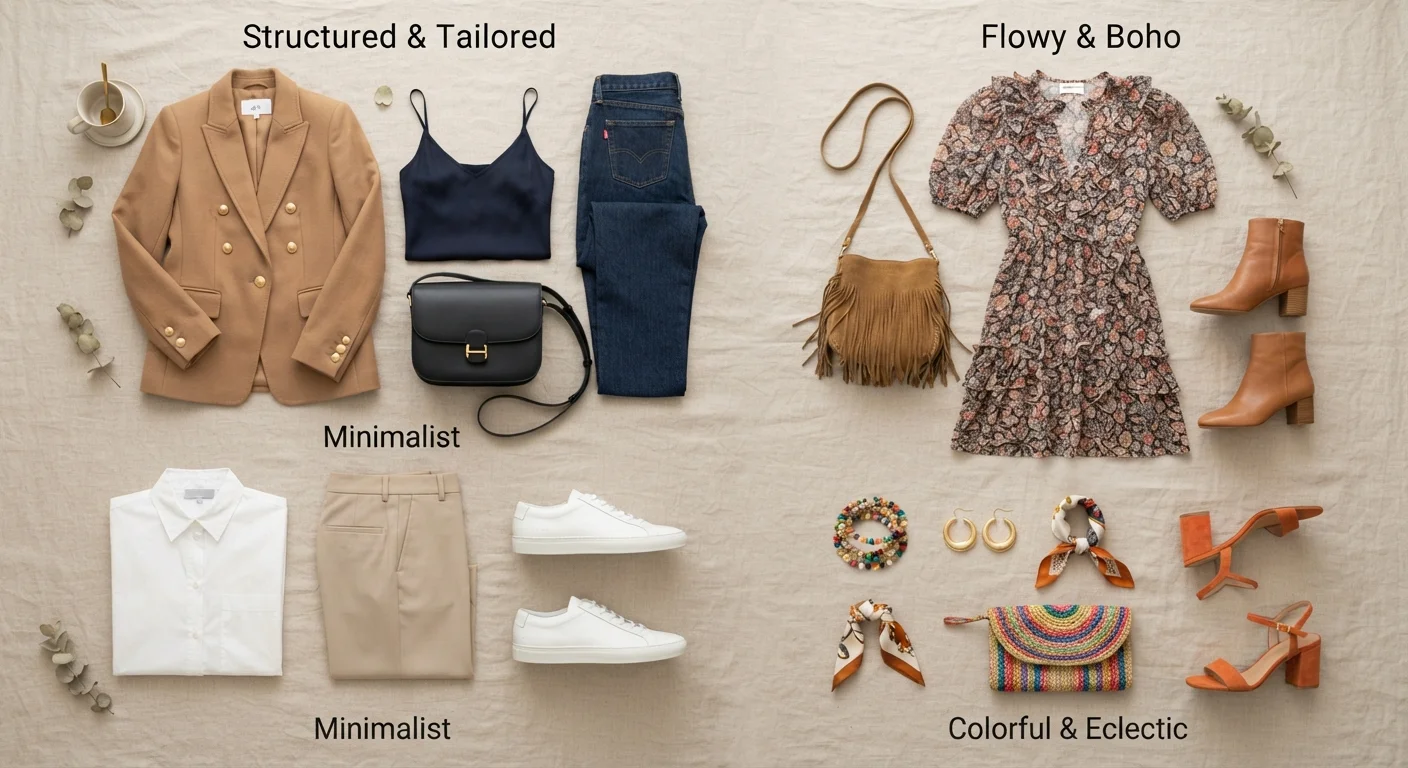
Defined by timelessness. The Classic dresser gravitates toward tailored silhouettes, neutral palettes, quality fabrics, and minimal ornamentation. Think structured trousers, a well-cut trench coat, or a crisp button-down worn with confidence. The goal is polish that doesn't date. This archetype prioritizes longevity over novelty and invests in foundational pieces that work across occasions and decades. For a deeper look at building around this approach, see our Wardrobe Essentials hub.
The Minimalist
Related to but distinct from the Classic, the Minimalist archetype is about reduction. Fewer pieces, cleaner lines, a tightly edited color story — often monochrome or near-neutral — and deliberate negative space in an outfit. Minimalism values restraint as its own form of expression. The emphasis is on fit, fabric quality, and proportion rather than detail or decoration.
The Romantic
Softness defines this archetype: flowing fabrics, floral prints, feminine silhouettes, delicate textures like lace or chiffon, and a generally warm or pastel palette. The Romantic dresser leans into ornamentation — ruffles, shirring, puffed sleeves — and treats dressing as an emotional, expressive act. The aesthetic can range from cottagecore softness to polished femininity depending on how it's executed.
The Bohemian
Rooted in artistic, free-spirited dressing, the Bohemian archetype draws from global textiles, vintage references, layered silhouettes, and earthy or jewel-toned palettes. Prints mix freely. Accessories are rich and often handcrafted. Rules around proportion and occasion-dressing feel secondary to personal expression and comfort. This archetype rewards creative layering and unconventional combinations.
The Edgy or Urban
This archetype prioritizes attitude and modernity. Leather elements, asymmetry, hardware details, oversized or deconstructed silhouettes, and a largely dark or high-contrast palette are hallmarks. The Edgy dresser often subverts expected dress codes — softening a sharp silhouette with unexpected texture or mixing formal and streetwear references deliberately.
The Preppy
Rooted in collegiate and sport-leisure tradition, the Preppy archetype centers on clean, structured pieces — polo shirts, blazers, crisp chinos, loafers — executed in classic color combinations like navy and white or red and camel. It communicates ease within a certain establishment framework, blending casual and smart-casual with practiced nonchalance.
The Eclectic
The Eclectic dresser borrows deliberately from multiple archetypes and decades, combining references in ways that feel intentional rather than inconsistent. This is not about liking everything without direction — it's about curating contrast with a skilled eye. If this sounds familiar, the guide on distilling a coherent aesthetic from wide-ranging influences is worth reading alongside this one.
Style Archetype
A recognizable pattern of dressing built around consistent silhouettes, palettes, and mood. It functions as a wardrobe foundation rather than a rigid rule set.
Silhouette
The overall shape or outline of an outfit as seen from a distance. Silhouette — loose vs. fitted, structured vs. draped — is often the first signal of a style archetype.
Capsule Wardrobe
A tightly edited collection of versatile, complementary pieces that can be mixed and matched across many outfits. Often aligned with Classic or Minimalist archetypes.
Signature Style
A consistent, recognizable personal aesthetic that remains stable across seasons and occasions. It is usually anchored by one or two dominant style archetypes.
Style Palette
The recurring set of colors — whether neutral, bold, or tonal — that defines a person's wardrobe and contributes to visual coherence across outfits.
How to Identify Your Archetype
Most people blend two or three archetypes rather than inhabiting just one. The most useful starting point is an honest audit of what you already reach for — not what you bought hoping to change, but what you actually wear. Pull out the ten pieces you've worn most in the past few months. Look for the recurring thread: the silhouette, the color range, the level of detail. That pattern is your working archetype.
If you're building a style foundation from scratch rather than refining an existing one, the guided starting point for developing a personal look offers a practical framework. And if identifying your archetype feels complicated because you're drawn to conflicting references, read our piece on identifying your style base before making purchases — it helps separate genuine preferences from aspirational ones.
The value of an archetype is not confinement — it's clarity. Once you know your center, you can expand from it intentionally, borrow from other aesthetics without losing coherence, and dress in a way that feels consistently, recognizably yours.