
Texture, Proportion, and Fit: The Three Variables That Actually Change How an Outfit Reads

Key Takeaways
- Texture creates visual interest and outfit cohesion without relying on color or pattern.
- Proportion — not body shape — determines whether an outfit feels balanced or off.
- Fit is the single variable with the most immediate impact on how polished a look appears.
- These three variables work as a system; adjusting one usually requires adjusting another.
- Mastering these principles makes any wardrobe more versatile without adding new pieces.
Texture, Proportion, and Fit
These three variables are the structural logic behind how an outfit looks and feels on the body. Texture refers to the surface quality of fabric — matte, shiny, rough, smooth — and determines how pieces relate to each other visually. Proportion describes the relationship between the sizes and lengths of garments relative to your frame. Fit is how closely a garment conforms to your body's actual shape. Adjusting any one of these three can shift an entire look.
In styling practice, these variables operate as a system: a change in one typically requires a recalibration of the others to maintain visual balance.
Why These Three Variables — and Not Color or Pattern?
Color and pattern receive the most airtime in style conversations, but they're actually the variables that matter least to whether an outfit works. You can wear a beautifully coordinated palette and still look like something is off — because the fit is slightly wrong, or the proportions are competing, or every piece has the same flat texture.
Texture, proportion, and fit are the structural layer beneath aesthetic choices. They determine how an outfit reads at a distance, how put-together it looks in motion, and whether it feels cohesive or accidental. Understanding them is foundational to building the kind of repeatable outfit formulas that work across occasions — not just on good styling days.
These three variables also directly support the wardrobe essentials approach: when you understand the mechanics, you can make more from less.
3
Core variables that determine outfit success
Texture, proportion, and fit operate as an interconnected system — professional stylists consistently return to these three fundamentals when assessing and improving a look.
~80%
Of outfit improvement from fit alone
Fashion educators commonly estimate that proper fit accounts for the majority of how polished a garment appears, outweighing fabric quality and price point.
Texture: The Variable That Creates Depth
Texture is the surface quality of a fabric — its visual and tactile character. Think of the difference between a smooth cotton poplin shirt, a ribbed knit sweater, and a velvet trouser. Each carries a different visual weight, reflects light differently, and signals a different register of dressing.
The mistake most people make is treating texture as uniform — pairing a matte jersey top with flat cotton trousers creates a visually monotonous result even if the colors are complementary. Contrast in texture is what gives an outfit dimension.
A few reliable texture pairings to work from:
- Smooth with nubby: A sleek slip skirt with a bouclé cardigan
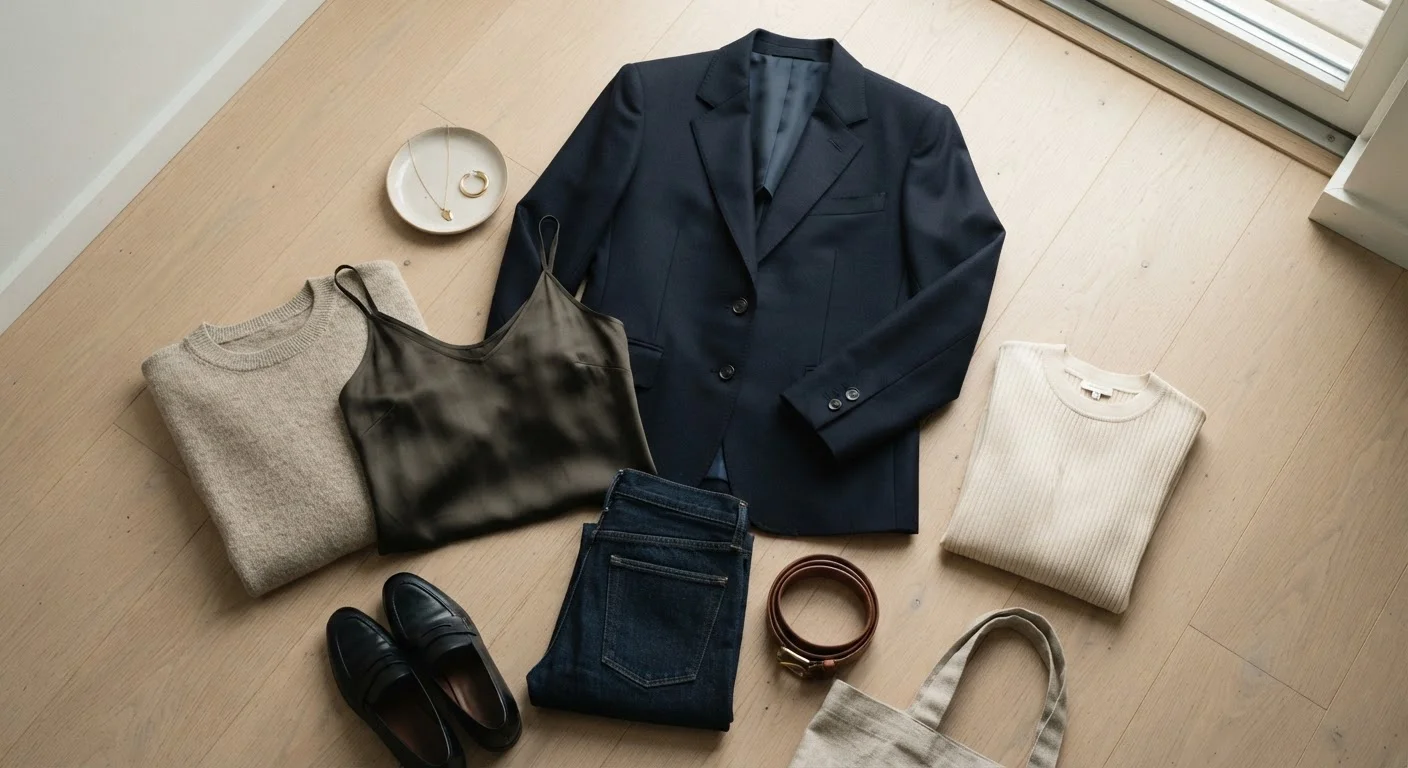
- Matte with sheen: A linen blazer over a satin cami
- Structured with fluid: A tailored wool coat over a draped jersey dress
Texture also functions as a tonal signal. Heavier, coarser textures — cable knit, tweed, denim — read as casual. Smoother, more reflective surfaces — silk, satin, fine merino — register as elevated. Mixing registers thoughtfully is how you dress something up or down without changing the piece itself. This overlaps with the principles covered in texture and silhouette as building blocks.
Proportion: The Variable That Creates Balance
Proportion is the relationship between the visual volumes of the pieces you're wearing — their lengths, widths, and how they divide your frame. It's the reason a cropped jacket over a midi skirt feels balanced while the same jacket over a mini skirt can look top-heavy, or why wide-leg trousers work beautifully with a fitted turtleneck but feel unwieldy with an oversized sweater.
The core principle is contrast: when one garment is voluminous, the other should be more contained. When one is cropped, the other should have more length. This doesn't mean rigid rules — it means being deliberate about the visual balance you're creating.
Common proportion adjustments that change an outfit without changing the clothes:
- The front tuck: Tucking just the front of a shirt changes where your waistline reads visually, shifting the proportional split of your silhouette.
- Layering a long coat: A longline coat over a mid-length dress creates a vertical proportion that elongates the overall look.
- Shoe silhouette: A pointed-toe flat lengthens the visual line of the leg under a cropped trouser; a chunky-soled shoe adds visual weight that can balance a voluminous top half.
For a deeper look at how proportion intersects with personal expression, dressing for body proportions vs. personal expression addresses where traditional advice ends and self-expression begins.
Fit: The Variable With the Most Immediate Impact
Fit is the single most powerful variable in this system. No texture contrast or clever proportion work compensates for garments that don't fit the body wearing them. Fit means shoulder seams sitting at the edge of your actual shoulders, fabric not pulling across the chest or hips, trousers breaking at the right point on the shoe, and sleeves ending at the wrist bone.
Fit is also the variable most people treat as fixed when it isn't. Basic alterations — hemming trousers, taking in a side seam, shortening sleeves — are often inexpensive relative to the transformation they create. A simple, affordable piece in a precise fit will consistently outperform a more expensive one that doesn't fit correctly.
Start With One Alteration
If your wardrobe feels like it's not working, pick one piece you reach for but never feel great in and have it altered before buying anything new. Hemming trousers to the correct break, or taking in a waistband, often costs less than a new top. You may find the piece becomes one you actually wear — proving fit was the issue all along.
It's also worth noting that fit is garment-specific, not body-specific. Different cuts are designed for different silhouettes, and finding what works for your body is a matter of understanding which fits are doing what — not a verdict on your frame. The anatomy of an everyday outfit framework is useful here, because it clarifies what role each piece is supposed to play and therefore what fit expectations apply.
Using All Three Together
These variables compound. An outfit that addresses all three — interesting texture contrast, intentional proportion, and precise fit — reads as pulled-together regardless of the price point or simplicity of the individual pieces. An outfit that neglects any one of them will feel slightly incomplete, even if the other two are strong.
A practical way to audit any outfit before leaving the house: identify the texture relationship (is there contrast, or is everything the same surface?), check the proportion (is one volume counterbalancing another?), and assess fit (are the seams and hemlines landing where they should?). This takes seconds once the framework is familiar, and it removes the vague sense that something is off without being able to name it.
For a broader framework on building personal style around these principles rather than around trend cycles, the key is treating your wardrobe as a system — where each variable can be dialed up or down depending on the look you're working toward.