

Key Takeaways
- Texture, pattern, and silhouette are the three design elements that give an outfit its visual weight and personality.
- Most style frustration stems from overlooking these elements while focusing almost entirely on colour.
- Each element works as a lever — adjusting one can transform an otherwise flat or incoherent outfit.
- Developing a preference for specific textures and silhouettes is the foundation of a recognisable personal style.
- These principles work across budgets, body types, and occasions — they are tools, not rules.
Why the Conversation Rarely Gets Here
Colour dominates most style conversations — which palettes flatter, which combinations clash, how to build a wardrobe around a neutral base. It's a useful starting point, but it's rarely the whole picture. The outfits that stop you mid-scroll, the ones that look effortlessly pulled together on a woman you admire, are usually doing something more subtle. They're working with texture, pattern, and silhouette in ways that feel considered without looking laboured.
These three elements are the quiet architecture of a great outfit. Colour gets credit for the mood; texture, pattern, and silhouette do the structural work. If you've ever assembled an outfit where every individual piece looked fine but the total felt off, the mismatch was almost certainly happening at this level. Colour logic matters, but it's only one dimension of a complete picture.
The good news is that once you understand how each element functions, you can use them deliberately — not to follow a trend, but to build a style identity that's unmistakably yours. Below are the core principles that make this possible.
Texture: The Element You Feel Before You See
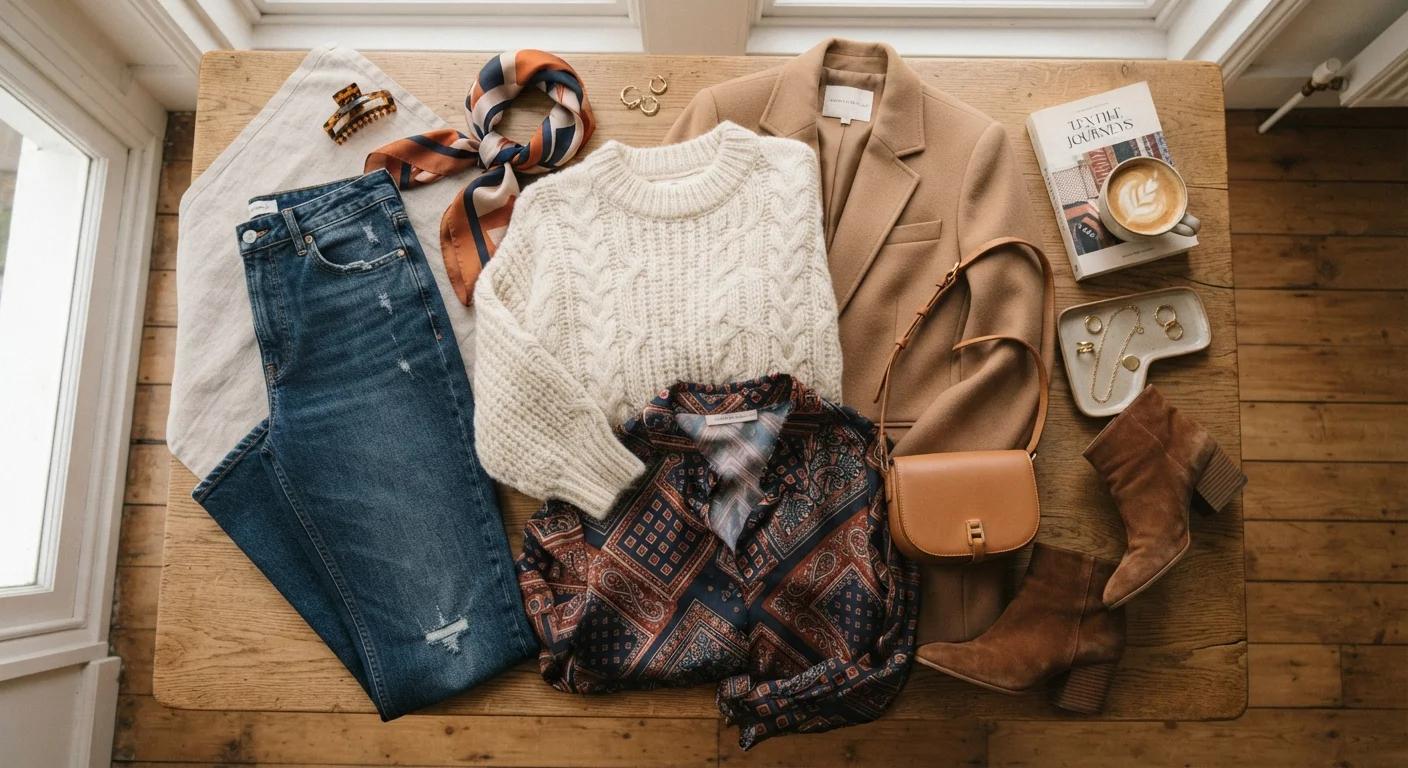
Texture is the tactile quality of a fabric — whether it's smooth, nubby, matte, shiny, stiff, or draped. It affects how light falls on a garment and, by extension, how much visual interest a piece carries. A cream silk blouse and a cream chunky knit sweater occupy the same colour space but read as entirely different statements because their surfaces behave oppositely.
The principle to internalize is contrast through texture. Pairing pieces of similar texture — say, two matte fabrics in similar weights — tends to flatten an outfit. Pairing a fluid, shiny fabric with something matte and structured creates depth without requiring pattern or colour contrast. A satin midi skirt with a relaxed cotton T-shirt works precisely because the surfaces are in conversation.
Your texture preferences are also one of the most reliable signals of personal style. Someone drawn to linen, worn denim, and raw-edge knits is building a very different style identity than someone who gravitates toward silk, leather, and wool crepe — even if their colour palettes overlap entirely.
Texture contrast creates depth without pattern or colour — it's the quietest tool with the biggest impact.
Pattern: Scale and Placement Over Print Choice
Most pattern anxiety centres on the wrong question: Which print is safe? The more useful questions are about scale and placement. A large-scale floral and a small-scale floral are not interchangeable — their scale changes how much visual weight they carry and how they interact with the rest of an outfit.
Large-scale patterns draw attention and command space. They work best when the rest of the outfit is comparatively quiet — solid, low-texture, simple silhouette. Small-scale patterns (fine stripes, micro-prints, subtle checks) function almost like a texture rather than a statement; they add visual interest without dominance and are easier to mix with other elements.
Placement matters too. A pattern concentrated at the neckline draws the eye upward. A patterned skirt anchors attention at the hem. Neither is inherently better — but knowing what a pattern is doing spatially lets you use it with intention rather than hoping it works. Proportion and fit interact with pattern scale in the same way, making this a natural pairing to study together.
Pattern scale and placement shape an outfit's visual weight more than the print itself ever could.
Silhouette: The Shape of the Whole, Not Each Piece
Silhouette is the overall shape an outfit creates when worn — not the shape of individual garments in isolation. Two pieces that look unremarkable separately can create a compelling silhouette together, while two pieces that look beautiful alone can compete and cancel each other out.
The foundational principle is volume balance. Volume at the top is balanced by structure or slim fit at the bottom, and vice versa. A voluminous blouse reads intentional with tailored trousers or a pencil skirt; paired with a full midi skirt, it can overwhelm the silhouette. This isn't a rigid rule — oversized-on-oversized can work — but it requires a deliberate anchor, like a defined waist or a strong shoe, to give the eye somewhere to land.
Silhouette is also where personal style becomes most physically expressive. Choosing a strong shoulder, a nipped waist, a dramatic hem, or a relaxed column shape is a statement independent of colour or print. It's what makes certain women's style immediately recognizable across seasons and trends.
Silhouette is the shape your outfit makes as a whole — that's what people actually see and remember.
Mixing Elements: The One-Anchor Rule
When texture, pattern, and silhouette are all competing for attention simultaneously, an outfit tends to feel busy or unresolved — even if every individual choice is interesting. The practical solution is the one-anchor rule: let one element be the primary statement and keep the others relatively quiet in support.
If silhouette is doing the work — a dramatic wide-leg trouser, an asymmetric hem — use solid fabrics and minimal texture contrast so the shape reads clearly. If a bold pattern is the point, choose a simple, balanced silhouette and consistent texture so the print isn't fighting anything. If texture is layered richly — say, a velvet blazer over a silk blouse — keep the silhouette clean and the pattern minimal or absent.
This principle doesn't produce boring outfits. It produces coherent ones, where the eye moves through the look rather than getting caught in competing signals. It's also a reliable editing tool: if an outfit feels off, ask which element is competing with the intended anchor and simplify it.
Let one element lead and the rest support — coherence comes from hierarchy, not from doing everything at once.
Building a Signature Through Repetition
Signature style isn't invented in a single outfit decision. It emerges through repetition — noticing which textures you reach for instinctively, which silhouettes make you feel most like yourself, which scale of pattern you keep returning to. These preferences, mapped over time, become the grammar of a personal style.
The practical exercise is to look at your most-worn pieces — not your most expensive or your most admired, but the ones you actually put on repeatedly — and identify the patterns across texture, silhouette, and print scale. Most women find a consistency they weren't consciously cultivating. That consistency is the starting point for intentional style development.
Once you see it, you can amplify it rather than constantly reaching for variety for its own sake. A wardrobe built around what you already know works — in all three dimensions — is far more functional than one assembled around colour alone. For a deeper look at how colour fits into this personal style picture, see the role of colour in defining how you dress. The wardrobe essentials hub is also worth exploring as you refine which pieces truly anchor your style.
Your most-worn pieces already reveal a pattern — signature style is built by seeing and amplifying what's already there.
Putting It Together
These three elements rarely operate in isolation. A strong silhouette reads differently in matte jersey versus structured wool. A subtle pattern in a relaxed fit communicates something entirely different from the same print in a tailored cut. Learning to think in combinations — asking not just what you're wearing but how each element is speaking to the others — is what separates a wardrobe from a personal style.
Try the One-Element Audit
Pick one outfit from your regular rotation and evaluate it through a single lens at a time: texture first, then pattern, then silhouette. Ask whether each element is working with or against the others. This focused approach trains your eye faster than trying to assess everything simultaneously — and it reveals exactly which lever to adjust when something feels off.
Start by identifying which element you currently give the least attention to. For most women, it's silhouette — defaulting to whatever fits rather than asking what shape serves the outfit. A simple edit, like swapping a straight-leg trouser for a wide-leg in the same fabric, can shift an entire look without touching anything else. That's the kind of intentional adjustment that makes style feel like yours.
For a complete framework on assembling outfits from the ground up, see our outfit formula guide. And if you want to understand how each individual piece earns its place, breaking down an everyday outfit walks through the role of every layer. Texture, pattern, and silhouette aren't extras — they're the building blocks that make the whole thing hold together.