

Key Takeaways
- Decluttering means deciding what to keep; organising means placing those kept items intentionally.
- Organising before decluttering creates systems that won't hold up because they're built around too much stuff.
- The correct sequence — declutter first, then organise — is what makes tidiness sustainable.
- Buying storage solutions before decluttering is one of the most common and costly mistakes.
- A smaller, well-organised home consistently feels calmer than a larger, neatly sorted one.
Option A
Decluttering
The essential first step — deciding what stays.
Best for: Anyone who wants lasting change: removing items that no longer serve you before any organisational system is put in place.
Option B
Organising
The finishing layer — finding a home for what remains.
Best for: After decluttering is complete, creating intuitive, maintainable systems for everything you've decided to keep.
If your space feels perpetually chaotic despite repeated tidying
Decluttering
Chaos that returns after tidying is almost always a volume problem. Start by removing rather than rearranging.
If you've already reduced your belongings and things still feel scattered
Organising
Once you're working with only what you genuinely use, building location-based systems gives every item a logical, returnable home.
If you're tempted to buy bins, baskets, or drawer dividers first
Decluttering
Storage solutions bought before decluttering almost always end up organising items you'll later discard — wasting both money and effort.
If you've done a thorough declutter but maintaining tidiness still feels effortful
Organising
Sustainable maintenance depends on intuitive systems — designated spots that make it easier to put things back than to leave them out.
Two Different Actions, Frequently Confused
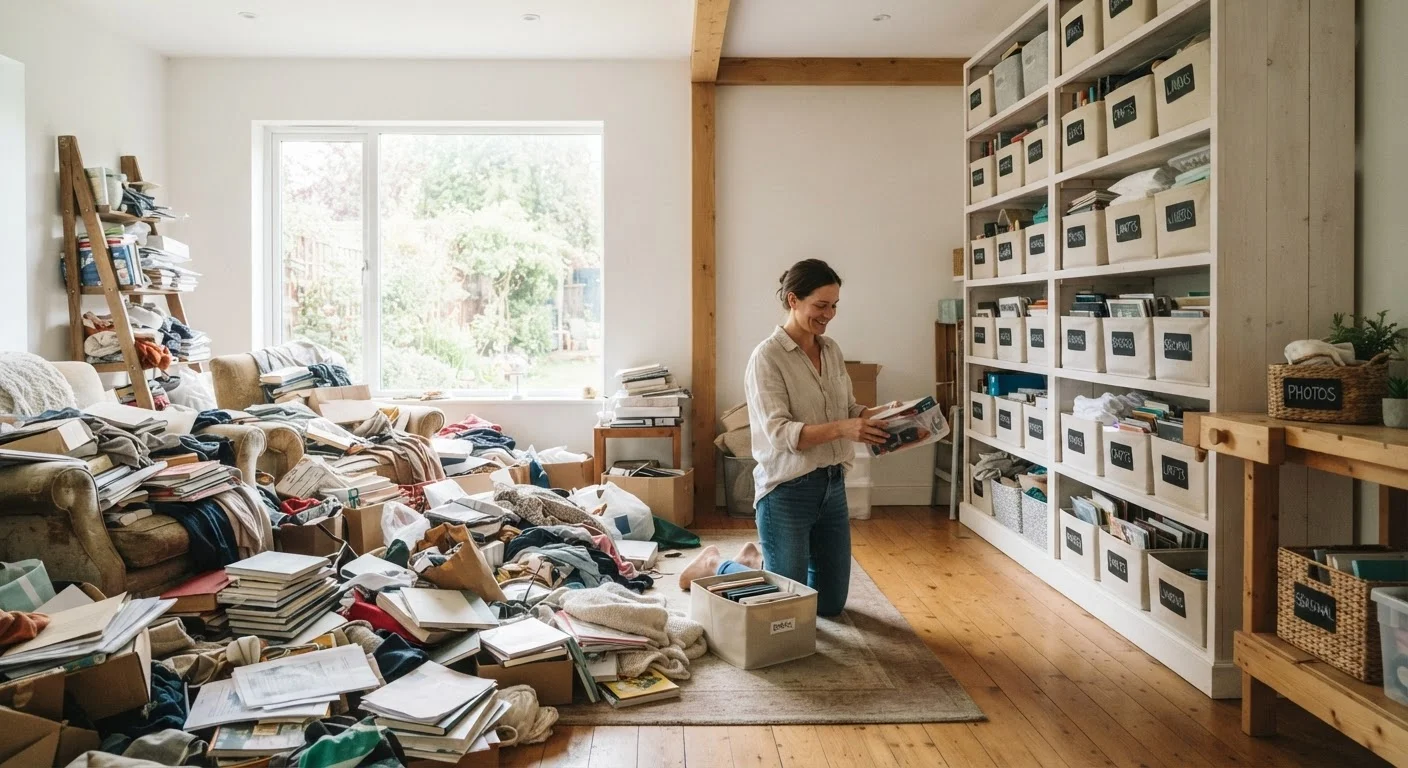
Most people treat decluttering and organising as interchangeable words for the same activity. They aren't. Decluttering is an act of subtraction — working through your belongings and deciding what genuinely earns its place in your life. Organising is an act of placement — creating logical, consistent homes for the things you've decided to keep.
Conflating the two is what leads to the familiar frustration: you spend a weekend sorting everything into labelled containers, and within two months the same chaos has crept back. That cycle isn't a willpower failure. It's a sequencing problem.
Think of it this way: organising a space that holds too much is like filing paperwork you haven't read yet. The papers are tidier, but you still haven't dealt with the ones that shouldn't be there at all. The reasons a tidy home still feels overwhelming often come down to this exact mismatch — surface order built on an unresolved foundation.
| Criterion | Decluttering | Organising |
|---|---|---|
| Core question | Does this belong in my life? | Where does this live? |
| Type of task | Decision-making and editing | Spatial and logistical |
| When to do it | Always first | After decluttering is complete |
| Common mistake | Skipping it entirely | Doing it before decluttering |
| Result if done correctly | Reduced volume to manage | Sustainable, returnable systems |
| Result if done out of order | Chaos returns quickly | Systems built on excess — need redoing |
Why Sequence Is the Whole Point
The logic becomes clear when you work through what each step actually requires.
Decluttering demands honest decision-making: Does this item reflect who I am now? Do I use it? Would I buy it again? That process is cognitively demanding and emotionally loaded. It works best when done without the distraction of simultaneously trying to create systems.
Organising, by contrast, is a spatial and logistical task. It asks: Where does this live? What container suits it? How often do I reach for it? These are easier questions — but only answerable once you know exactly what you're working with.
When people reverse the order, they end up designing systems around a volume of belongings that will later change. Shelving units get bought, drawer dividers get installed, and then — during the inevitable eventual declutter — half of what those systems were built to hold gets donated. The organising work has to be redone from scratch.
80%
Of clutter caused by disorganisation, not lack of space
Research cited by professional organising associations suggests the vast majority of clutter stems from too much volume rather than insufficient storage.
40%
Of household items rarely or never used
Studies on domestic storage habits consistently find a significant proportion of kept belongings are seldom or never accessed after being stored.
The same principle applies in other areas of intentional living. Skincare routine sequencing works on the same logic: doing steps out of order doesn't just reduce effectiveness — it can actively undermine results. Order is infrastructure, not detail.
Common Mistakes That Keep the Cycle Going
Buying storage before editing. This is the most widespread error. Attractive bins and baskets create the feeling of progress without requiring the harder work. If you find yourself shopping for organisation products before you've reduced your belongings, pause. The same pause-before-purchase discipline that applies to clothing works for home goods too.
Organising by category within a cluttered space. Grouping all your books, or all your kitchen gadgets, without first deciding which ones to keep means you're just making a tidier version of the same excess.
Skipping declutter entirely and relying on maintenance. Some people believe that if they just put things back consistently, the volume will regulate itself. In practice, belongings accumulate faster than habits manage them. The case for a single uncluttered surface illustrates what's possible when you reduce before you organise — even at a small scale.
When you're ready to work through your home room by room, the room-by-room decluttering checklist offers a structured, shame-free approach to the editing process. Organising follows naturally — and sustainably — once that foundation is in place. Building these habits into your daily routines is what makes the results stick.