

Key Takeaways
- A full-face routine offers creative control and coverage but requires significant time and skill.
- Heavy or occlusive products used daily can contribute to congestion and breakouts on some skin types.
- The 'right' amount of makeup is context-dependent — not a fixed standard.
- Consistency with fewer products often outperforms an ambitious routine that gets abandoned.
- Understanding each product's function helps you decide what your skin and schedule actually need.
Precise coverage for specific skin concerns
Layering targeted products lets you address redness, hyperpigmentation, or dark circles individually, achieving a result no single product can replicate.
Longer wear throughout the day
A properly layered routine — primer, foundation, powder, setting spray — significantly extends wear time compared to a single-product application.
Builds transferable technique and skill
Regular practice with a multi-step routine develops blending, color theory, and tool-handling skills that improve results across all levels of makeup application.
Supports creative expression and confidence
A full routine offers the most flexibility for experimenting with colour, structure, and finish — an important outlet for those who view makeup as a form of self-expression.
Acts as a meaningful daily ritual
The process itself can serve as a focused, intentional transition — particularly useful for those who work from home and benefit from a structured start-of-day cue.
Significant daily time commitment
A careful full-face application typically takes 20–40 minutes, which is difficult to sustain consistently across a busy week without shortcuts that compromise the result.
Potential to contribute to skin congestion
Daily use of occlusive or pore-blocking formulations — particularly without thorough double cleansing — can lead to clogged pores, milia, or increased breakout frequency on susceptible skin types.
High product and maintenance cost
A full lineup requires purchasing, replacing, and maintaining a wider range of products, and the financial and storage demands add up over time.
Complexity reduces long-term consistency
More steps mean more decision fatigue and more opportunities to skip the routine entirely on difficult mornings, undermining the discipline needed for any habitual practice.
Steeper learning curve for beginners
Achieving a blended, cohesive full-face look requires practiced technique; beginners attempting too many steps at once often produce results that feel discouraging rather than motivating.
Our Verdict
A full-face routine is a legitimate and rewarding practice when it aligns with your schedule, skin type, and genuine desire for that level of finish. It delivers coverage, polish, and creative expression that a minimal look simply cannot. However, if time is tight or your skin reacts to layered products, a streamlined approach is not a compromise — it's often the smarter, healthier choice.
Best suited for those with the time, skin tolerance, and interest in makeup artistry who want a consistent, polished finish for specific occasions or daily preference.
What 'Full Face' Actually Means
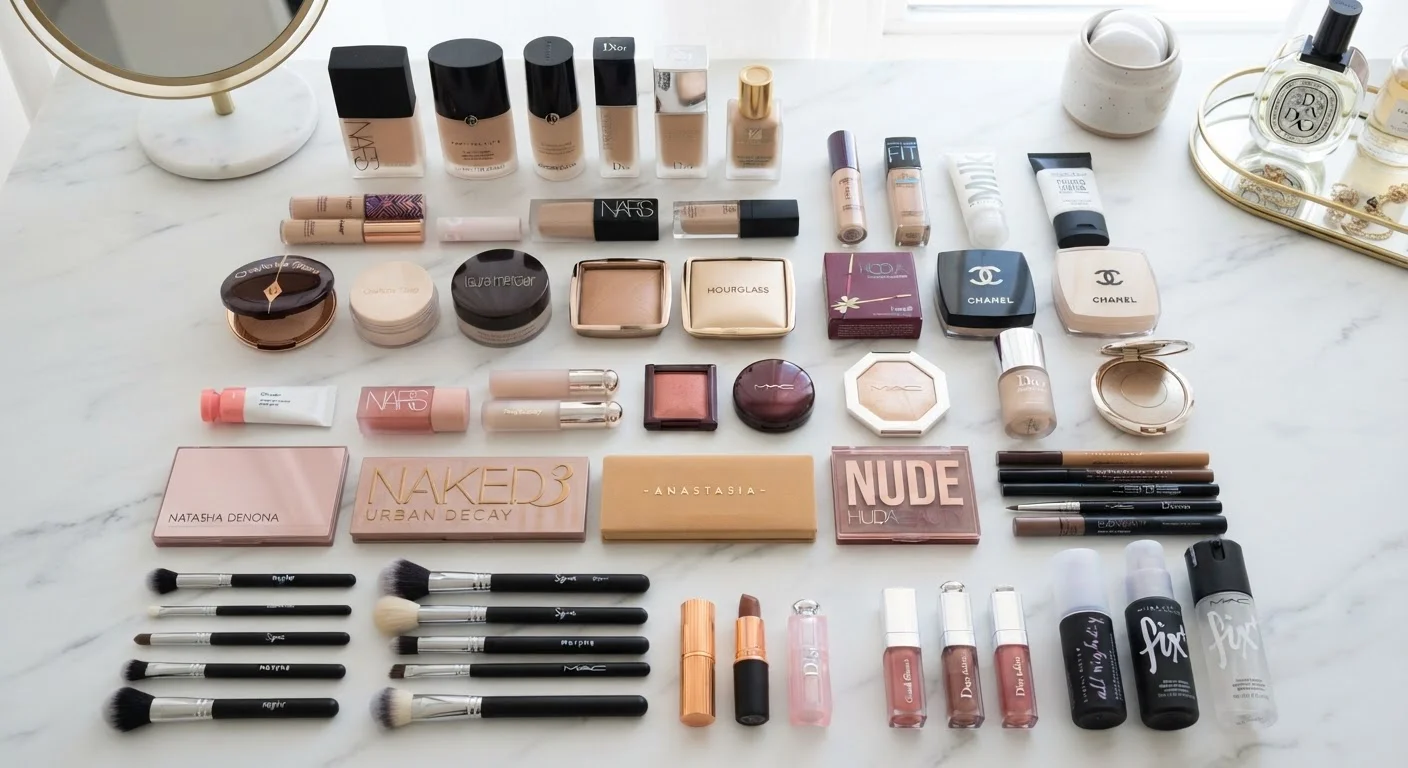
A full-face makeup routine typically involves layering multiple products in a defined sequence: primer, foundation or skin tint, concealer, setting powder, contour or bronzer, blush, highlight, eye shadow, liner, mascara, and a lip product. That can represent anywhere from eight to fourteen individual steps depending on how granularly you break it down.
It's worth defining this clearly because 'full face' means different things to different people. For some, it means a perfected base with a bold eye. For others, it includes cut-crease shadow, precise brow shaping, and a setting spray finish. Before weighing the pros and cons, understanding where your version of a full routine actually lands on that spectrum helps you apply this analysis honestly to your own habits. For a structured way to build skills progressively, see this skill-level guide.
The Case For a Full-Face Routine
The most straightforward argument for a complete routine is coverage and finish control. A layered approach lets you address specific concerns — redness, uneven tone, dark circles — with targeted products rather than asking a single item to do everything. The result is typically more refined and longer-lasting than a minimal application.
Precise coverage for specific skin concerns
Layering targeted products lets you address redness, hyperpigmentation, or dark circles individually, achieving a result no single product can replicate.
Longer wear throughout the day
A properly layered routine — primer, foundation, powder, setting spray — significantly extends wear time compared to a single-product application.
Builds transferable technique and skill
Regular practice with a multi-step routine develops blending, color theory, and tool-handling skills that improve results across all levels of makeup application.
Supports creative expression and confidence
A full routine offers the most flexibility for experimenting with colour, structure, and finish — an important outlet for those who view makeup as a form of self-expression.
Acts as a meaningful daily ritual
The process itself can serve as a focused, intentional transition — particularly useful for those who work from home and benefit from a structured start-of-day cue.
There's also a skill-building dimension. Regularly practicing with a full product lineup is how most people develop blending, color-matching, and application technique. Each session is effectively practice. If you're building a makeup kit from the ground up, this guide to first-kit essentials helps distinguish which products merit the learning curve and which don't.
Finally, a full routine can serve as a deliberate ritual — a focused window of time that functions as a transition between contexts, particularly for women who work from home and benefit from a visible cue that the workday has begun.
The Case Against a Full-Face Routine
The most practical objection is time. A thorough full-face application, done carefully, takes 20–40 minutes — a non-trivial daily commitment that compounds across a week or month. When that time isn't available, the routine either gets rushed (undermining results) or abandoned entirely.
Significant daily time commitment
A careful full-face application typically takes 20–40 minutes, which is difficult to sustain consistently across a busy week without shortcuts that compromise the result.
Potential to contribute to skin congestion
Daily use of occlusive or pore-blocking formulations — particularly without thorough double cleansing — can lead to clogged pores, milia, or increased breakout frequency on susceptible skin types.
High product and maintenance cost
A full lineup requires purchasing, replacing, and maintaining a wider range of products, and the financial and storage demands add up over time.
Complexity reduces long-term consistency
More steps mean more decision fatigue and more opportunities to skip the routine entirely on difficult mornings, undermining the discipline needed for any habitual practice.
Steeper learning curve for beginners
Achieving a blended, cohesive full-face look requires practiced technique; beginners attempting too many steps at once often produce results that feel discouraging rather than motivating.
Skin health is a second substantive concern. Some occlusive or comedogenic ingredients found in certain primers, full-coverage foundations, and setting powders can contribute to congestion, milia, or breakouts when applied daily — particularly over skin that isn't fully prepped or thoroughly cleansed afterward. This doesn't mean all full-coverage products are problematic, but the risk scales with frequency and product formulation. The skincare routines hub covers how to maintain a healthy base if you do wear makeup regularly.
There's also the issue of complexity as a barrier to consistency. Research in habit formation consistently shows that simpler routines are more sustainable. A pared-back look you execute reliably tends to serve you better than a polished routine you abandon by Wednesday. When a minimal routine outperforms a complex one explores this trade-off in more depth.
Finding the Practical Middle Ground
The most useful framework here is context-matching: calibrating your routine to what a given day actually requires rather than defaulting to either extreme. A full face for a presentation, a client meeting, or an event makes clear sense. A full face for a grocery run or a home work session may not be worth the time or the skin load.
The Middle-Ground Approach Worth Considering
Rather than treating 'full face' and 'no makeup' as the only options, many experienced wearers build a rotating set of looks — a complete routine for select occasions, a three-to-five product version for everyday use. This approach preserves the skill and the ritual while substantially reducing daily wear on the skin and the clock. It also makes the full routine feel more deliberate when you do apply it.
If you want the polished look of a full routine without the full step count, focusing on three high-impact products — a skin-evening base, a blush, and one eye product — can close most of the gap. See the five products that build a versatile everyday look for a curated starting point. And if longevity is your concern on days when you do go full-face, this morning checklist for long-wear results walks through how to make that effort last.
This article is for general informational purposes only and does not constitute medical or dermatological advice. Consult a qualified professional for concerns about skin conditions or reactions.