

Key Takeaways
- Undertone is different from skin tone — it's the underlying hue that stays constant regardless of tan or season.
- The three undertone categories are warm, cool, and neutral — each responds differently to makeup pigments.
- Matching foundation to your undertone prevents the common "masked" or ashy look.
- Your undertone also guides which clothing colors and jewelry metals will look most harmonious on you.
- Simple at-home tests — like checking your veins or how your skin reacts to gold vs. silver — can identify your undertone reliably.
Skin Undertone
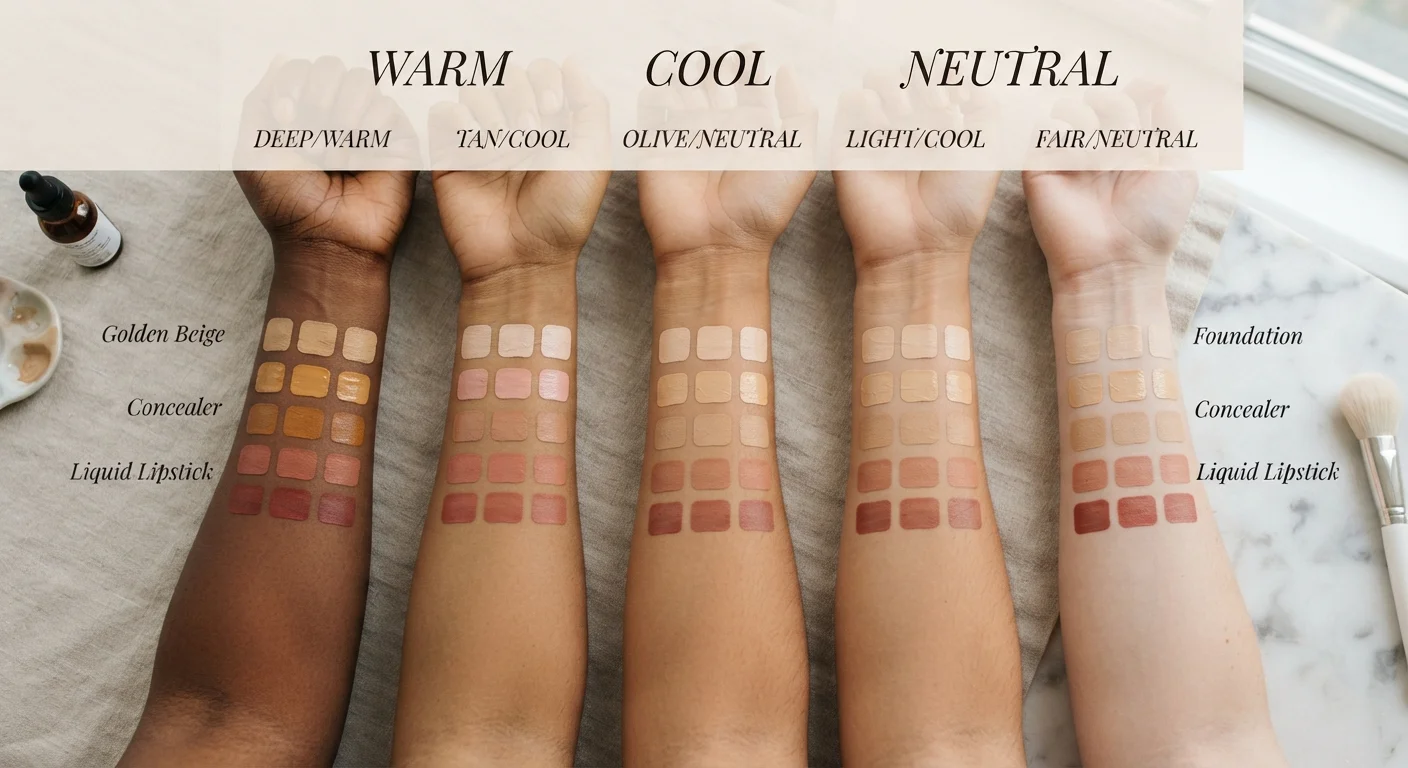
Your skin undertone is the subtle hue that lives beneath the surface of your skin, distinct from your skin tone (how light or dark your skin appears). Undertones are typically categorized as warm (yellow, peachy, or golden), cool (pink, red, or bluish), or neutral (a balance of both). Unlike your surface tone, which can change with sun exposure or seasons, your undertone remains consistent throughout your life.
Undertone is determined by the mix of melanin, hemoglobin, and carotenoids visible through the skin's translucent upper layers — making it a stable biological characteristic rather than a cosmetic classification.
Tone vs. Undertone: A Critical Distinction
Most people learn to match foundation by shade — fair, medium, tan, deep — and stop there. But shade matching alone explains why so many foundations look "off" even when the depth is technically correct. The missing variable is undertone.
Your skin tone describes surface depth: how light or dark your skin appears. It's what shifts after a summer holiday or fades in winter. Your undertone, by contrast, is the permanent hue cast that lives beneath that surface layer. Two people can have the same medium skin tone while one has distinctly peachy-warm skin and the other a clearly cool-pink complexion — and they will look completely different in the same foundation.
This distinction matters because makeup pigments interact with your undertone, not your surface tone. A foundation with yellow-warm undertones applied to a cool-toned skin will look sallow or muddy. A cool-pink formula on warm skin can look ashy or washed out. Getting the depth right while ignoring undertone is like buying shoes in the right style but the wrong width — technically close, but uncomfortable in practice.
Surface Tone and Undertone Are Independent
It's a common misconception that darker skin tones must have warm undertones or lighter skin must be cool. In reality, every depth of skin — from the fairest to the deepest — can carry warm, cool, or neutral undertones. Your undertone says nothing about how light or dark your skin is; it describes only the hue beneath the surface.
The Three Undertone Categories and How to Identify Yours
Undertones fall into three broad groups. Understanding each one makes self-identification much more straightforward.
- Warm undertones have golden, yellow, or peachy casts. Skin may tan easily and rarely burns severely. Gold jewelry typically looks more harmonious than silver.
- Cool undertones carry pink, red, or bluish hues. Skin may burn more easily in the sun. Silver jewelry generally sits more naturally against the skin.
- Neutral undertones are a balanced mix of warm and cool — neither dominates. Both gold and silver jewelry work, and neither explicitly warm nor cool foundations look jarring.
Reliable At-Home Tests
- The vein test: Look at the inside of your wrist in natural light. Greenish veins suggest warm undertones (the yellow in your skin makes blue veins look green). Bluish or purple veins suggest cool undertones. A mix of both points to neutral.
- The jewelry test: Hold gold and silver against your bare skin. Which makes your complexion look brighter and more alive? Gold indicates warm; silver indicates cool; both working equally well suggests neutral.
- The white paper test: Hold a plain white sheet next to your bare, unmade-up face in daylight. Note the color your skin reflects — yellow-orange casts indicate warm, pink-grey casts indicate cool.
No single test is definitive, but if two or three tests point consistently in the same direction, you have a working answer.
3
Primary undertone categories used in makeup formulation
Warm, cool, and neutral are the standard classification system used across the cosmetics industry for foundation and concealer undertone matching.
~60%
Foundation returns attributed to wrong undertone
Industry estimates from cosmetics retailers suggest the majority of foundation returns involve undertone mismatch rather than incorrect shade depth.
How Undertone Shapes Your Foundation Choice
Foundation formulas are labeled in ways that hint at undertone, though labeling isn't always consistent across brands. Common indicators include letters like W (warm), C (cool), N (neutral), or descriptors like "golden," "porcelain," "beige," "rose," or "sand." Learning to read these alongside the shade number — rather than relying on shade number alone — dramatically improves your chances of a match without a professional consultation.
When testing a foundation, always swatch it along your jawline in natural daylight. The jawline is the blending zone between face and neck, so it's the most diagnostic location. A correct match disappears into the skin with no visible line. If the swatch pulls yellow or orange on your skin, the formula is too warm. If it looks greyish or pink-toned, it's too cool.
For a deeper dive into choosing between different coverage formats once you've nailed your undertone, see our guide to tinted moisturiser, BB cream, and foundation — the undertone principles apply equally across all three formats.
Test Foundation in Natural Daylight
Store lighting — especially fluorescent overhead light — is notorious for masking undertone mismatches. If possible, swatch a foundation on your jawline and step outside, or stand near a window, before deciding it's a match. What looks seamless under artificial light can reveal a distinct warm or cool pull in natural daylight.
Beyond Foundation: Undertone's Wider Role in Your Look
Once you understand your undertone, you can apply that knowledge far beyond foundation. It becomes a quiet organizing principle for makeup, clothing, and even metal choices.
Eyeshadow: Warm undertones tend to look particularly vibrant with bronze, terracotta, peach, and gold shadows. Cool undertones respond well to taupe, mauve, silver, and cool-brown tones. Our guide to neutral eyeshadow palettes explains how to work within these parameters without limiting your range.
Blush and bronzer: Warm-toned blushes (peach, coral, warm rose) integrate more naturally on warm undertones. Cool-toned or berry-leaning blushes sit better on cool complexions. Neutral undertones have the most flexibility here, though balance remains key.
Clothing color: Undertone informs which color families feel cohesive against your skin — a principle explored in detail in how color defines the way you dress. Warm undertones often feel most at ease in earthy, amber, and warm-toned garments; cool undertones lean into jewel tones, icy shades, and cool neutrals. This doesn't mean you're limited to those families — it means those colors require less effort to make work.
Understanding your undertone won't restrict your choices — it will make them more deliberate and consistently successful. It's one of those foundational pieces of knowledge that pays dividends every time you stand in front of a mirror.
This article is for informational and educational purposes only and does not constitute professional medical or dermatological advice. If you have concerns about your skin health, consult a qualified dermatologist or healthcare professional.