

Key Takeaways
- Fast furniture offers genuine affordability, but durability and environmental costs are real trade-offs worth knowing.
- Lower upfront prices can mask higher long-term replacement costs over time.
- Environmental impact — from materials to shipping to landfill — is significant but not always visible at the point of purchase.
- Secondhand, solid-wood, and modular options each offer different compromises worth considering.
- There is no universally right approach — your living situation, budget, and priorities all matter.
Low upfront cost makes furnishing accessible
For people on limited budgets or those setting up a home quickly, fast furniture dramatically lowers the barrier to having a functional, decent-looking space without significant financial strain.
Wide availability and fast delivery
Mass-market furniture retailers have extensive distribution networks, meaning most items are available quickly — often within days — without the long lead times associated with custom or artisan pieces.
Practical for temporary or transitional living
Renters who move frequently, people relocating for work, or anyone in a transitional phase benefit from furniture that doesn't represent a high-stakes financial or emotional investment.
Trend-responsive design at low risk
Fast furniture allows people to try out styles — an arched mirror, a fluted sideboard — without committing significant money to a look they might outgrow or redecorate around.
Shorter lifespan drives higher long-term cost
A $150 dresser replaced every three to four years costs more over a decade than a $400 solid-wood equivalent. The math isn't always obvious at point of purchase, but it compounds over time.
Composite materials are difficult to repair
Particleboard and MDF don't respond well to refinishing, sanding, or structural repair the way solid wood does — meaning a damaged piece is typically replaced rather than fixed.
Significant environmental footprint
Fast furniture contributes meaningfully to landfill volume; the adhesives and laminates used in composite board make items difficult to recycle, and low resale value means pieces are rarely rehomed.
Formaldehyde and off-gassing concerns
Some engineered wood products use adhesives that can off-gas volatile organic compounds (VOCs), particularly when new. Ventilating newly assembled pieces and researching certification standards (such as CARB Phase 2 compliance) is advisable.
Lower structural integrity under heavy use
Cam-lock and dowel assembly systems common in flat-pack furniture can loosen over time with regular movement or heavy loads, reducing stability in ways that aren't always apparent from product listings.
Our Verdict
Fast furniture isn't inherently wrong, but it works best as a deliberate choice rather than a default one. Understanding what you're trading — longevity, environmental footprint, and sometimes quality — lets you decide when it genuinely makes sense and when another approach might serve you better in the long run.
Best for renters, people in transition, or those furnishing temporary spaces who need functional pieces at low upfront cost and aren't expecting items to last a decade.
What 'Fast Furniture' Actually Means
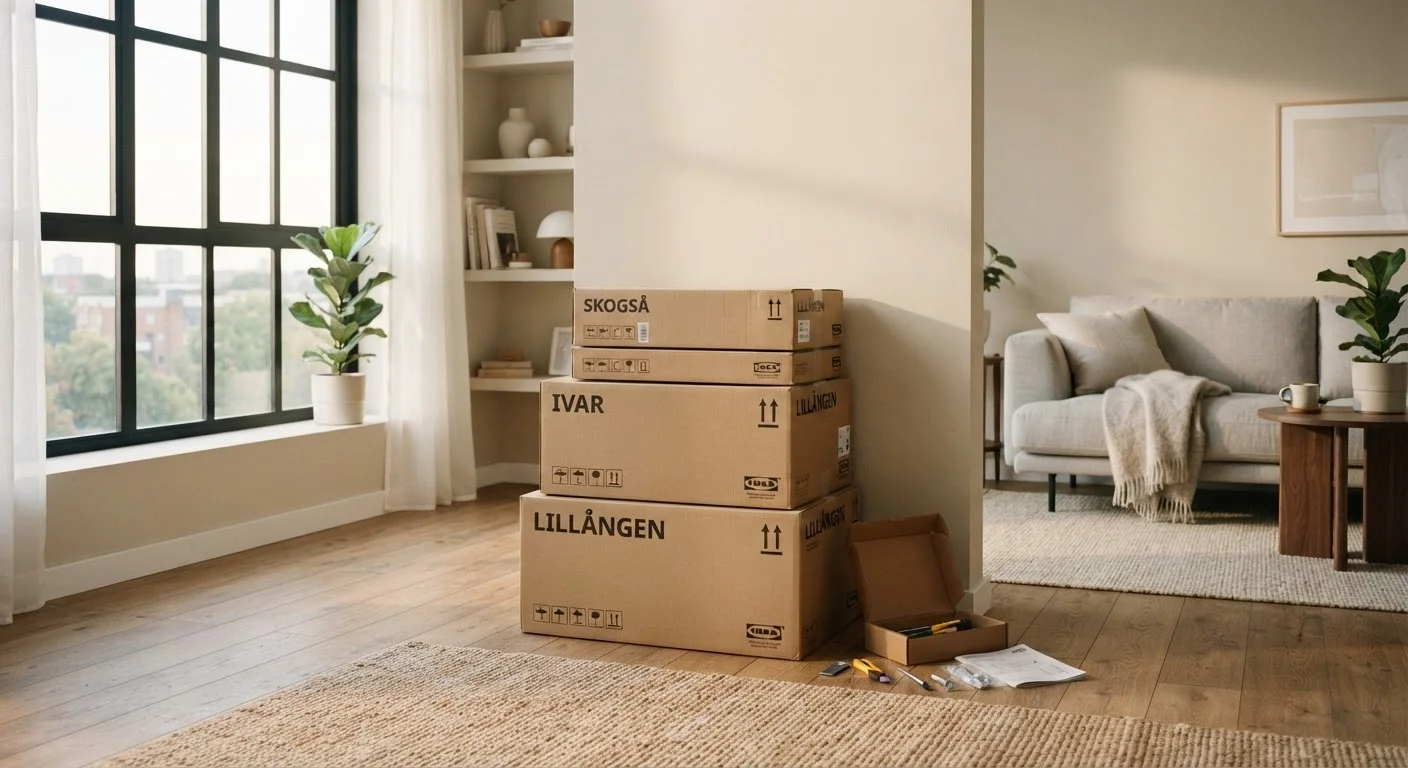
The term fast furniture borrows its framing from fast fashion: mass-produced, trend-responsive pieces manufactured at high volume and sold at low price points. Think flat-pack shelving, pressed-wood bed frames, and particle-board dressers — items designed to be accessible, easy to ship, and quick to assemble.
The category spans a wide range of retailers and price tiers, but the defining characteristics tend to be the same: engineered wood composites rather than solid timber, streamlined supply chains, and designs that prioritize visual appeal over longevity. That's not a condemnation — it's a description. And understanding those characteristics is what allows you to make a more deliberate decision.
Much like the conversation around wardrobe building, the fast-versus-slow divide in furniture isn't simply about price. It's about what you're optimizing for — and whether that matches your actual life. Rethinking quality versus quantity applies just as usefully to a bookcase as it does to a cashmere sweater.
The Genuine Advantages
Fast furniture's appeal is real, and it's worth naming honestly before weighing the costs.
Low upfront cost makes furnishing accessible
For people on limited budgets or those setting up a home quickly, fast furniture dramatically lowers the barrier to having a functional, decent-looking space without significant financial strain.
Wide availability and fast delivery
Mass-market furniture retailers have extensive distribution networks, meaning most items are available quickly — often within days — without the long lead times associated with custom or artisan pieces.
Practical for temporary or transitional living
Renters who move frequently, people relocating for work, or anyone in a transitional phase benefit from furniture that doesn't represent a high-stakes financial or emotional investment.
Trend-responsive design at low risk
Fast furniture allows people to try out styles — an arched mirror, a fluted sideboard — without committing significant money to a look they might outgrow or redecorate around.
For renters who move frequently, people setting up a first apartment, or anyone furnishing a space they know is temporary, low-cost furniture that does the job without demanding a long-term commitment is genuinely useful. Flexibility matters.
The Hidden Trade-Offs
The drawbacks of fast furniture are less visible at the point of purchase — which is precisely why they're worth knowing in advance.
Shorter lifespan drives higher long-term cost
A $150 dresser replaced every three to four years costs more over a decade than a $400 solid-wood equivalent. The math isn't always obvious at point of purchase, but it compounds over time.
Composite materials are difficult to repair
Particleboard and MDF don't respond well to refinishing, sanding, or structural repair the way solid wood does — meaning a damaged piece is typically replaced rather than fixed.
Significant environmental footprint
Fast furniture contributes meaningfully to landfill volume; the adhesives and laminates used in composite board make items difficult to recycle, and low resale value means pieces are rarely rehomed.
Formaldehyde and off-gassing concerns
Some engineered wood products use adhesives that can off-gas volatile organic compounds (VOCs), particularly when new. Ventilating newly assembled pieces and researching certification standards (such as CARB Phase 2 compliance) is advisable.
Lower structural integrity under heavy use
Cam-lock and dowel assembly systems common in flat-pack furniture can loosen over time with regular movement or heavy loads, reducing stability in ways that aren't always apparent from product listings.
~12M tons
Furniture sent to US landfills annually
According to US Environmental Protection Agency estimates, Americans discard around 12 million tons of furniture each year, with the majority going to landfill rather than recycling or reuse.
80%
Share of discarded furniture not recycled
EPA material flow data suggests the large majority of furniture waste is landfilled rather than recovered, reflecting the difficulty of recycling composite and upholstered materials.
The environmental dimension is particularly easy to underestimate. Fast furniture contributes to a significant volume of landfill waste, largely because the composite materials used — medium-density fiberboard, particleboard, melamine wrap — are difficult to repair, hard to recycle, and have little secondhand value. This is one area where the trade-offs of more intentional living become genuinely tangible rather than abstract.
What to Consider Instead — or Alongside
Stepping back from fast furniture doesn't require a single wholesale alternative. There are several directions worth exploring depending on your constraints.
- Secondhand and vintage pieces — solid-wood furniture from earlier decades is often more durable than new equivalents at comparable price points. Thrift stores, estate sales, and online marketplaces are worth browsing before buying new.
- Modular systems — some furniture lines are designed for longevity and adaptability, with interchangeable parts and replacement components. These typically cost more upfront but can adapt as your space changes.
- Selective investment — not every piece needs to last twenty years. A strategy that concentrates spending on high-use items (a sofa, a bed frame, a dining table) while using budget options elsewhere is a reasonable middle path.
This connects to a broader conversation about values-based spending — the idea that aligning purchases with longer-term priorities doesn't mean spending more everywhere, but choosing deliberately where durability matters. Understanding the trade-offs of a values-based budget can help frame that thinking practically.
A Note on 'Sustainable' Furniture Claims
Some furniture retailers market products as eco-friendly or sustainable, but the claims can vary significantly in what they actually cover — whether that's material sourcing, manufacturing processes, or end-of-life recyclability. Third-party certifications such as FSC (Forest Stewardship Council) for wood sourcing or GREENGUARD for chemical emissions provide more verifiable benchmarks than general marketing language. It's worth checking what a sustainability claim specifically refers to before weighing it in your decision.
Making the Decision That Fits Your Life
There's no universally correct answer here, which is worth saying plainly. Someone furnishing a studio apartment on a tight timeline has genuinely different needs than someone designing a home they intend to stay in for a decade. Both deserve thoughtful options, not judgment.
What helps most is clarity about your own situation: How long do you plan to stay? How heavily will this piece be used? What's the realistic replacement cost if it wears out in three years rather than ten? Asking those questions before purchasing — rather than after assembling — shifts the decision from reactive to intentional.
If you're also thinking about how your physical environment reflects your broader approach to daily life, slow living doesn't require an aesthetic overhaul — sometimes it's simply about making more considered choices, one piece at a time.