

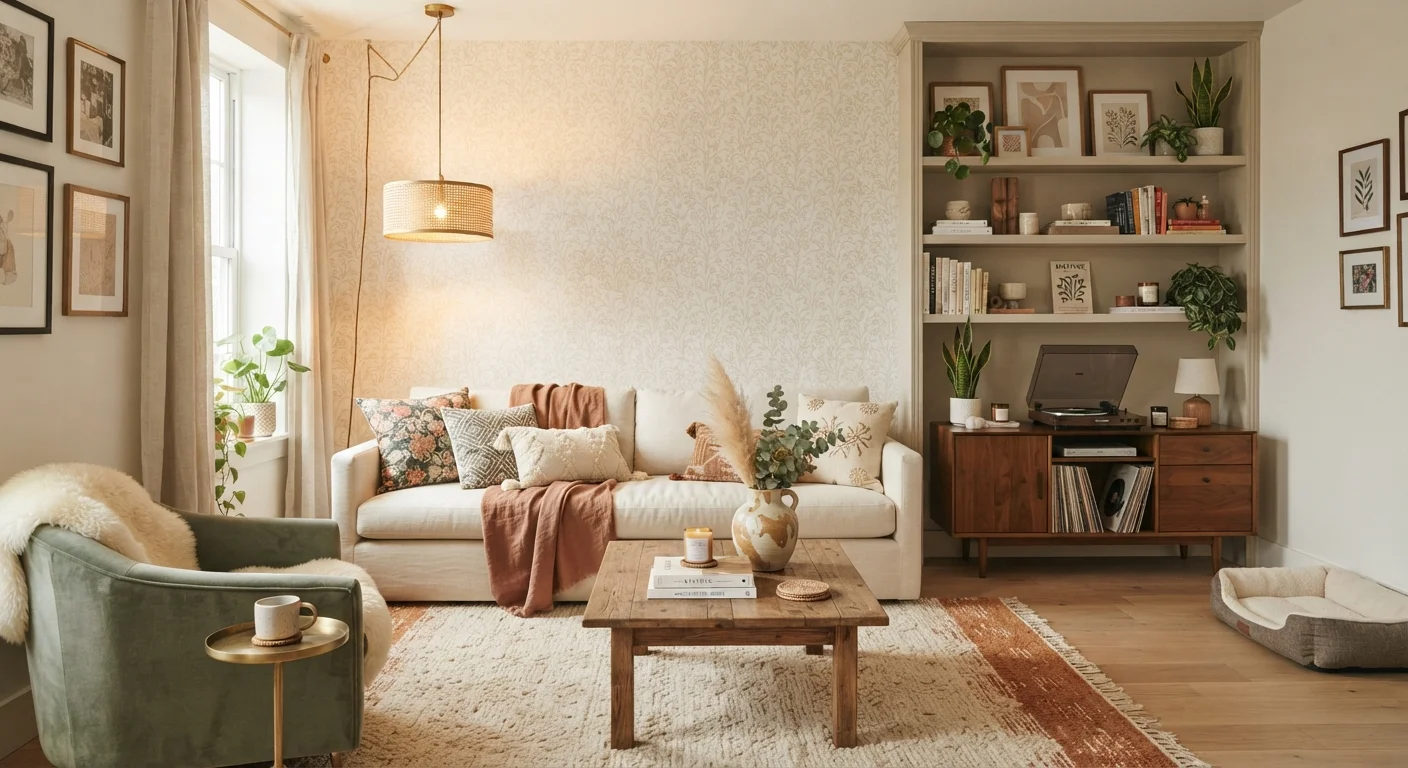
Key Takeaways
- Reading your lease carefully before making any changes protects your deposit and your peace of mind.
- Removable wallpaper, peel-and-stick tiles, and renter-friendly hooks transform walls without damage.
- Furniture arrangement and scale matter more than ownership status — renters have full control here.
- Swapping in warm-toned bulbs and adding floor lamps costs little but changes a room's entire mood.
- Textiles — rugs, curtains, cushions — do more decorative work per dollar than almost any other element.
- Documenting every change with photos before and after is your strongest protection at move-out.
Know Your Lease Before You Style Anything
The most common mistake renters make isn't a décor choice — it's skipping the lease entirely and learning the rules only when the landlord flags a problem. Before hanging a single frame or rolling out a rug, read your rental agreement with genuine attention. Look specifically for language about painting, drilling, adhesives, alterations, and the definition of "normal wear and tear."
Most standard leases prohibit structural changes but say little about furniture, lighting accessories, or removable materials. If a clause is ambiguous, ask your landlord in writing — a quick email exchange costs nothing and creates a paper trail. Some landlords are more flexible than their standard lease implies, particularly if you offer to return the space to its original condition.
For a deeper look at what's typically possible within lease constraints, see what's actually possible in a rented home. Understanding the rules is what makes creative freedom within them feel genuinely liberating.
Get Permission in Writing
If your landlord verbally agrees to let you paint an accent wall or install a light fixture, follow up with a brief email confirming the conversation. A written record protects both parties and removes ambiguity when you move out. Even a short message saying 'just confirming what we discussed' is sufficient.
Walls: The Biggest Visual Opportunity
Bare, landlord-white walls are the defining frustration of renting — and the area where the market for renter-friendly solutions has grown most dramatically. Removable wallpaper (also called peel-and-stick wallpaper) is now widely available in hundreds of patterns and textures. Applied carefully to clean, dry walls, it installs in under an hour and peels away cleanly when you leave, leaving no residue behind when used as directed.
For a more minimal approach, gallery walls built with adhesive picture-hanging strips — the kind designed to hold frames damage-free — work well for lighter frames. A single oversized mirror leaned against a wall rather than mounted creates visual depth with zero commitment. Washi tape, when used to outline geometric shapes or frame a section of wall, adds graphic interest and removes without marking paint.
44 million
Renter households in the US
According to US Census Bureau data, approximately 44 million households in the United States rent their homes rather than own them.
~36%
Share of US households that rent
Roughly one in three American households rents, meaning rental-friendly design is a genuinely mainstream need, not a niche concern.
Floating shelves mounted with removable adhesive systems can hold lightweight objects and plants, layering visual interest vertically. The key is staying within each product's stated weight limit — which is genuinely important, not just fine print.
Furniture and Layout: Your Greatest Leverage
Renters own their furniture outright, which means arrangement is entirely within your control. Yet furniture layout is one of the most underused tools in rental styling. Most people push everything against the walls; pulling pieces inward, even by eighteen inches, creates a sense of curated intention rather than storage.
Scale matters more than volume. One well-proportioned sofa and a single side table of real visual weight will do more for a room than four mismatched pieces accumulated over time. If your rental is compact, our guide to small-space living principles offers practical approaches to furniture selection and negative space. For renters sharing a home, navigating shared spaces addresses the specific challenge of styling with a housemate's needs in mind.
Furniture with dual purpose — a storage ottoman, a console that doubles as a desk — is especially valuable in rentals where built-in storage is often minimal.
Lighting: The Detail That Changes Everything
Overhead lighting in rental apartments is frequently harsh, low, or poorly positioned — and almost always replaceable with a little thought. You cannot usually rewire or install new fixtures, but you can supplement aggressively. A floor lamp in a dark corner, a table lamp on a sideboard, and warm-toned LED bulbs in every overhead socket will transform the mood of a space more dramatically than almost any furniture purchase.
Plug-in pendant lights — which hang from a ceiling hook and plug into a standard outlet — have become a genuine design solution, not just a workaround. They require only a small adhesive hook or a single screw to the ceiling, both of which patch easily at move-out. String lights used intentionally (rather than draped loosely) can frame a headboard, line a bookshelf, or illuminate a reading nook.
Swap the bulbs in every overhead fixture on move-in day — warm white LEDs (around 2700K) cost a few dollars and immediately make a rental feel less institutional.
Colour temperature has a documented effect on how spaces feel. Harsh cool-white bulbs (5000K+) are energising in offices but read as clinical in homes; warm white mimics the glow of incandescent light that most people associate with comfort.
When styling open shelving, follow the thirds rule: one-third books or stacked objects, one-third single statement pieces, one-third empty space. Resist the urge to fill every inch.
Visual rest is what separates a curated shelf from a cluttered one. Negative space allows the eye to land and move deliberately, making individual objects feel chosen rather than accumulated.
For rooms that feel particularly dim, consider whether window treatments are part of the problem. Heavy landlord-installed blinds can be unhooked, stored safely, and replaced temporarily with sheer panels that dramatically increase natural light.
Textiles, Objects, and the Art of Layering
No element of a room is more transformative per dollar than textiles. A large area rug grounds a living space, softens noise, and defines zones — all without touching a single wall. Layering a smaller rug on top adds texture and personality. Curtains hung from tension rods or clip-on rings (requiring no drilling) instantly make a window feel finished; choosing a length that pools slightly on the floor signals intentionality.
Cushions, throws, and bedding are the fastest way to inject colour and pattern into a neutral rental without any permanence. The design principle of using pattern in at most two of those three layers keeps a space cohesive rather than chaotic.
Objects — books, ceramics, plants, art leaned against surfaces — complete the picture. Plants in particular do work that no purchased item can replicate: they introduce organic shape, living colour, and the sense that a space is genuinely inhabited. You can explore how personal aesthetic thinking extends beyond interiors in the personal style hub.
Moving Out Without Losing Your Deposit
A well-styled rental is only a success if you leave it cleanly. The single most protective habit is documentation: photograph every room in detail on the day you move in, and again before you move out. Pay close attention to pre-existing marks, scratches, and wall scuffs — these are the source of most deposit disputes.
When removing adhesive hooks or strips, follow the manufacturer's removal instructions precisely, including pulling at the specified angle and removing slowly. Most damage from these products comes from rushing the removal, not the product itself. Touch-up paint in the original wall colour (ask your landlord for the exact shade on move-in) covers minor scuffs with minimal effort.
Return any landlord fixtures — light fittings, blinds, hardware — that you temporarily swapped out, and keep them stored safely throughout your tenancy. A thoughtful move-out is the final act of good renter design: it protects your financial interests and leaves the space ready for whoever comes next.
For how intentional curation applies to other areas of life, consider the renting-versus-owning question in fashion — a parallel exercise in living beautifully with what you have access to, rather than what you own outright.
Deposit Disputes Begin at Move-In
The time to protect your deposit is on day one, not move-out day. Document every pre-existing mark, stain, or damage with timestamped photographs, and ideally share this with your landlord by email so there is a clear record of condition. Many tenants lose deposit money not because they caused damage, but because they cannot prove they didn't.