

| Most breathable natural fibre | Linen (Textile industry consensus) |
| Most commonly used fabric globally | Cotton (FAO / global textile production data) |
| Fabric that retains warmth when wet | Wool (Wool fibre properties, industry standard) |
| Most delicate common fabric | Silk (Apparel care guidelines) |
| Semi-synthetic fabric made from wood pulp | Viscose (Rayon) (Textile science) |
| Synthetic fabric most resistant to moisture | Polyester (Performance fabric standards) |
Why Fabric Knowledge Matters Before You Buy
The fabric content label is one of the most informative — and most ignored — pieces of information on any garment. It determines how a piece will feel against your skin, how it will age with repeated washing, whether it will hold its shape through a full workday, and whether it can realistically live in your wardrobe for years rather than seasons.
Building a wardrobe around pieces that truly last starts with understanding what they're made from. When you know that a linen shirt will soften beautifully over time but crease readily, or that a viscose blouse drapes elegantly but demands gentle handling, you can make buying decisions with genuine clarity. This glossary is your quick-reference guide. Use it alongside our wardrobe essentials guide for a complete foundation.
| Most breathable natural fibre | Linen (Textile industry consensus) |
| Most commonly used fabric globally | Cotton (FAO / global textile production data) |
| Fabric that retains warmth when wet | Wool (Wool fibre properties, industry standard) |
| Most delicate common fabric | Silk (Apparel care guidelines) |
| Semi-synthetic fabric made from wood pulp | Viscose (Rayon) (Textile science) |
| Synthetic fabric most resistant to moisture | Polyester (Performance fabric standards) |
Natural Fibres: Cotton, Linen, Wool, and Silk
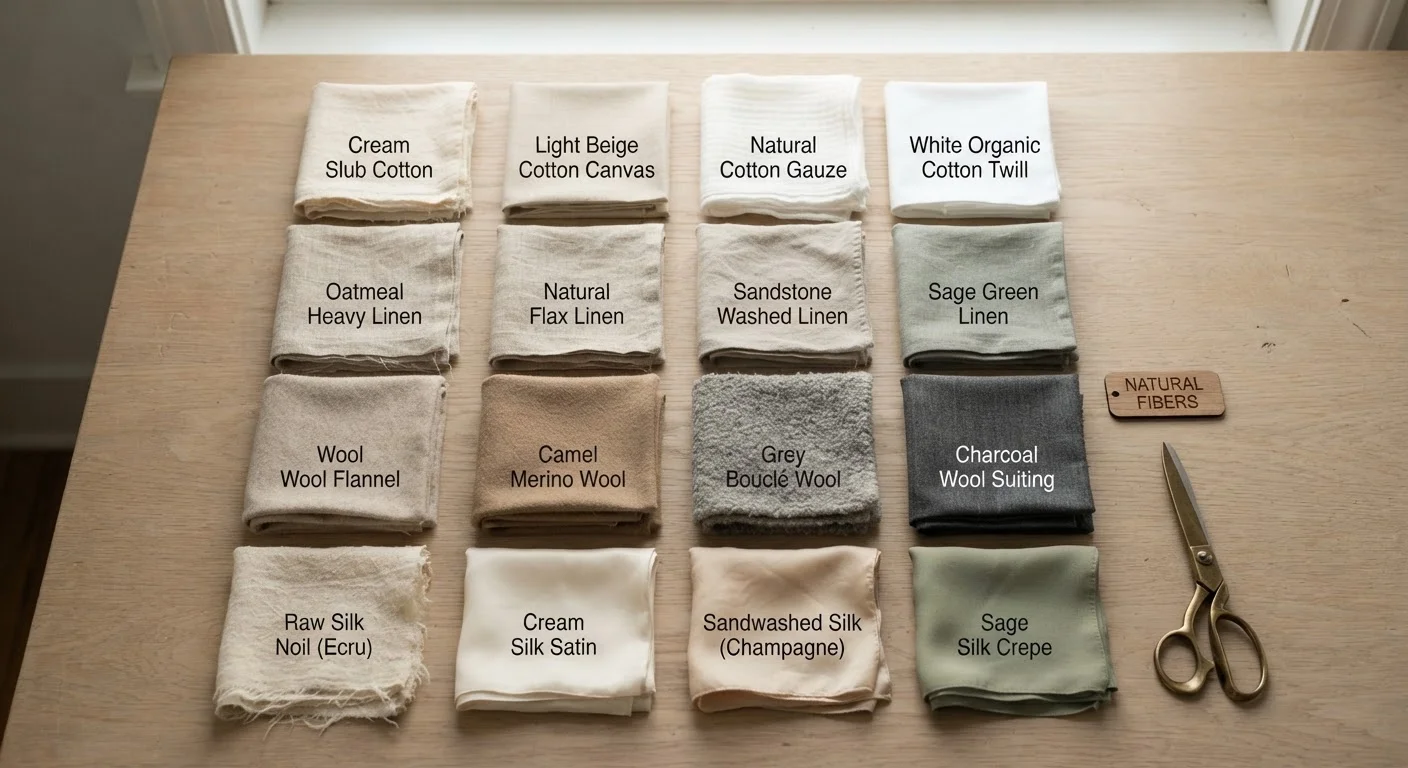
Cotton is the most widely worn natural fibre in the world — versatile, washable, and comfortable across seasons. It absorbs moisture well but can shrink if washed in hot water. Heavier cotton weaves (denim, canvas) are more durable; lighter ones (poplin, lawn) are breathable but less forgiving of rough handling. Opt for tightly woven cotton in workwear basics and loosely woven styles for relaxed, warmer-weather pieces.
Linen is derived from flax plant fibres and is exceptionally breathable — making it the go-to fabric for warm climates and summer dressing. Its characteristic crease is a textural feature, not a flaw, and the fabric actually softens and improves with each wash. Linen is stronger than cotton by weight and, with basic care, can last decades.
Wool is a protein fibre with natural temperature-regulation properties — it insulates in cold and releases heat in milder conditions. Crucially, it retains warmth even when damp. Fine merino wool, with fibres around 18 microns or below, is soft enough to wear close to the skin. Wool resists odour and wrinkles, making it a practical investment in tailoring and knitwear. Hand wash or use a wool cycle; avoid heat, which causes felting.
Silk is the strongest natural fibre by thread but the most delicate in daily wear. It regulates temperature, drapes fluidly, and has a distinctive luminosity. However, it is vulnerable to perspiration, sunlight, and rough washing. Reserve silk for occasion pieces or invest in silk-care products if wearing it regularly. Always check whether dry-clean-only labelling applies.
GSM (grams per square metre)
A measurement of fabric weight. Higher GSM generally means a denser, heavier cloth; lower GSM indicates a lighter, more breathable weave. It's a reliable indicator of a garment's warmth and drape.
Warp and weft
The two sets of threads that interlace at right angles to form a woven fabric. The warp runs lengthwise; the weft runs crosswise. How tightly these threads are woven determines a fabric's strength and texture.
Pilling
The formation of small fibre balls on a fabric's surface caused by friction during wear or washing. Lower-quality fibres and looser weaves are more prone to pilling over time.
Natural fibre
A textile derived from plant or animal sources — such as cotton, linen, silk, or wool. Natural fibres are generally breathable and biodegradable, though care requirements vary significantly.
Synthetic fibre
A fabric made from chemically derived materials, typically petroleum-based, such as polyester, nylon, or acrylic. Synthetics are often durable and wrinkle-resistant but less breathable than natural fibres.
Viscose / Rayon
A semi-synthetic fibre made from processed wood pulp. It drapes beautifully and feels soft against skin, but it weakens when wet and often requires gentle or dry cleaning.
Twill weave
A weaving pattern that produces a diagonal rib texture, used in denim, chinos, and gabardine. Twill fabrics are durable and resist wrinkles better than plain-weave counterparts.
Mercerisation
A finishing treatment applied to cotton that improves lustre, strength, and dye absorption. Mercerised cotton has a slightly silkier appearance than untreated cotton.
Semi-Synthetic and Synthetic Fabrics: Viscose, Polyester, and Beyond
Viscose (also called rayon) sits in a category of its own: it originates from natural wood pulp but undergoes significant chemical processing. The result is a soft, fluid fabric with excellent drape — often used to replicate the look of silk or linen at a lower cost. However, viscose weakens when wet, is prone to stretching out of shape, and typically requires more careful laundering than its appearance suggests. Look for 'modal' or 'lyocell (TENCEL™)' as more durable, responsibly processed variants of this fibre family.
Polyester is durable, moisture-wicking, and highly resistant to wrinkles and fading. These properties make it practical for activewear and travel pieces. Its drawback is breathability — polyester traps heat and odour more readily than natural fibres — and it sheds microplastics with each wash. In blends, polyester extends the life and shape-retention of natural fibres without fully sacrificing comfort.
Nylon shares many of polyester's performance traits but is lighter and more elastic, making it common in hosiery, swimwear, and lightweight outerwear linings. Acrylic mimics the appearance of wool but pills quickly and lacks wool's breathability and longevity — useful in lower-cost knitwear but rarely a long-term investment.
Fabric Blends: Pros and Trade-Offs
Many garments combine two or more fibre types — for example, a cotton-polyester blend that offers breathability alongside wrinkle resistance. Blends can enhance performance, but they also complicate care and affect biodegradability. When reading a label, the fibre listed first is dominant by percentage. A garment labelled '60% cotton, 40% polyester' behaves more like cotton but with added durability.
Understanding fabric properties connects directly to building outfits that actually work. Our guide to the anatomy of an everyday outfit explores how each garment layer — and by extension its fabric — serves a distinct function in a complete look. For building a longer-lasting wardrobe with fewer but better pieces, explore our overview of foundational wardrobe pieces that earn their keep across seasons.