

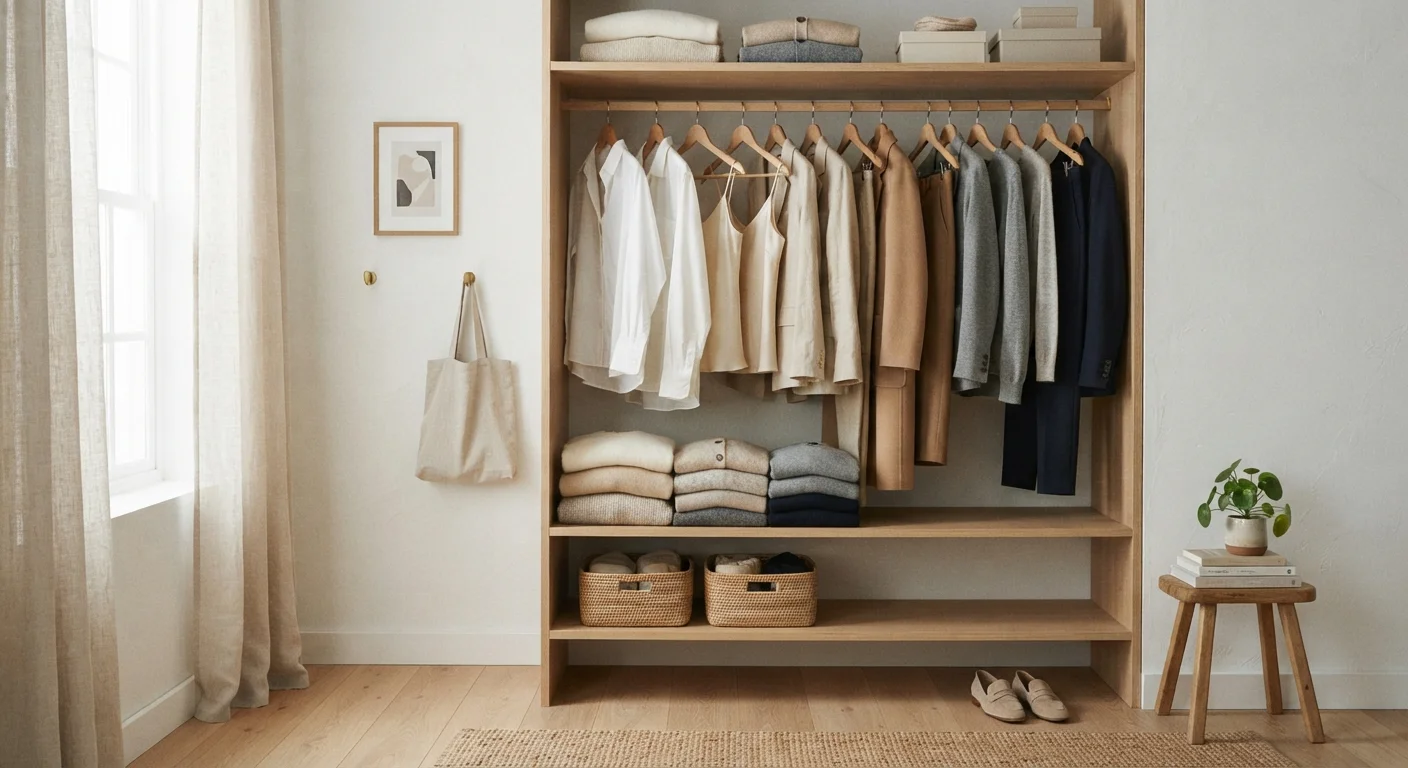
Key Takeaways
- A transitional wardrobe is built on neutral, versatile foundational pieces — not seasonal trend cycles.
- Fabric choice determines whether a garment can cross temperature ranges without looking wrong.
- Layering is the primary mechanism that makes the same outfit work across seasons.
- Editing your existing wardrobe is nearly always more effective than replacing it wholesale.
- Garment longevity depends as much on care and storage as on the quality of construction.
- Intentional investment in fewer, better pieces reduces both cost and decision fatigue over time.
Why Seasonal Wardrobe Overhauls Are Holding You Back
The idea that your wardrobe needs a full quarterly reset is one of fashion's most persistent — and expensive — myths. In practice, rebuilding around each season drives impulsive purchasing, creates closet clutter, and keeps you permanently reactive to the retail calendar rather than anchored in your own style. The result: more clothes, fewer outfits that actually work.
A genuinely functional wardrobe isn't structured around seasons. It's structured around you — your occasions, your body, your color palette — with pieces chosen for their ability to flex across temperature ranges and contexts. Before you map out what to add, it's worth understanding what every woman should know before she shops so purchases serve a clear purpose rather than filling a momentary gap.
When evaluating a new purchase for transitional versatility, ask whether it works with at least five items already in your wardrobe — across different temperature contexts. If you can't mentally style it five ways, it's likely a seasonal one-off.
Outfit combination count is the most reliable proxy for cost-per-wear; pieces that connect broadly across your existing wardrobe consistently deliver higher value than trend-specific additions.
Build your neutral palette first, then add depth with texture and print — not additional colors. A tonal wardrobe in two or three shades creates more combinations than a wide color range with fewer linking pieces.
Color cohesion is what allows layering to look intentional. When base and mid-layer tones are compatible, getting dressed becomes a system rather than a daily creative challenge.
The Foundational Framework: What a Transitional Wardrobe Actually Needs
Every wardrobe that works across seasons shares a common architecture: a core of neutrals that anchor outfits, a set of mid-layer pieces that add warmth or texture, and a small selection of statement items that bring personality without dependence on a specific season.
- Neutral base pieces: Tailored trousers, straight-leg jeans, a well-cut white or ivory shirt, a midi skirt in a solid tone. These form the skeleton of dozens of outfits.
- Mid-layers: Crewneck knits, shirt-weight jackets, a structured blazer. These are the real workhorses — worn alone in mild weather, over base pieces when temperatures drop.
- Outer anchors: One or two quality coats in neutral shades that work from early autumn through late winter without competing with what's underneath.
- Footwear bridges: Ankle boots and clean-line loafers that read appropriately from September through April in most US climates.
The goal is maximized outfit combinations from a minimal number of items. Foundational pieces that make getting dressed easier earn their closet space precisely because they connect across the full wardrobe — nothing exists in isolation.
~30
Average pieces worn from a typical wardrobe
Wardrobe utilization studies consistently suggest most people regularly wear roughly 30% of the clothes they own, regardless of closet size.
3–5x
Outfit combinations per foundational piece
Styling research indicates that each true wardrobe foundation piece can generate three to five distinct outfit combinations when paired within a cohesive wardrobe system.
Fabric Intelligence: Choosing Materials That Work Year-Round
Fabric is the single most undervalued variable in wardrobe planning. The same silhouette in two different materials can behave entirely differently across seasons — one feeling clammy in July, the other perfect from March through November.
Fabrics with broad seasonal range include:
- Mid-weight wool and wool blends
- Naturally temperature-regulating, wool manages warmth without overheating in transitional weather. A fine merino crewneck layers under a blazer in winter and stands alone in spring.
- Cotton twill and poplin
- Structured enough for tailored pieces, breathable enough for warmer months. Shirt-weight cotton in a tailored cut remains appropriate across a wide temperature range.
- Silk and silk-like weaves (cupro, viscose)
- Fluid and lightweight, these fabrics layer well and add visual interest without bulk.
- Linen-cotton blends
- Less prone to heavy creasing than pure linen, these work from spring through early autumn with the right layering.
Fabrics to use strategically — rather than as wardrobe anchors — include heavily textured boucle, sheer organza, and purely synthetic performance fabrics, which read seasonally specific or contextually limited.
The Layering Method: One Outfit, Multiple Climates
Layering is not about piling on clothes. It's a deliberate system that takes the same outfit foundation and adapts it to a 20-degree temperature swing without requiring a change of plan. The most reliable layering formula operates in three zones:
- Base: A fitted or semi-fitted piece — a shirt, a fine-knit turtleneck, a simple tank — that sits close to the body and reads well if the outer layers come off.
- Mid-layer: Something that adds warmth and structure — a blazer, an overshirt, a chunky knit cardigan. This is where most of the outfit's visual interest lives.
- Outer layer: A coat or jacket that completes the look without obscuring it. Proportions matter here: a longer coat over a mid-length skirt, a cropped jacket over wide-leg trousers.
Proportion awareness is what separates intentional layering from looking bundled. When the outer layer and the base piece share a tonal family, the layered result feels cohesive rather than accidental. For everyday outfit ideas built on this principle, the formula translates seamlessly from a cool morning to a warm afternoon without a wardrobe change.
Editing Your Current Closet Without Starting from Scratch
The most cost-effective wardrobe shift happens not at the checkout but at the closet rail. A structured edit — not a panic purge — is how you discover what you actually have and what structural gaps genuinely exist.
A practical edit process:
- Pull everything out by category (all trousers together, all knitwear together) rather than by season. Seasonal thinking is what you're moving away from.
- Assess each piece against three questions: Does it fit well right now? Does it work with at least three other items I own? Would I reach for it across more than one season?
- Identify the real gaps — not based on trend wish lists but on the outfit formulas that keep failing. If every morning you're searching for the right mid-layer, that's your signal.
- Repair before replacing. A loose button, a dropped hem, or a minor moth hole is fixable. Replacing a quality garment that can be mended is a false economy.
This edit approach connects directly to how personal style evolves with you — it's iterative, not revolutionary. Your wardrobe should grow from what already works, not from a blank slate.
Longevity Is a Strategy: Care and Investment Thinking
A transitional wardrobe only delivers on its promise if the pieces in it remain in good condition year after year. This means treating garment care as an active practice, not an afterthought. Care and storage practices that protect your investment are what extend a quality piece's life from two seasons to ten.
The fundamentals: wash less, and on gentler cycles when you do. Store knitwear folded, never hung. Use cedar blocks rather than chemical moth repellents in storage areas. Steam rather than iron where possible — heat stress breaks down fibers faster than wear. Rotate pieces so the same items aren't under continuous stress.
On the investment side, the quality vs. quantity question has a clear answer for transitional wardrobe building: cost-per-wear over time consistently favors fewer, better-constructed pieces over frequent low-cost replacements. A well-made wool coat worn nine months a year for eight years costs far less per wearing than a budget equivalent replaced every two seasons — and generates significantly less waste in the process.
The wardrobe that works across seasons isn't built in a weekend. It's refined deliberately, piece by piece, with each addition chosen because it strengthens the whole system rather than fills a momentary impulse. That discipline is what transforms a collection of clothes into something that genuinely serves your life.