

Key Takeaways
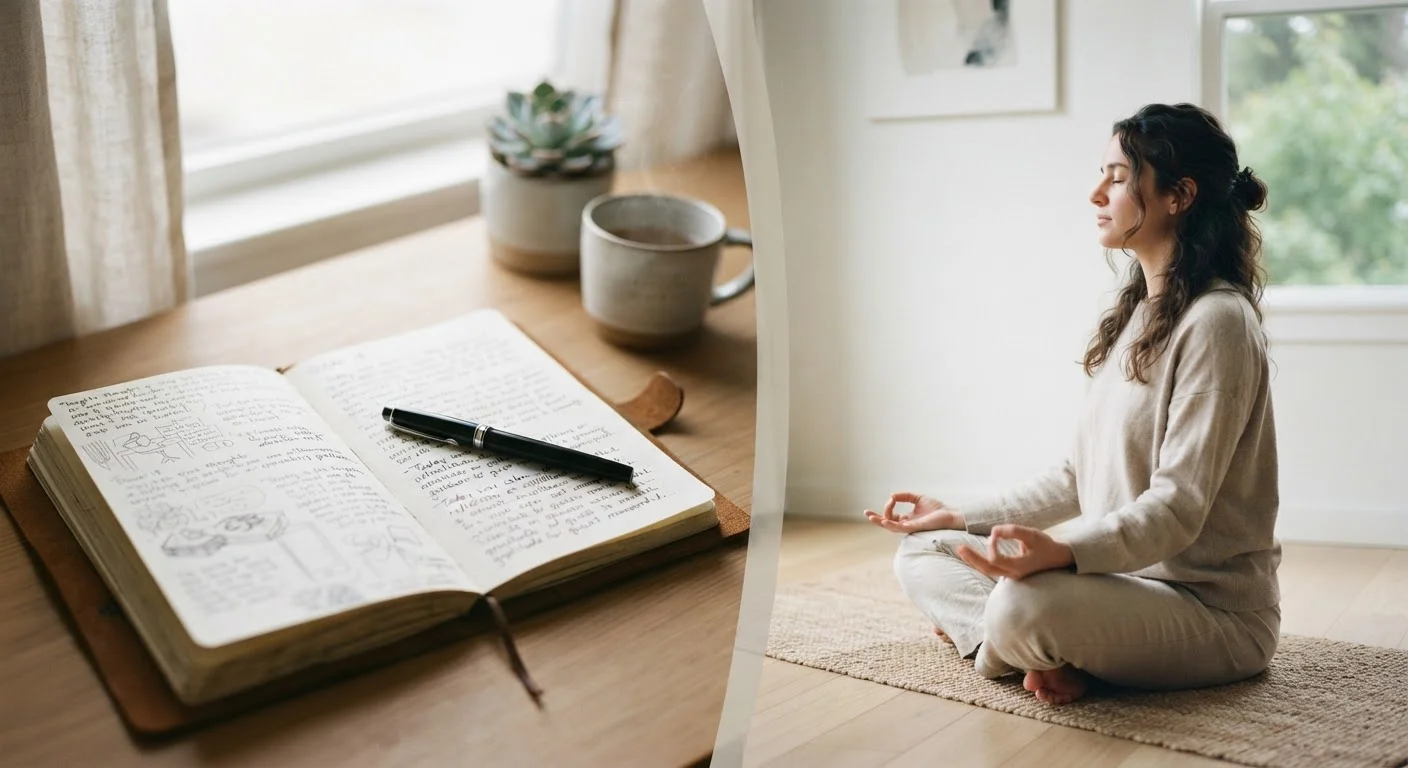
- Journalling externalizes thoughts through writing; meditation trains the mind to observe them without engagement.
- Research links both practices to reduced stress, improved emotional regulation, and greater self-awareness.
- Journalling tends to suit analytical thinkers; meditation often benefits those seeking relief from mental chatter.
- Both practices require only minutes per day to deliver measurable benefit.
- Combining the two practices can address different needs at different times.
Our Verdict
Neither journalling nor meditation is universally superior — each targets a different mental gear. Journalling works best when you need to untangle complex emotions or solve a recurring problem. Meditation works best when you need to step back from the stream of thought entirely. For most women, the ideal is not choosing one over the other but knowing when each tool applies.
| Best for | Recommended |
|---|---|
| Those who process emotions through writing and analysis | Journalling |
| Those overwhelmed by racing or repetitive thoughts | Meditation |
| Those new to reflective practice who want a low-barrier entry point | Journalling |
| Those building a long-term mindfulness foundation | Meditation |
What Each Practice Actually Does
Journalling and meditation are often grouped under the same wellness umbrella, but they work through distinct mechanisms. Journalling is an active, language-based process: you convert internal experience into written words, which forces the brain to organize, label, and examine what you're feeling or thinking. Research on expressive writing — much of it building on the work of psychologist James Pennebaker — suggests that this translation process can reduce psychological distress and improve immune function over time.
Meditation, by contrast, is largely a non-verbal, observational practice. Rather than analyzing thoughts, you train yourself to notice them arising and passing without attaching narrative. The goal of most meditation styles is not to empty the mind but to change your relationship with its contents. Neuroscience studies using neuroimaging have found that consistent meditation practice is associated with changes in regions linked to attention regulation and emotional reactivity, though researchers note more long-term data is still needed.
For a deeper look at how meditation relates to broader mindfulness principles, see our guide to meditation vs. mindfulness.
How They Compare Across Practical Dimensions
Choosing between the two often comes down to cognitive style, schedule, and the specific need you're trying to meet. The table below maps both practices across the criteria that matter most in a real daily routine.
| Journalling | Meditation | |
|---|---|---|
| Primary mechanism | Writing to externalize and organize thoughts | Observing thoughts without engaging them |
| Time required to start | Immediate — pen and paper suffice | Minimal, but technique guidance helps |
| Best time of day | Evening or after difficult events | Morning or mid-day reset |
| Suits analytical thinkers | High — language-based processing | Moderate — requires stepping back from analysis |
| Evidence base | Strong for emotional processing and clarity | Strong for stress response and attention regulation |
| Visible output | Yes — written record over time | No — benefit is internal and cumulative |
| Portability | Requires notebook or device | Fully portable, no tools needed |
| Common barrier | Blank page anxiety, inconsistency | Restlessness, unclear early progress |
One practical note: journalling has a lower barrier to entry for most beginners because it feels familiar and produces a visible output. Meditation's benefits, while well-documented, can take several weeks of consistent practice before they feel tangible — which is why many people abandon it prematurely.
Which Practice Matches Your Mental Style
Pay attention to how your mind typically responds to stress. If you instinctively reach for a notebook, voice memo, or a long conversation to work through a problem, journalling likely aligns with your natural processing style. Structured approaches — like prompted journalling or a daily three-sentence reflection — can help if free writing feels overwhelming. Our guide to journalling for mental clarity covers several formats worth trying.
If your stress response is more physical — tight chest, shallow breathing, inability to stop ruminating — meditation is often the more direct intervention. It interrupts the loop rather than continuing to engage with it. Even five minutes of breath-focused attention can activate the parasympathetic nervous system, shifting the body out of a low-grade stress response.
Stack Practices Around an Existing Habit
The most reliable way to make either practice stick is to attach it to something you already do reliably — morning coffee, a lunch break, or a pre-sleep routine. Even three to five consistent minutes outperforms an ambitious thirty-minute session you skip four days out of five. Start smaller than feels necessary.
For those unsure where to begin with the broader mindfulness landscape, our complete starting point for mindful living offers grounded, practical orientation.
Using Both Without Overcomplicating Your Routine
There's no rule that requires choosing one exclusively. Many people find that a brief meditation session in the morning clears mental static, while a short journalling habit in the evening helps process the day's events before sleep. The key is keeping each practice genuinely short — five to ten minutes is enough for both to deliver value when done consistently.
If you're exploring different approaches to seated practice, our comparison of guided vs. unguided meditation outlines what works for different learning styles. Those interested in fitting these habits into a slower, more intentional lifestyle will also find relevant context in our slow living hub.
This article is for general informational and educational purposes only and does not constitute medical or mental health advice. If you are experiencing significant stress, anxiety, or mental health concerns, please consult a qualified healthcare professional.