

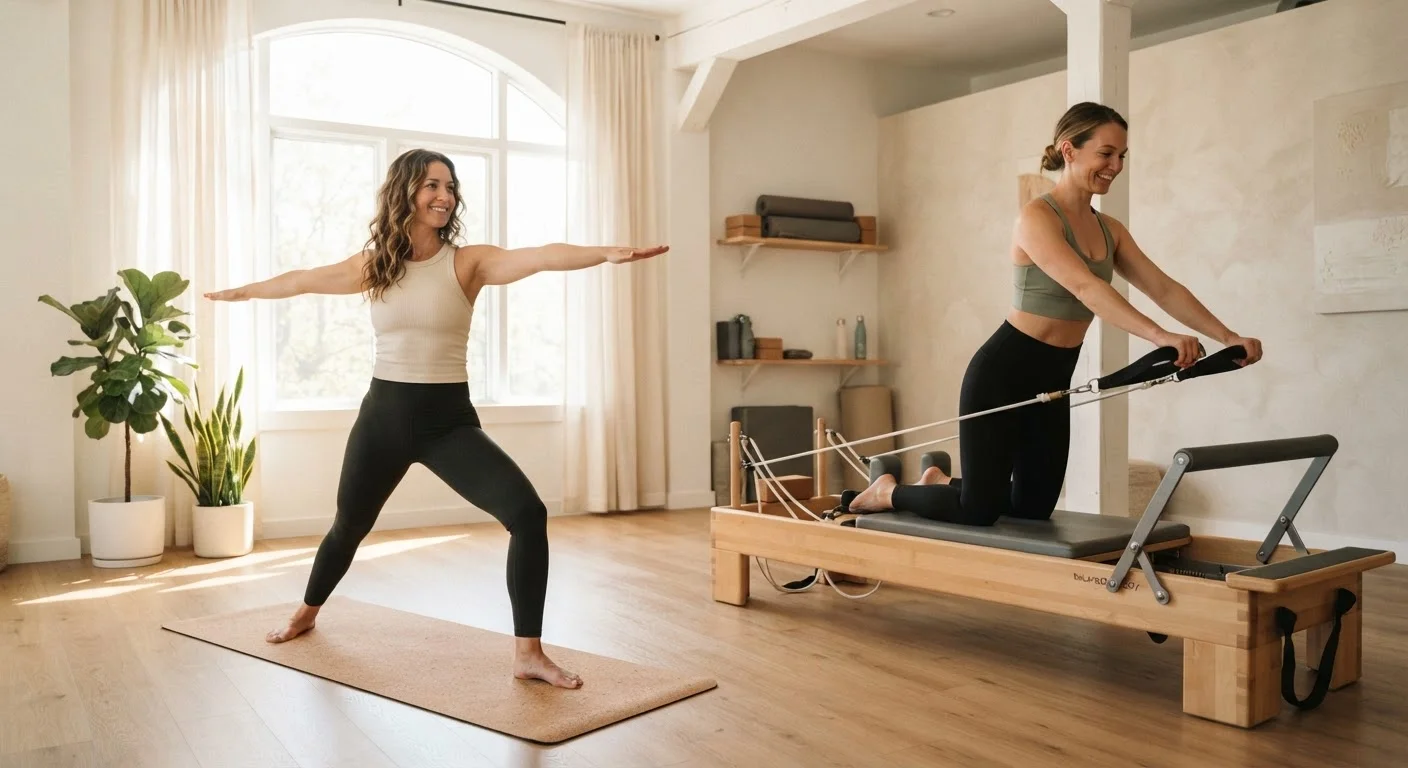
Key Takeaways
- Yoga is a centuries-old practice with philosophical roots; Pilates was developed in the early 20th century as a rehabilitation method.
- Yoga emphasizes breathwork, flexibility, and mindful awareness; Pilates prioritizes core stability, postural alignment, and controlled movement.
- Both are low-impact and accessible for most fitness levels, though specific styles vary widely in intensity.
- Neither is universally superior — the better fit depends on your goals, physical needs, and what feels joyful.
- Many practitioners find combining both practices offers complementary physical and mental benefits.
Option A
Yoga
The ancient, whole-self practice rooted in philosophy and breath.
Best for: Those seeking a mind-body-spirit connection alongside physical flexibility and stress relief.
Option B
Pilates
The modern, precision-driven method built around core strength and alignment.
Best for: Those focused on building functional core strength, postural correction, and controlled movement.
If you want to manage stress and build a mind-body connection
Yoga
Yoga's emphasis on breathwork, meditation, and mindful movement directly addresses the nervous system, making it a strong choice for stress regulation and emotional grounding.
If you're recovering from an injury or working on posture
Pilates
Pilates was originally developed as a rehabilitation tool and remains widely used in physiotherapy settings for its precise, low-load approach to building supportive strength.
If you want flexibility and a spiritual or philosophical dimension
Yoga
Yoga's philosophical framework — including concepts like intention-setting and non-judgment — offers a richer context for those who want movement to be part of a broader wellness practice.
If core strength and functional movement are your primary goals
Pilates
Pilates systematically targets deep stabilizing muscles in the trunk and pelvis, supporting everyday movement quality and athletic performance.
If you're new to movement and want something flexible in format
Yoga
Yoga has an enormous range of styles — from slow restorative classes to dynamic vinyasa — and is widely available in studios, apps, and free online formats.
Where Each Practice Comes From
Understanding what separates yoga and Pilates starts with their origins — because each was built to solve a very different problem.
Yoga is one of the world's oldest movement systems, with roots stretching back thousands of years in South Asia. It was never purely physical: classical yoga encompasses ethical guidelines, breathwork (pranayama), meditation, and philosophical frameworks. What most Western studios teach today is primarily asana — the physical posture practice — which is just one branch of a much larger tradition.
Pilates, by contrast, is relatively recent. Joseph Pilates developed his method in the early 20th century, initially to rehabilitate injured dancers and interned civilians during World War I. He called it "Contrology" — a system of controlled, precise movements designed to integrate body and mind through deliberate physical effort. The apparatus he designed (including the reformer machine) remains central to many Pilates studios today, alongside mat-based work.
These different lineages matter because they shape everything: the vocabulary used in class, the cues instructors offer, and what you're actually training when you show up.
How They Differ in Method and Focus
| Criterion | Yoga | Pilates |
|---|---|---|
| Origin | Ancient South Asian tradition (thousands of years old) | Early 20th-century rehabilitation method |
| Primary focus | Breath, mindfulness, flexibility, whole-self awareness | Core stability, postural alignment, controlled movement |
| Philosophical dimension | Strong — includes ethics, meditation, philosophy | Minimal — primarily physical and biomechanical |
| Equipment | Mat, optional blocks and straps | Mat or specialised apparatus (reformer, Cadillac) |
| Intensity range | Restorative to highly dynamic | Gentle rehabilitation to athletic challenge |
| Stress relief evidence | Substantial research base | Emerging, less studied |
| Best studied for | Anxiety, sleep, flexibility, chronic pain | Core strength, lower back pain, posture |
In a yoga class, you'll typically move through postures linked by breath, with the instructor guiding awareness inward. The breath is treated as the anchor — not just a mechanical function but a tool for regulating the nervous system and cultivating presence. Flexibility, balance, and strength all develop as byproducts of consistent practice, and many styles incorporate explicit mindfulness or meditation components.
Pilates classes focus more narrowly on movement quality. The central concept is the "powerhouse" — the deep core muscles of the abdomen, lower back, hips, and glutes — which are engaged throughout every exercise. Movements are deliberate and typically slow, with instructors cueing precision over pace. There's less emphasis on spirituality and more on biomechanical efficiency. For readers curious about how Pilates fits alongside other low-impact options, our overview of low-impact movement forms covers the wider landscape.
What the Research Generally Suggests
~55%
Yoga practitioners citing stress relief as primary motivation
A survey by Yoga Alliance and Yoga Journal found stress relief was the top reason Americans reported practicing yoga.
12+ weeks
Typical study duration for measurable Pilates core outcomes
Multiple published studies on Pilates and core strength have used 10–12 week intervention periods to observe significant changes in trunk stability.
300M+
Estimated global yoga practitioners
Industry estimates suggest yoga has become one of the most widely practiced movement disciplines worldwide, with participation growing across age groups.
Both practices have been studied for their health effects, though the research base varies in quality and scale. Yoga has a larger body of published research, with studies suggesting benefits for stress, anxiety, sleep quality, and chronic pain — largely attributable to its effects on the autonomic nervous system. The physical benefits — improved flexibility, balance, and muscular endurance — are also reasonably well supported.
Pilates research, while growing, tends to focus more specifically on musculoskeletal outcomes: core strength, postural alignment, lower back pain relief, and functional movement. Some evidence suggests it may be particularly useful in rehabilitation contexts, which aligns with its origins. Comparisons between the two are relatively limited, partly because styles within each practice vary so widely.
It's worth noting that the "best" movement practice is almost always the one you'll actually do consistently. If you're interested in how mental practices interact with movement, our piece on meditation vs. mindfulness explores a related question about choosing practices that suit your mind.
This article is for general informational purposes only and is not a substitute for medical or professional fitness advice. If you have an existing health condition or injury, consult a qualified healthcare professional before starting a new exercise practice.