

Key Takeaways
- Door-to-door travel time often favors trains on routes under 500 miles once airport logistics are factored in.
- Flight prices can appear lower until you add baggage fees, transfers, and city-center access costs.
- Train travel produces significantly lower carbon emissions per passenger than short-haul flights.
- Comfort, flexibility, and the quality of the journey itself are often stronger on rail.
- The best choice depends on your specific route, budget, timeline, and travel priorities.
Our Verdict
Neither rail nor flying is universally superior — the right choice shifts with every route and traveler. Trains tend to win on short-to-medium distances, city-center convenience, comfort, and environmental impact. Flights can make sense for longer distances or when time is genuinely tight. What matters most is looking at the full picture rather than just the headline fare.
| Best for | Recommended |
|---|---|
| Short-to-medium routes (under ~500 miles) and multi-city trips | European Rail |
| Long-haul routes within Europe where time is the primary constraint | Flying |
| Travelers prioritizing low environmental impact and in-journey comfort | European Rail |
| Budget travelers flying point-to-point with carry-on only | Flying (with caveats) |
The Clock Doesn't Lie: Real Travel Time Compared
The single biggest misconception about flying within Europe is how fast it actually is. A flight from Paris to Amsterdam might be listed as 1 hour 20 minutes in the air — but the full journey rarely resembles that. Factor in check-in windows, security queues, boarding, taxiing, baggage claim, and the time it takes to get from a peripheral airport into the city center, and you're easily looking at four to five hours door-to-door.
The Thalys (now Eurostar) train on the same route takes under two hours and drops you in the heart of Amsterdam Centraal. No security theater, no gate anxieties, no shuttle buses. You board, you sit, you arrive somewhere walkable.
This pattern holds across many classic European corridors: London–Brussels, Madrid–Barcelona, Frankfurt–Cologne, Milan–Rome. On routes under roughly 500 miles, trains consistently deliver comparable or shorter total journey times once all airport logistics are counted. The calculus starts to shift around the 600-to-800-mile mark, where flight time begins to outpace even fast rail connections.
Build in buffer time honestly
When comparing rail and flight options, map out the complete journey from your accommodation to your destination's center — not just the scheduled transit time. Include check-in minimums, security, transfers, and ground transport on both ends. This single exercise often changes which option appears faster or more affordable.
The True Cost: Beyond the Headline Fare
A €29 flight can feel like a clear win — until you start adding line items. Checked baggage, priority boarding (often necessary to guarantee overhead space), the taxi or train to a remote airport, the coffee you buy at the gate because you had to arrive two hours early. The final tally frequently surprises people.
Rail tickets are generally more transparent. The price you see typically includes your seat, standard luggage allowance, and arrival at a central station. High-speed rail passes — particularly Interrail for European residents and Eurail for visitors from outside the EU — can offer strong value on multi-city itineraries, though individual route tickets often require advance booking to secure the best fares.
That said, flying genuinely can cost less on some long-haul European routes or when booked well in advance with a carry-on-only approach. The honest answer is: compare the full door-to-door cost, not just the headline. Our piece on travelling well on a tighter budget offers useful framing for thinking through these calculations.
| European Rail | Flying Within Europe | |
|---|---|---|
| Door-to-door time (short routes) | Often faster under 500 miles | Slower once airport time added |
| Cost transparency | Generally inclusive pricing | Headline fare often rises with add-ons |
| City-center access | Central station arrival | Often peripheral airport + transfer |
| Luggage flexibility | Generous, no strict rules | Restrictions and fees common |
| In-journey comfort | Spacious, free to move | Confined cabin, dry air |
| Carbon footprint | Significantly lower | Among highest per km |
| Best for long distances | Less competitive over ~600 miles | Faster over long European routes |
Comfort, Ease, and the Quality of the Journey
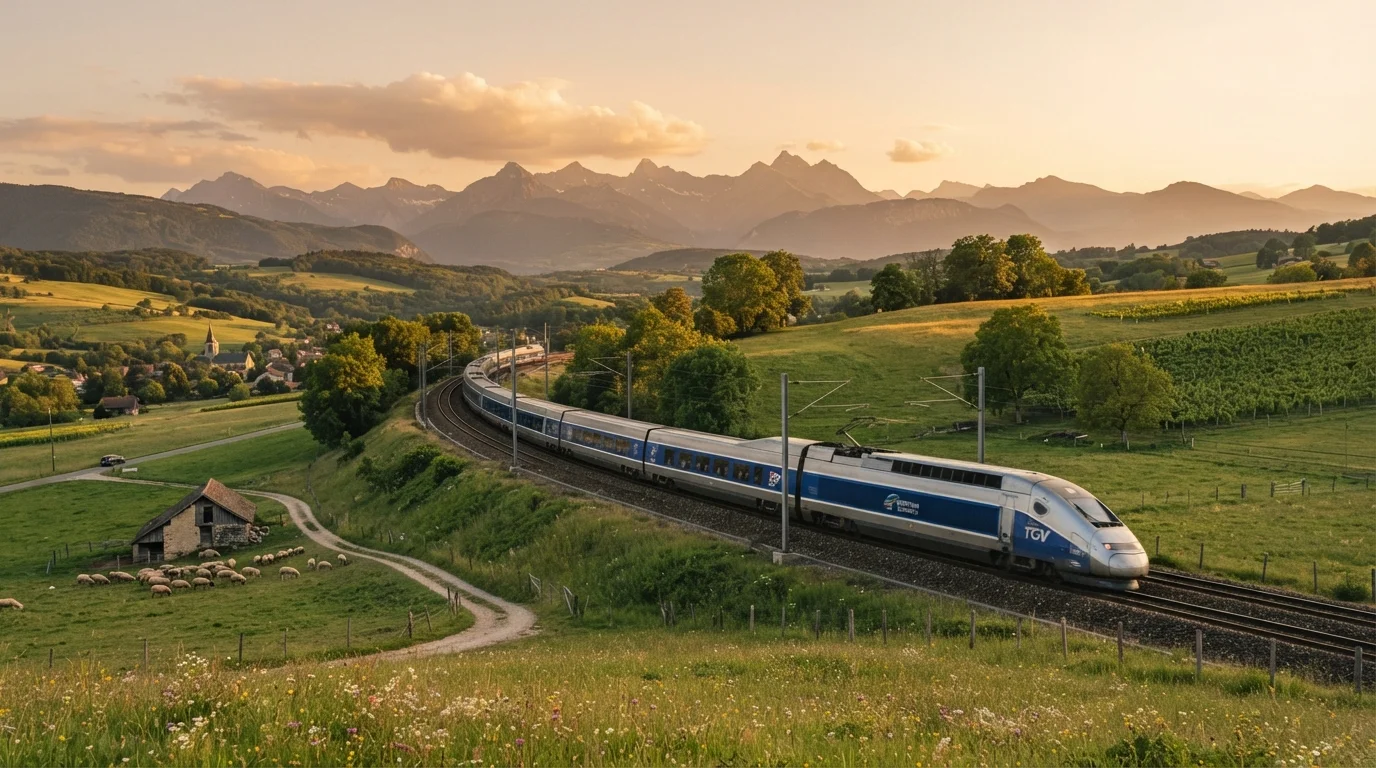
This is where train travel makes its most compelling argument. European high-speed trains — France's TGV, Spain's AVE, Germany's ICE, Italy's Frecciarossa — offer spacious seats, large windows, dining cars, reliable Wi-Fi on many routes, and the freedom to move around. You can arrive 10 minutes before departure. Your luggage stays with you, in a rack above your head or beside you. There are no liquids rules, no laptop trays, no enforced mode of sitting.
For women traveling alone, this freedom to move, observe, and engage with the journey rather than endure it matters. There's something restorative about watching the landscape shift from city outskirts to farmland to mountain passes — the kind of travel that slow travel advocates recognize as meaningful in itself.
Flying, by contrast, compresses the journey into an experience most people simply tolerate. The cabin is small, the air is dry, and the routine has become increasingly fraught. For many travelers, the arrival-day fatigue from a short flight rivals that from a much longer train ride.
Environmental Impact: A Gap Worth Knowing
Short-haul aviation is one of the most carbon-intensive forms of travel per passenger kilometer. While exact figures vary by aircraft type, load factor, and how emissions are calculated, the broad consensus among transport researchers is that a short-haul flight produces several times more CO₂-equivalent per passenger than a high-speed rail journey on the same route. The gap is particularly significant in Europe, where much of the rail network runs on electricity from increasingly low-carbon grids.
This doesn't mean every traveler can or should always choose rail — geography, time constraints, and affordability are real factors. But for travelers who care about the environmental dimension of their choices, the difference between these two modes is substantial and worth factoring in, especially on the shorter routes where trains are already competitive on time and cost.
If you're weighing the kind of traveler you want to be — not just where you're going but how — thinking intentionally about what kind of trip restores you is a useful starting point.
How to Decide: A Practical Framework
Rather than a blanket rule, consider these questions for each trip: What's the actual door-to-door time difference? What's the total cost including transport to and from departure points? How much does the quality of the journey matter to you on this particular trip? And how much does environmental impact factor into your travel decisions?
For multi-city European itineraries, rail almost always wins on the first three counts for most routes. Flying tends to make practical sense when you're crossing from one end of the continent to the other — say, Lisbon to Warsaw — and time is genuinely the binding constraint.
It's also worth remembering that the two modes aren't mutually exclusive. Many well-planned European trips combine an overnight flight into a hub city, then use trains for everything in between. That hybrid approach — fly once, rail the rest — often offers the best of both worlds for an extended trip. Whatever shape your itinerary takes, how you travel matters as much as where.