

Key Takeaways
- Rest is not one-size-fits-all — your ideal escape depends on what kind of depletion you're recovering from.
- City breaks offer stimulation and novelty, which can be genuinely restorative for some types of burnout.
- Nature escapes reduce cortisol and sensory overload, making them effective for deep nervous-system recovery.
- Your social energy level, work environment, and current stress type are useful guides when choosing.
- Many travellers find a hybrid approach — slow urban stays or nature-adjacent towns — works best long-term.
Option A
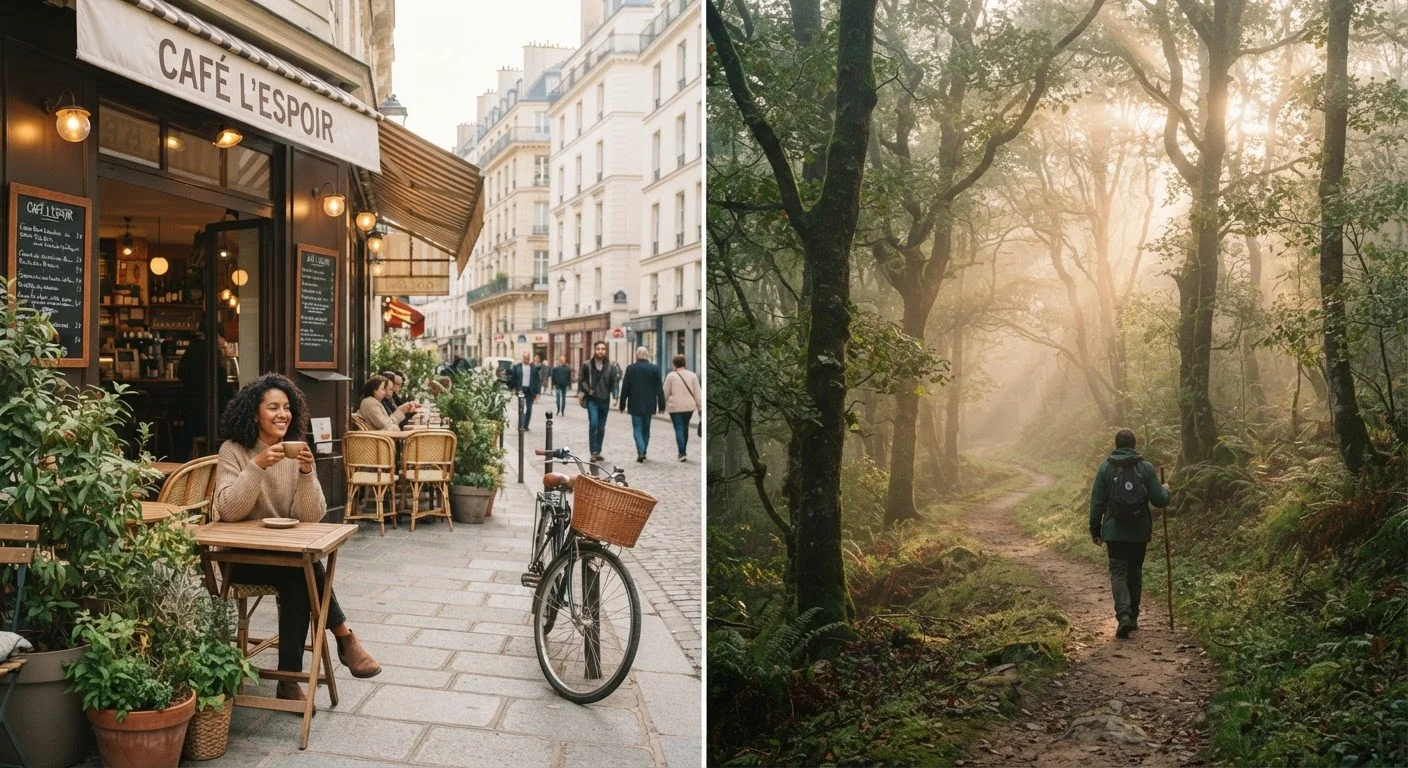
City Breaks
The stimulating, culture-rich recharge.
Best for: Women who feel restored by new experiences, social energy, and the creative charge of an unfamiliar urban environment.
Option B
Nature Escapes
The quiet, sensory-slow reset.
Best for: Women who need distance from screens, noise, and decision fatigue — restored by open skies, physical movement, and unstructured time.
If you're exhausted from isolation or routine monotony
City Breaks
Urban novelty, cultural immersion, and social energy can reignite curiosity and motivation when daily life has gone flat.
If you're overwhelmed by screens, noise, and decision fatigue
Nature Escapes
Unstructured time outdoors lowers cognitive load and gives your nervous system genuine space to downregulate.
If you're an introvert who craves beauty without crowds
Nature Escapes
Solitude in landscape offers restoration without the social performance that city travel often involves.
If you're craving creative inspiration and cultural input
City Breaks
Art, architecture, food scenes, and human observation offer the kind of rich sensory input that sparks new thinking.
If you're uncertain what you need and open to experimentation
Nature Escapes
Research consistently suggests time in green or blue spaces offers the broadest baseline recovery — a safe starting point when you're unsure.
Why the Type of Rest Matters as Much as the Break Itself
We tend to treat vacation as a binary — you either go away or you don't. But there's a more useful question underneath that one: what are you actually recovering from? The wrong kind of trip can leave you returning home more drained than when you left. A weekend packed with city museums and dinner reservations is exhilarating if you're bored and understimulated — but genuinely taxing if you're already running on empty from a high-input work environment.
Research into stress recovery and restorative environments suggests that different settings support different types of psychological repair. Attention Restoration Theory, developed by environmental psychologists Rachel and Stephen Kaplan, proposes that natural environments are particularly effective at restoring directed attention — the effortful, focused kind we burn through in modern work and life. Urban environments, by contrast, tend to engage involuntary attention, which can feel stimulating rather than draining when the right conditions are met.
Understanding this distinction is the starting point for choosing travel that actually restores you. As we explore in our look at what slow travel changes, how you move through a destination shapes your experience as much as where you go.
| Criterion | City Breaks | Nature Escapes |
|---|---|---|
| Primary restoration type | Novelty, stimulation, cultural input | Sensory calm, low cognitive demand |
| Best for recovering from | Monotony, isolation, creative block | Burnout, decision fatigue, overstimulation |
| Social energy required | Moderate to high | Low to none |
| Typical trip length | 2–4 days works well | Benefits deepen over 4+ days |
| Logistics complexity | Easier — more infrastructure | Can require more advance planning |
| Screen and tech detox potential | Low — connectivity is constant | High — often naturally limited |
| Physical engagement | Walking, exploring neighbourhoods | Hiking, swimming, outdoor movement |
What City Breaks Actually Offer (and When They Work)
A well-chosen city break can be genuinely restorative — not in spite of its energy, but because of it. The novelty of a new urban landscape, the pleasure of wandering without agenda, eating food you didn't cook, and absorbing art and architecture you've never seen engages the brain in a way that feels like play rather than work. For women who feel dulled by repetition or hemmed in by domestic routine, this kind of stimulation can function as a real reset.
City travel also offers practical advantages: walkable neighborhoods, accessible accommodation, and the ease of spontaneous planning once you're there. It suits shorter windows of time — a long weekend rather than a full week — and pairs well with social travel, whether you're going with a friend or meeting people along the way. The rhythm of solo versus group city travel also shapes what kind of restoration you'll find.
The caveat is pacing. A city break structured like a checklist — five museums, four neighborhoods, three restaurants per day — replicates the pressure of everyday life in a new postcode. The restorative benefit comes from how you inhabit the city, not from how much of it you cover.
20 min
Minimum nature exposure to lower stress hormones
A 2019 study published in Frontiers in Psychology found that as little as 20 minutes in a natural setting was associated with measurable reductions in cortisol levels.
74%
Travellers who say trips rarely feel truly restful
A 2023 survey by the Global Wellness Institute found a significant majority of leisure travellers felt their holidays did not deliver genuine recovery.
2x
Greater reduction in rumination after nature walks
Stanford research found participants who walked in a natural setting showed roughly half the neural activity associated with rumination compared with those who walked in an urban area.
What Nature Escapes Deliver That Urban Environments Can't
There's a growing body of evidence that time in natural environments — forests, coastlines, mountains, open farmland — has measurable effects on stress physiology. Studies have found that walks in wooded areas are associated with lower cortisol levels and reduced activity in brain regions linked to rumination, compared with equivalent walks in urban settings. Japan's practice of shinrin-yoku (forest bathing) has informed a range of clinical wellness applications, though it's worth noting that research is still evolving and results vary across populations.
What nature consistently offers that cities do not is low-demand presence. There are no menus to choose from, no social performances to maintain, no notifications arriving. The sensory input — birdsound, water, light through trees — is rich but non-urgent. For women recovering from decision fatigue, social exhaustion, or the specific burnout of always-on work culture, this kind of environment allows the nervous system to genuinely downregulate rather than simply distract itself.
Our guide to wellness-focused destinations worth travelling for explores specific places where landscape and local culture actively support this kind of recovery. And if you're thinking about how these restorative principles apply beyond travel, solitude versus social support as a reset offers useful psychological grounding.
How to Read What You Actually Need Right Now
The most honest guide to choosing your next escape is a clear-eyed look at your current depletion. Ask yourself: Is your tiredness primarily cognitive — too many decisions, too much information? Or is it emotional and social — drained by people, conflict, or the pressure to perform? Cognitive fatigue tends to respond well to nature's low-demand restoration. Social exhaustion can go either way: some people find solitude in landscape healing; others need the social anonymity of a city, where you're among people without being for people.
Also consider your everyday environment. If you work from a home office in a quiet suburb, a city break's bustle may feel like a genuine contrast. If you work in a busy open-plan office or a high-pressure urban role, more city — even beautiful city — may not shift your baseline enough to count as rest.
Neither choice is inherently superior, and many travellers find they need different things at different seasons of life. The goal is not to find the objectively better escape, but to develop enough self-awareness to choose intentionally. That's the same principle that underlies the daily routines most likely to sustain your energy long-term — matching the input to what you actually need, rather than what looks appealing in theory.