

Key Takeaways
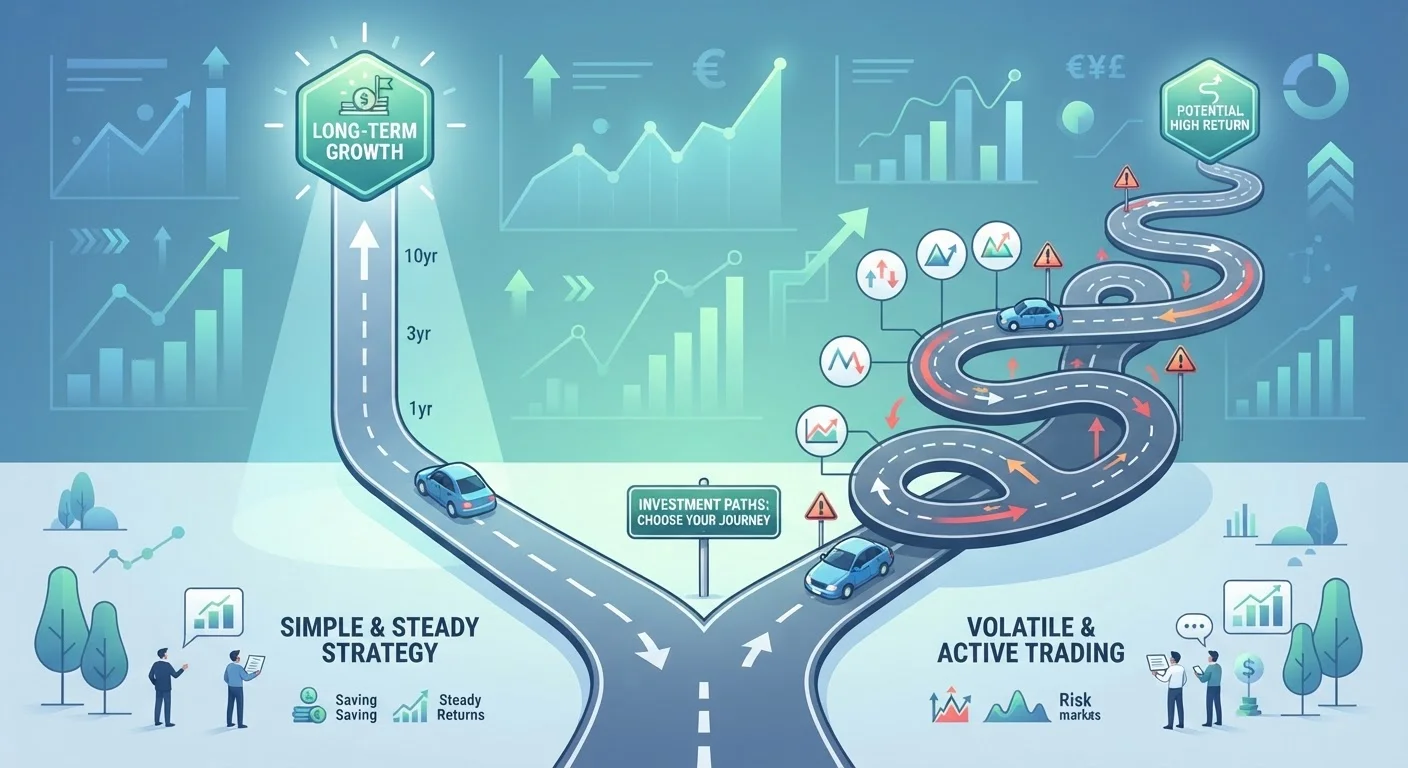
- Index funds track a market index passively, while actively managed funds rely on human stock selection.
- Decades of research consistently show most actively managed funds underperform their benchmark index over long periods.
- Lower expense ratios in index funds compound meaningfully over time, directly improving net returns.
- Active funds may offer advantages in less efficient markets, though outcomes remain unpredictable.
- Neither approach is universally superior — your time horizon, goals, and risk tolerance all matter.
- Consulting a licensed financial adviser before making investment decisions is always recommended.
Option A
Index Funds
The low-cost, market-matching approach.
Best for: Long-term investors who want broad diversification, minimal fees, and a hands-off strategy.
Option B
Actively Managed Funds
The research-driven, manager-led strategy.
Best for: Investors seeking potential outperformance in specific market segments, willing to accept higher fees and variable results.
If you're a long-term investor focused on retirement savings
Index Funds
Decades of research support passive investing for cost-efficiency and reliable market-rate returns over long horizons, making index funds a strong foundation for retirement portfolios.
If you're investing in niche or less-liquid market segments
Actively Managed Funds
Active managers may add value in less-efficient markets like small-cap or emerging markets, where information gaps can be exploited more readily than in large-cap indices.
If minimizing fees is your primary concern
Index Funds
Index fund expense ratios are typically a fraction of actively managed fund fees, and fee differences compound significantly over a 20–30 year investment period.
If you're building your first investment portfolio with limited experience
Index Funds
Simplicity, transparency, and diversification make index funds a practical starting point, removing the burden of evaluating individual fund manager performance.
If you want tailored risk management during volatile markets
Actively Managed Funds
Active managers can potentially shift allocations defensively during downturns, although whether they successfully do so consistently varies considerably by manager and fund.
How Each Approach Works
Understanding the structural difference between index funds and actively managed funds is the starting point for any informed investment decision.
An index fund is a type of investment fund — often a mutual fund or exchange-traded fund (ETF) — designed to replicate the performance of a specific market index, such as the S&P 500. The fund simply holds the same securities in the same proportions as the index it tracks. No team is selecting stocks; the portfolio adjusts only when the index itself changes. This passive structure keeps operating costs very low.
An actively managed fund employs a professional portfolio manager (or a team) who analyzes data, researches companies, and makes deliberate decisions about which securities to buy, hold, or sell. The explicit aim is to outperform a benchmark index. That human expertise and ongoing research comes at a cost, reflected in higher annual fees known as the expense ratio.
To understand why this comparison matters for building long-term wealth, it helps to first grasp the basics of the underlying assets. Our guide to stocks, bonds, and cash explains how these building blocks behave across different market conditions.
| Criterion | Index Funds | Actively Managed Funds |
|---|---|---|
| Management style | Passive — tracks an index | Active — human stock selection |
| Typical expense ratio | 0.03%–0.20% annually | 0.50%–1.50%+ annually |
| Long-term benchmark performance | Matches index return (minus fees) | Most underperform index after fees |
| Tax efficiency | Generally higher (fewer trades) | Generally lower (more frequent trades) |
| Transparency | Holdings always known and predictable | Holdings disclosed periodically |
| Potential for outperformance | None by design | Possible, but inconsistent and rare |
| Complexity for investors | Low — straightforward to understand | Higher — requires manager evaluation |
What the Research Actually Shows
The debate between passive and active investing has been studied extensively, and the findings lean in a consistent direction.
S&P Global's SPIVA (S&P Indices Versus Active) scorecards — published regularly and covering multiple markets — have repeatedly found that the majority of actively managed funds underperform their relevant index benchmark after fees over 10- and 15-year periods. The longer the time horizon examined, the larger the proportion of active funds that fall short.
The primary culprit is cost. Even a seemingly small annual fee difference of 1% compounds significantly across decades. On a $20,000 investment growing at an average annual rate over 30 years, a 1% higher expense ratio can erode tens of thousands of dollars in final value — a structural headwind active managers must consistently overcome before delivering any net benefit to investors.
~85%
Active large-cap funds underperforming index over 15 years
S&P Global's SPIVA U.S. Scorecard has consistently found roughly 85% or more of actively managed large-cap funds underperform the S&P 500 over 15-year periods.
0.03%
Lowest typical index fund expense ratio
Some broad market index funds carry annual expense ratios as low as 0.03%, compared to industry averages for active funds that can exceed 1%.
1%
Fee difference that erodes long-term returns
Financial educators commonly illustrate that a 1% annual fee difference, compounded over 30 years, can reduce a portfolio's final value by tens of thousands of dollars.
There are nuances. Research does show that some active managers demonstrate genuine skill in less-efficient markets — such as small-cap equities or certain emerging markets — where price discovery is slower and information advantages are more possible. But identifying those managers in advance, reliably, is itself a significant challenge that most individual investors are not well-positioned to solve.
The gender investing gap adds another layer of urgency to understanding these dynamics. Women who delay or avoid investing often do so partly because the landscape feels opaque. Our article on why the gender investing gap exists explores the structural factors driving that hesitation and the long-term financial cost of staying on the sidelines.
Fees, Risk, and Real-World Considerations
Beyond raw performance data, several practical factors shape which approach may suit your situation better.
Expense Ratios
Index funds commonly carry expense ratios between 0.03% and 0.20% annually. Actively managed funds frequently charge between 0.50% and 1.50% or more. Over a 30-year investment horizon, that differential matters enormously due to compounding.
Tax Efficiency
Because index funds trade infrequently, they tend to generate fewer taxable capital gains distributions than actively managed funds, which can be meaningful in taxable (non-retirement) accounts.
Behavioral Risk
Actively managed funds with higher volatility or strong short-term narratives can encourage reactive decision-making — buying after strong performance and selling during downturns — which research consistently identifies as damaging to individual investor returns.
Transparency
Index fund holdings are fully predictable and publicly known. Active fund holdings are disclosed less frequently, making it harder to assess exactly what you own at any given time.
If you're still building the financial foundations that make investing possible — including emergency reserves — our overview of savings, emergency funds, and sinking funds is a helpful prerequisite. Investing typically makes sense once short-term financial stability is established.
This article is for general informational and educational purposes only and does not constitute personalized financial, investment, tax, or legal advice. Past performance is not a guarantee of future results. Please consult a qualified financial adviser before making investment decisions based on your individual circumstances.