

Why the Distinction Matters
Most people keep their money in one or two accounts and call it all "savings." But treating every saved dollar the same way is a bit like storing your work clothes, gym gear, and formal wear in one giant pile — technically efficient, functionally confusing. When an unexpected car repair hits, do you tap your vacation money? When the holidays roll around, does your emergency fund take the hit?
Giving each type of saved money a distinct purpose prevents that confusion. It also makes your budget feel less restrictive, because you can spend from a sinking fund without guilt — that's exactly what it's there for. Below is a plain-language breakdown of all three fund types, what each one is designed to do, and how they work together. For a deeper look at the vocabulary that underpins this kind of planning, see financial terms every woman building wealth should know.
General Savings: Your Goal-Oriented Money
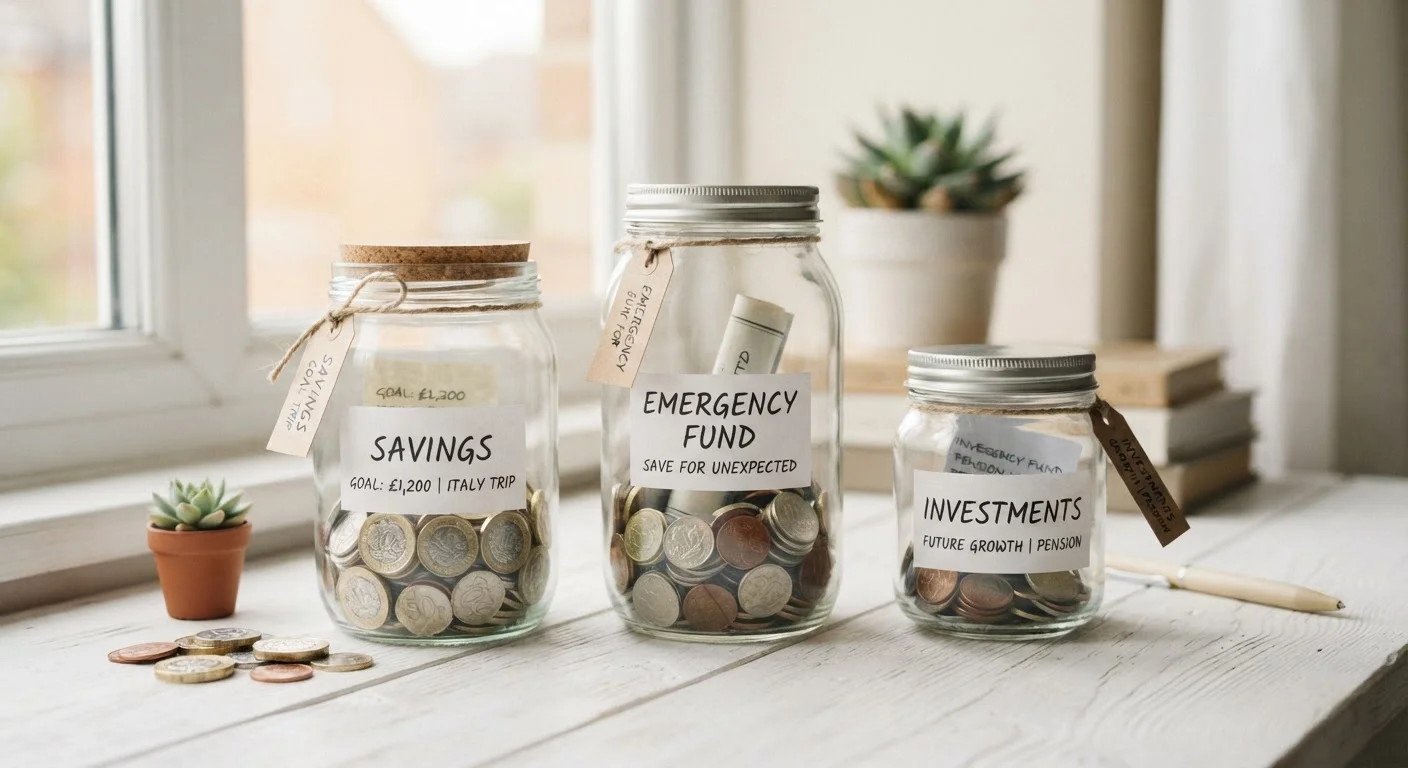
A general savings account holds money you're intentionally setting aside for a positive future purpose — a vacation, a down payment, a wardrobe refresh before a new job. It is discretionary, goal-driven, and planned. You decide the target, set a timeline, and contribute toward it.
The key characteristic of general savings is that spending it is the whole point. Unlike an emergency fund, drawing it down for its intended purpose is a success, not a setback. General savings can be kept in a high-yield savings account to earn interest while you accumulate toward your goal — though the appropriate account type depends on your timeline and individual circumstances.
The psychology here matters. When savings have a named purpose, research in behavioral economics consistently finds that people are less likely to raid those funds impulsively. Naming a bucket "Paris trip" creates a mental ownership effect that a generic "savings" label doesn't provide.
General Savings
Money set aside for a specific, chosen goal such as a vacation or large purchase. Spending it on its intended purpose is the expected outcome.
Emergency Fund
A liquid reserve covering three to six months of essential expenses, held strictly for genuine financial emergencies like job loss or unexpected major costs.
Sinking Fund
Money accumulated monthly in advance for a known, periodic expense — such as annual insurance premiums or holiday gifts — so the cost doesn't hit as a surprise.
Liquid Savings
Funds that can be accessed quickly, typically within one to two business days, without penalty. Emergency funds should always be liquid.
High-Yield Savings Account
A savings account, typically offered by online banks, that pays a higher annual percentage yield (APY) than a traditional savings account while keeping funds accessible.
Behavioral Economics
A field of study examining how psychological factors influence financial decision-making, including why people save more consistently when money has a named purpose.
Emergency Funds: Your Financial Buffer
An emergency fund is not savings in the goal-oriented sense — it's insurance against income disruption or large, unexpected expenses. Job loss, a medical bill, a major appliance failure, an urgent flight home: these are the scenarios an emergency fund is built to absorb.
Common guidance from financial educators suggests keeping three to six months of essential living expenses in an emergency fund, though the right amount varies depending on job stability, household structure, and income predictability. The fund should be liquid — accessible within a day or two — but ideally kept separate from your everyday checking account so it isn't casually spent.
Critically, an emergency fund is not touched for non-emergencies. A planned car service is not an emergency; an unexpected transmission failure is. Maintaining that distinction is what keeps the fund functional when you genuinely need it. For a more detailed comparison of how emergency funds and savings accounts differ structurally, see how emergency funds and savings accounts differ.
Sinking Funds: Planned Spending, Pre-Funded
A sinking fund is money set aside in advance for a known, irregular, or periodic expense. Think: annual car registration, holiday gifts, a friend's destination wedding, back-to-school costs. These expenses aren't emergencies — you know they're coming — but they often feel like one because they weren't budgeted for month to month.
The mechanics are simple: estimate the total cost, divide by the number of months until you need it, and save that amount each month. By the time the expense arrives, the money is ready. This is arguably the most underused budgeting tool available, and it's the one most likely to stop irregular expenses from derailing a careful plan. irregular expenses that quietly derail even careful planners are exactly what sinking funds are designed to neutralize.
You can maintain multiple sinking funds simultaneously — one for home maintenance, one for travel, one for gifts. Many people use a simple spreadsheet or a budgeting app with envelope-style features to track them.
How They Work Together
These three fund types aren't competing — they're complementary layers of a sound financial system. A simple way to think about it: your emergency fund protects you from the unpredictable; your sinking funds protect you from the predictable but irregular; your general savings move you toward the life you want.
When all three are funded (even partially), your budget becomes more responsive and less stressful. You stop making high-stakes decisions under pressure, and you stop depleting one fund to cover what another was supposed to handle. For those navigating shared finances, the principles are the same — though the coordination is more involved. how couples manage shared and separate finances explores how couples can apply these structures together.
Building all three at once isn't always realistic, especially on a tight or variable income. In that case, prioritize the emergency fund first — even a small starter cushion of $500–$1,000 provides meaningful protection — then add sinking funds as income allows. For approaches tailored to irregular income, saving strategies for variable income offers practical strategies worth reviewing.
This article provides general financial information for educational purposes only and does not constitute personalized financial advice. Consult a qualified financial professional for guidance specific to your circumstances.