

Key Takeaways
- Skin is in protection mode during the day and repair mode at night — your routine should match each state.
- SPF is non-negotiable in the morning; retinoids and exfoliating acids are better suited to the evening.
- Antioxidants like vitamin C work synergistically with SPF in the morning to neutralise free radicals.
- Evening cleansing is critical — sleeping in residual sunscreen, makeup, and pollutants impairs overnight recovery.
- You don't need two entirely different product ranges — many moisturisers and serums work well in both routines.
Option A
Morning Routine
The protective, prep-focused start to the day.
Best for: Defending skin against UV, pollution, and oxidative stress while priming for makeup or daily activity.
Option B
Evening Routine
The restorative, repair-focused close to the day.
Best for: Supporting skin's natural overnight renewal cycle with treatment actives and deeper nourishment.
If you're building your very first routine and can only commit to one
Evening Routine
Evening is when skin actively repairs itself; a thorough cleanse and a targeted treatment at night delivers more measurable change than skipping both.
If your main concern is preventing premature ageing and pigmentation
Morning Routine
Consistent SPF application in the morning is the single highest-impact anti-ageing habit supported by dermatological evidence.
If you want to address texture, acne, or fine lines with active ingredients
Evening Routine
Retinoids and exfoliating acids are photosensitising and work best applied at night, away from UV exposure.
If you travel frequently or have an unpredictable schedule
Morning Routine
A minimal morning routine — cleanser, SPF, moisturiser — is quick to complete, easy to pack, and reliably protective regardless of location.
Why the Time of Day Actually Matters for Skin
Skin isn't passive. It follows a circadian rhythm — an internal biological clock that shifts its behaviour depending on the time of day. In the morning, skin increases sebum production, tightens its barrier, and braces for environmental assault. At night, it switches into cellular repair mode: blood flow to the skin increases, cell turnover accelerates, and transepidermal water loss (the rate at which moisture evaporates through the skin) rises. Understanding this rhythm is the foundation of building routines that actually work.
A morning routine built on the same logic as an evening one — or vice versa — isn't just inefficient. In some cases, it can actively undermine results. Applying a photosensitising retinoid in the morning without adequate SPF, for example, can increase UV-induced damage rather than counteract it. The division between AM and PM isn't a marketing convention — it reflects genuine differences in skin physiology.
For a broader look at how external factors layer onto this rhythm, see our guide on adjusting your routine when the weather shifts.
What Belongs in a Morning Routine — and Why
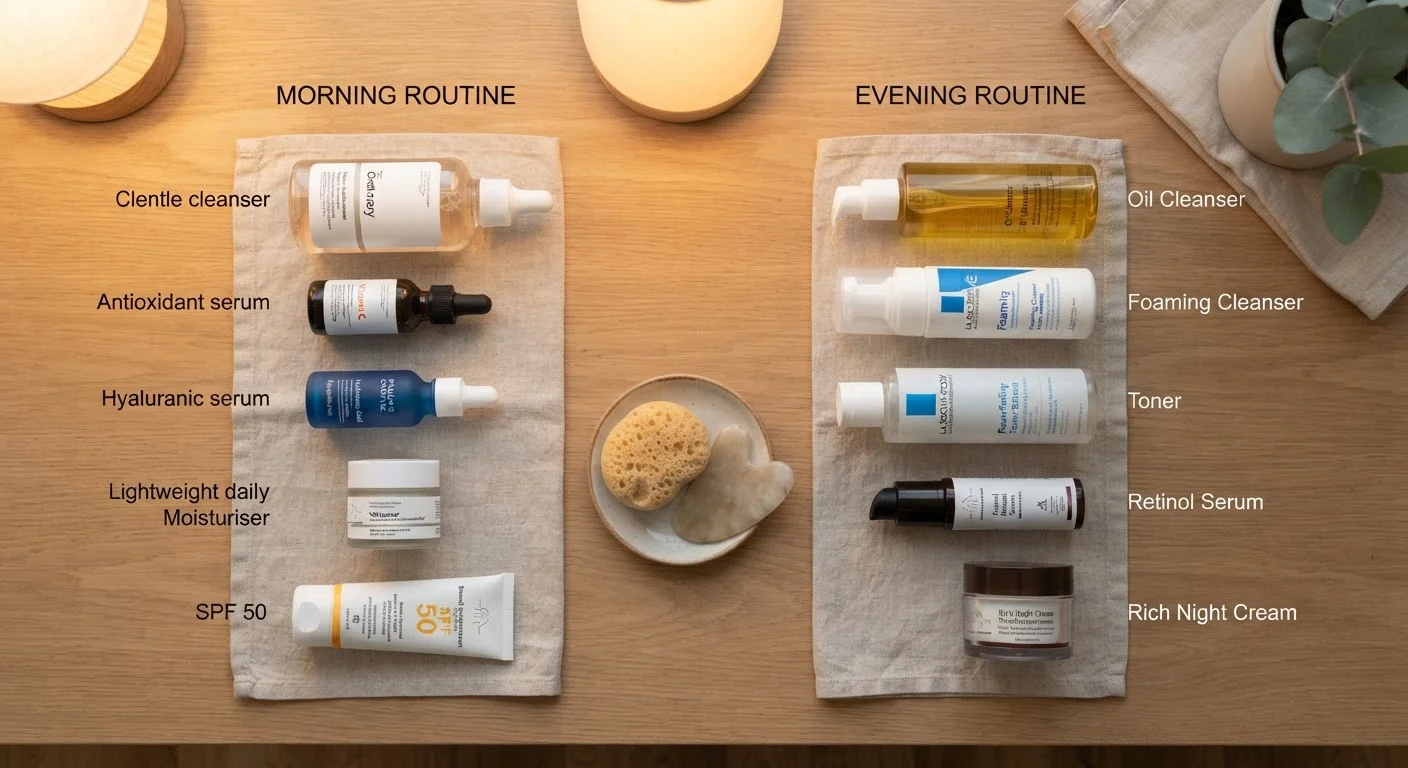
The morning routine's job is protection and preparation. The key steps and their reasoning:
- Gentle cleanse (or rinse): Overnight, skin sheds dead cells and releases oils. A light cleanse or water rinse removes this residue without stripping the barrier. If you cleansed thoroughly the night before, a heavy morning cleanse is often unnecessary.
- Antioxidant serum: Vitamin C (L-ascorbic acid) is the most studied option. Antioxidants neutralise free radicals generated by UV and pollution before they can damage collagen and DNA. They also enhance SPF efficacy — making this a genuinely synergistic pairing.
- Moisturiser: Hydration supports barrier integrity. In the morning, a lighter texture is generally preferable so it layers well under SPF and sits comfortably through the day.
- SPF (broad spectrum, SPF 30 minimum): This is non-negotiable. UV exposure is the leading environmental driver of premature ageing and pigmentation change. SPF belongs at the end of the morning routine, applied as the final skin step before any makeup.
| Criterion | Morning Routine | Evening Routine |
|---|---|---|
| Primary goal | Protection from UV and pollution | Repair and cellular renewal |
| Cleanse intensity | Light rinse or gentle cleanse | Thorough; double cleanse if wearing SPF/makeup |
| SPF | Essential — final step | Not needed |
| Antioxidants | Recommended (vitamin C) | Optional, not a priority |
| Retinoids / exfoliating acids | Avoid or use with caution | Best suited for nighttime |
| Moisturiser texture | Lighter, layers under SPF | Richer, supports overnight hydration |
| Skin's biological state | Higher sebum output, barrier primed | Elevated cell turnover, increased water loss |
Active ingredients like retinoids, AHAs, and BHAs have no place in a morning routine unless paired with high SPF and applied with caution — and even then, most dermatologists recommend reserving them for evenings.
What Belongs in an Evening Routine — and Why
The evening routine's job is restoration and treatment. Skin's elevated nighttime repair activity creates a receptive environment for actives that would otherwise cause sensitivity or photodegradation in daylight.
- Double cleanse (if wearing SPF or makeup): An oil-based cleanser first breaks down sunscreen and makeup, followed by a water-based cleanser to clear the skin itself. Sleeping on accumulated SPF and environmental pollutants can impair the skin barrier and block renewal processes.
- Exfoliating acids (2–3 nights per week): AHAs (such as glycolic or lactic acid) work on the skin surface; BHAs (such as salicylic acid) penetrate pores. Both are photosensitising — nighttime use reduces the risk of UV-triggered irritation.
- Retinoids: Whether prescription tretinoin or over-the-counter retinol, retinoids accelerate cell turnover and stimulate collagen synthesis. They degrade in UV light, making nighttime the only appropriate application window.
- Richer moisturiser or facial oil: As transepidermal water loss peaks overnight, a denser moisturiser helps maintain hydration during this vulnerable window.
The evening routine also benefits from being thorough rather than rushed. As explored in our related piece on evening habits that affect sleep quality, the wind-down period before bed shapes more than just your skin.
80%
Of visible skin ageing attributed to UV exposure
Research published in dermatology literature consistently estimates that photoageing accounts for the majority of extrinsic skin ageing, underscoring the importance of daily SPF.
2×
Higher cell turnover rate during sleep
Skin cell mitosis (division) has been shown to peak at night, roughly doubling relative to daytime rates, according to chronobiology research on skin physiology.
25–30%
Increase in transepidermal water loss overnight
Studies on skin barrier function indicate that moisture evaporation through the skin is measurably elevated during sleep, supporting the case for a richer evening moisturiser.
Ingredients That Cross Over — and Ones That Don't
Not every product needs two versions. Hyaluronic acid, niacinamide, peptides, and ceramide-based moisturisers are well-suited to both AM and PM use — they support hydration and barrier repair without photosensitivity concerns. If you're working with a simpler approach, a minimal routine can often outperform a complex one — particularly when fewer products means higher compliance.
The ingredients to keep strictly time-coded:
- Morning only
- Broad-spectrum SPF, antioxidant serums (especially vitamin C), lightweight hydrators
- Evening only
- Retinoids (retinol, retinaldehyde, tretinoin), AHAs, BHAs, benzoyl peroxide
- Either, with caution
- Niacinamide, azelaic acid (low concentrations), most peptides
If your skin is changing across decades, ingredient compatibility may shift too — our overview of how skin changes at 30, 40, and 50 explains what to anticipate and how to adapt.
This article is for informational purposes only and does not constitute medical or dermatological advice. If you have a skin condition or are unsure about specific ingredients for your skin type, consult a qualified dermatologist or healthcare professional.