

Key Takeaways
- Hair is made of keratin protein arranged in three layers: cuticle, cortex, and medulla.
- The cuticle acts as a protective barrier; its condition determines shine and smoothness.
- The cortex holds the pigment and gives hair its tensile strength and elasticity.
- Chemical and heat processes work by altering bonds within the cortex.
- Keeping the cuticle flat and intact is the foundation of most effective hair care.
- Structure knowledge helps you choose products that work at the right layer of the strand.
Hair Strand Structure
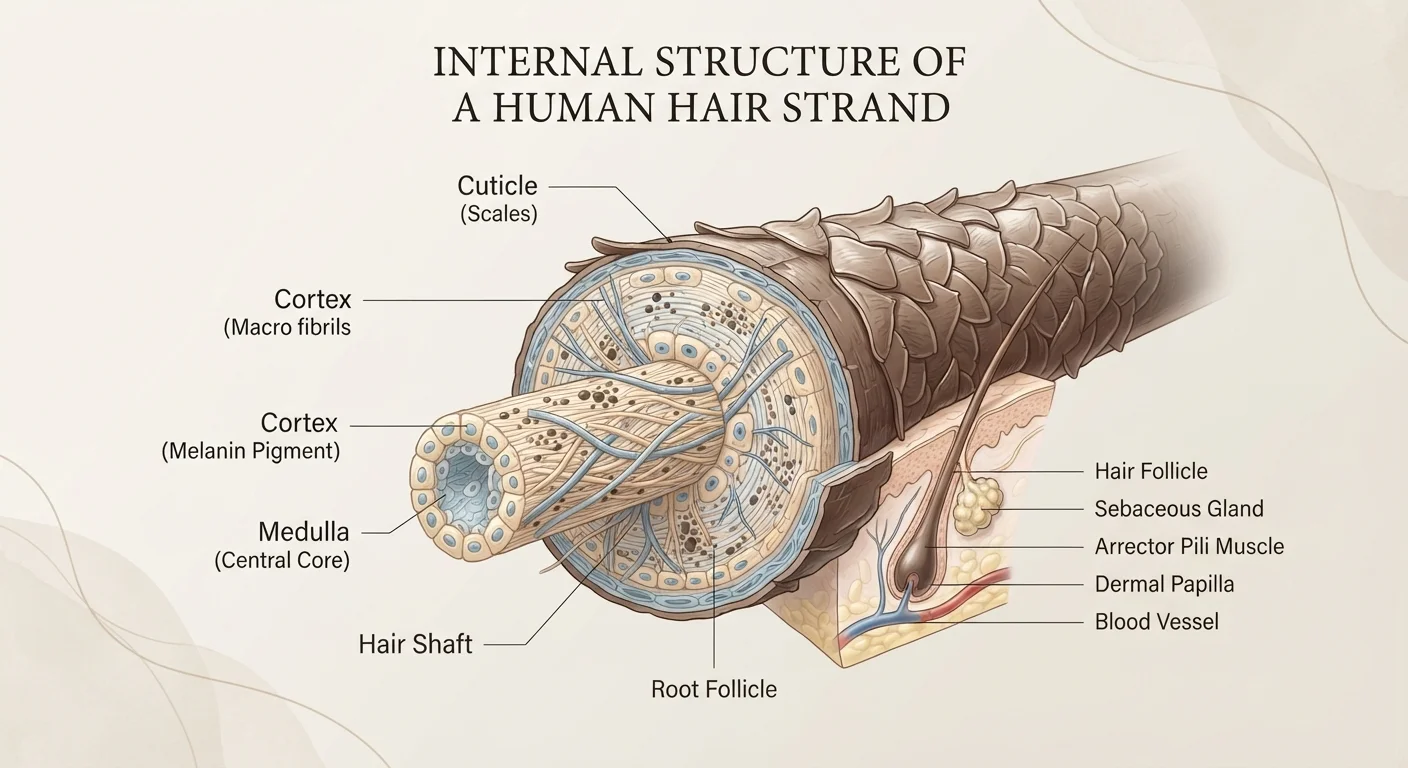
Every hair strand is composed of three concentric layers: an outer cuticle made of overlapping scale-like cells, a middle cortex that gives hair its strength and color, and an innermost medulla that runs through the center of thicker strands. Together, these layers determine how your hair looks, feels, and responds to products and styling. Understanding this architecture helps you make more informed decisions about how you treat and care for your hair.
Hair is primarily composed of a fibrous structural protein called keratin, arranged in alpha-helical coils within the cortex. The integrity of these protein bonds — including disulfide, hydrogen, and salt bonds — directly affects hair's mechanical behavior under chemical or thermal stress.
The Three Layers of Every Hair Strand
Before choosing a conditioner, a heat protectant, or any hair treatment, it helps to understand what you're actually working with. Each strand of hair, regardless of texture or type, shares the same basic architecture — three distinct layers that together determine how your hair behaves.
The cuticle is the outermost layer, composed of flat, overlapping cells arranged much like roof shingles or fish scales. Its primary job is protection: it shields the interior of the strand from environmental damage, friction, and moisture fluctuation. When cuticle cells lie tightly together, hair reflects light evenly and feels smooth to the touch. When they are raised — by heat, alkaline chemicals, or mechanical stress — the strand becomes rougher and more vulnerable.
The cortex sits beneath the cuticle and makes up the bulk of each strand. It is a dense matrix of keratin protein filaments and contains melanin, the pigment responsible for your natural hair color. The cortex is also where the bonds that give hair its strength, flexibility, and curl pattern reside. Disulfide bonds, which are strong and permanent, define the overall shape of the strand. Hydrogen bonds are weaker and temporary — they are the ones reset when you blow-dry or curl your hair.
The medulla is the soft, loosely structured core running down the center of the strand. It is most consistently present in coarser hair types and is sometimes absent in fine hair. Its precise role in hair function is not fully established by current research, though its presence or absence does not indicate a problem with hair health.
Why This Matters for Your Hair Care Routine
Most common hair concerns — frizz, breakage, dullness, lack of moisture retention — trace back to what is happening at the cuticle and cortex level. Products and practices work (or don't work) because of how they interact with these layers.
Hair Is Not Living Tissue
The hair shaft that extends beyond the scalp is composed of dead, keratinized cells. It cannot heal itself the way skin does. This is why prevention — minimizing damage before it occurs — is more effective than attempting to repair a strand after the fact. Treatments that claim to 'repair' damaged hair are typically smoothing or temporarily reinforcing the existing structure, not regenerating it.
Conditioners, for example, work primarily at the cuticle. Ingredients like cationic polymers and fatty alcohols deposit onto the negatively charged surface of the hair shaft, smoothing lifted cuticle scales and temporarily reducing static and friction. They don't penetrate the cortex in meaningful amounts, which is why conditioning alone won't fix structural damage.
Heat styling works on hydrogen bonds in the cortex. Apply heat, and those bonds break; remove heat (and allow the strand to cool in its new shape), and the bonds reform. This is why cooling down after heat styling helps hold a curl or a blowout. Repeated or excessive heat degrades both the cuticle integrity and cortex protein structure over time.
Chemical services — relaxers, perms, and bleach — go further. They penetrate the cuticle to alter disulfide bonds in the cortex, which is why these processes create more lasting structural changes and also carry more risk of damage if overused or misapplied.
For a deeper look at how different product categories interact specifically with the hair shaft, see how oils, butters, and serums each behave at the fibre level.
Protect the Cuticle First
Most hair care advice ultimately reduces to one principle: keep the cuticle intact. Use lukewarm rather than hot water when washing, always apply heat protectant before any thermal styling, and detangle gently starting from the ends. These habits reduce mechanical and thermal stress at the cuticle before they can cascade into cortex damage.
From Structure to Smarter Choices
Knowing the basics of hair architecture shifts the way you evaluate products and routines. Instead of chasing trending ingredients, you can ask a more useful question: which layer of my strand does this product target, and is that what my hair actually needs right now?
~95%
Keratin protein composition of each hair strand
Hair is composed of approximately 95% keratin protein by dry weight, according to established trichology references, with the remainder comprising lipids, water, and trace minerals.
3 layers
Structural layers in every hair strand
Regardless of hair type, texture, or ethnicity, all human hair shares the same three-layer architecture: cuticle, cortex, and medulla.
~4.5–5.5
Healthy hair shaft surface pH range
The natural surface pH of hair falls in the mildly acidic range, which helps keep cuticle scales closed; products that significantly exceed this range can raise and weaken the cuticle over time.
Hair that feels dry but looks shiny might have an intact cuticle but a depleted cortex — a scenario where deep conditioning or protein support is more relevant than adding more surface-smoothing serums. Hair that looks dull and feels rough is more likely dealing with raised cuticle cells, which respond well to acidic rinses, smoothing conditioners, and reduced friction during detangling.
This structural framework also helps explain why hormonal shifts can change your hair's feel and behavior. Changes in sebum production, cortex protein synthesis, and growth cycles all have downstream effects on strand integrity — a topic explored further in how hormonal changes affect hair texture, density, and growth cycles.
Once you have a working model of your hair's structure, the next logical step is understanding how it performs — which is where properties like porosity and elasticity come in. Porosity, elasticity, and density are the measurable expressions of your strand's structural condition, and knowing yours makes every product and routine decision more precise.
This article is for general informational and educational purposes only. It is not a substitute for professional advice from a licensed trichologist, dermatologist, or other qualified healthcare provider.