

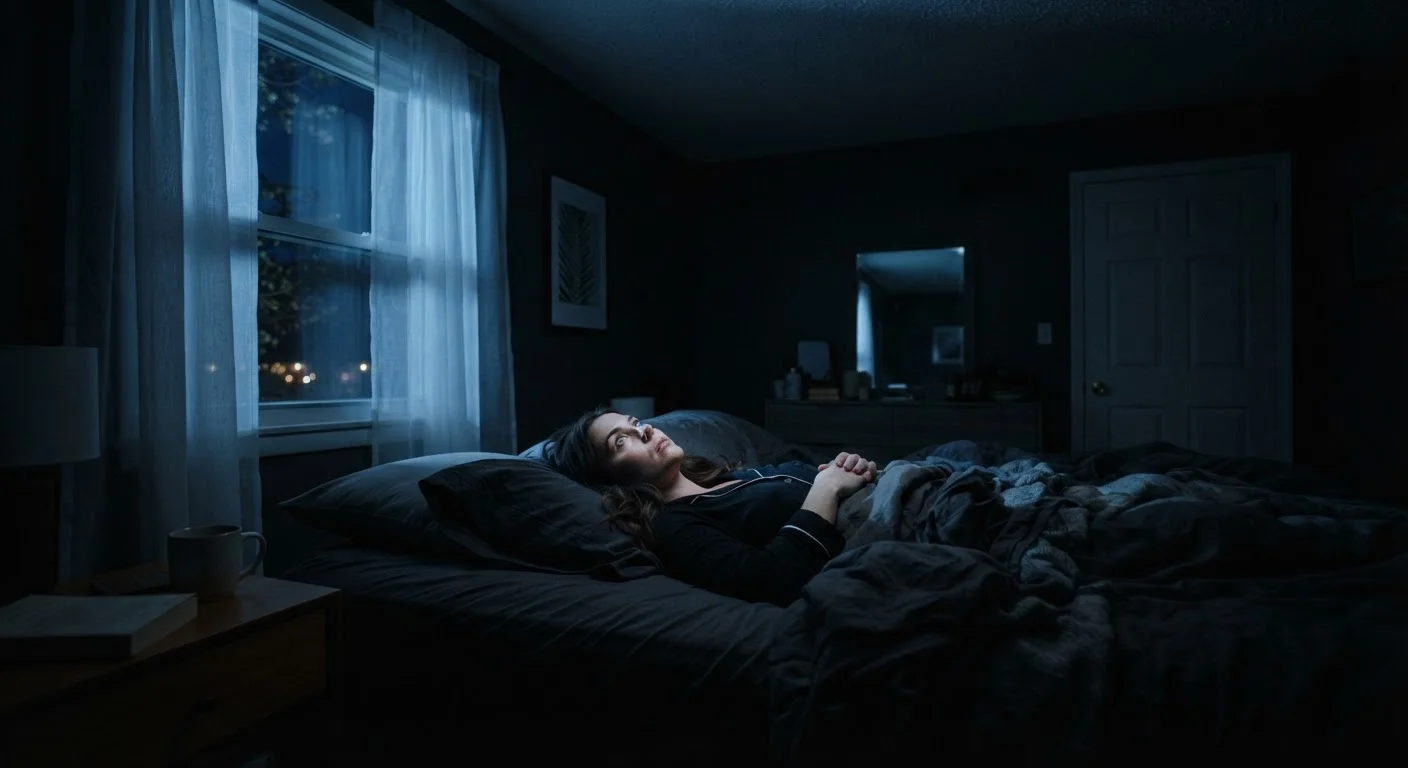
Key Takeaways
- Nighttime stress feels worse because the brain loses its daytime distractions, not because problems get bigger after dark.
- Cortisol, the body's primary stress hormone, follows a daily rhythm that can misfire when chronic stress is present.
- The prefrontal cortex becomes less active near sleep, reducing the brain's ability to rationalize anxious thoughts.
- Evidence-informed habits like scheduled worry time and body-based relaxation can interrupt the cycle.
- Persistent nighttime anxiety that disrupts sleep regularly warrants a conversation with a healthcare professional.
Nocturnal Stress Amplification
Nocturnal stress amplification is the tendency for anxiety and worry to feel significantly more intense at night than during the day. This happens because the brain's natural daytime distractions disappear, cortisol levels shift, and the nervous system enters a different regulatory state. The result is a quieter environment in which anxious thoughts take center stage.
Research in sleep science points to the role of the prefrontal cortex, which governs rational thinking and becomes less active as the brain prepares for sleep, leaving the amygdala — the brain's threat-detection center — with relatively more influence over emotional processing.
Why the Brain Turns Up the Volume at Night
Picture this: you managed the day with reasonable composure — meetings, to-do lists, family logistics. Then you lie down, and suddenly the thing you barely thought about at 2 p.m. becomes an overwhelming preoccupation at 11 p.m. You haven't changed. The problem hasn't changed. But something in your brain has.
During the day, constant sensory input — screens, conversations, physical movement — keeps the brain's attentional resources occupied. This isn't avoidance; it's normal cognitive load. At night, that scaffolding disappears. The brain, now understimulated externally, turns its processing power inward. Unresolved emotional material that was effectively suppressed by busyness surfaces with new clarity and urgency.
Sleep researchers describe this as a reduction in "cognitive load buffering" — the daytime noise that keeps rumination at bay. Once the buffer is gone, the default mode network (the brain's introspective, self-referential circuit) becomes more active, and worry loops have room to run. Understanding this mechanism is the first step toward working with your brain rather than against it. For a deeper look at how the body's stress chemistry interacts with sleep, see the cortisol connection explained.
~1 in 3
Adults who regularly experience poor sleep
According to the U.S. Centers for Disease Control and Prevention (CDC), insufficient sleep is considered a public health concern affecting a substantial portion of the adult population.
Up to 40%
Of insomnia cases linked to anxiety or stress
Research published in sleep medicine literature consistently finds that psychological stress and anxiety disorders are among the most common identifiable contributors to chronic insomnia.
6–8 hrs
Recommended nightly sleep for most adults
The American Academy of Sleep Medicine recommends that adults aged 18–60 get at least seven hours of sleep per night for optimal health.
The Hormonal Shift Nobody Warned You About
Cortisol — often called the stress hormone — follows a predictable daily curve. It peaks in the early morning to help the body mobilize for the day, and gradually declines through the afternoon and evening, reaching its lowest point around midnight. This decline is supposed to signal the body that it's safe to rest.
But chronic stress disrupts this rhythm. When the body has been in a prolonged state of threat-response, cortisol levels may remain elevated into the evening, or the normal evening drop becomes blunted. The physiological result is a body that is biochemically primed for alertness at exactly the time it needs to wind down.
Simultaneously, the prefrontal cortex — responsible for rational appraisal, perspective-taking, and calming emotional reactions — becomes progressively less active as sleep pressure builds. The amygdala, which flags threats and generates fear responses, doesn't power down at the same rate. This neurological imbalance means that by 10 or 11 p.m., the brain's threat-detector has more relative influence than its rational moderator. Anxious thoughts don't just feel louder; they are, in a measurable sense, less filtered. This is not a character flaw. It is biology.
What Sleep Science Actually Recommends
The field of behavioral sleep medicine offers several evidence-informed strategies for reducing the intensity of nighttime stress. These aren't quick fixes — they work by gradually retraining the nervous system's association between bed and safety.
Scheduled Worry Time
One of the most counterintuitive but well-studied techniques is to deliberately worry — but earlier. Setting aside 15–20 minutes in the afternoon or early evening to write down concerns and, where possible, a single next step, teaches the brain that problems have a dedicated processing window. When worry surfaces at midnight, the brain has a reference point: this has already been attended to.
Extended Exhale Breathing
Breathing with a longer exhale than inhale activates the parasympathetic nervous system — the "rest and digest" branch — which counteracts the arousal state that stress produces. Patterns like a four-count inhale and six-to-eight-count exhale are cited in multiple clinical contexts as accessible and effective for promoting calm.
Environmental Cues That Signal Safety
The brain learns to associate environments with states. If your bedroom is also where you work, scroll, or argue, the brain doesn't reliably associate it with rest. Small, consistent cues — a specific scent, dimmed lighting, a consistent pre-sleep sequence — help the nervous system shift gear. See evening wind-down signals your brain needs for practical examples of building these associations.
Try the 4-6 Breathing Pattern Tonight
Inhale slowly through your nose for a count of four, then exhale through your mouth for a count of six to eight. Repeat for five minutes in bed. The extended exhale is the key — it's what signals the parasympathetic nervous system to shift the body toward calm. This technique requires no equipment and has no reported side effects for most people.
Building Habits That Stick
None of these strategies require perfection or a completely overhauled lifestyle. What sleep science consistently shows is that small, repeated signals compound over time. A five-minute breathing practice done nightly is more effective than an hour-long relaxation session done occasionally.
If you want a structured way to assess which evening habits may already be working against your sleep, auditing your evening routine is a useful starting point. And for a step-by-step framework to build a calming end-of-day practice, building a wind-down routine that reduces evening anxiety offers concrete, accessible guidance.
It's also worth noting what the evidence does not support as broadly effective: alcohol as a sleep aid (it reduces REM sleep quality), exhausting yourself to force sleep (it increases arousal), and suppressing anxious thoughts (which tends to amplify them). For a fuller picture of what common stress advice gets wrong, stress management myths worth questioning is worth a read.
This article is for general informational purposes only and does not constitute medical advice. If nighttime anxiety is significantly affecting your sleep or daily wellbeing, please consult a qualified healthcare professional.