

Key Takeaways
- Functional fitness trains movement patterns, not just isolated muscles.
- It prioritizes how your body performs daily tasks over how it looks.
- Activities like squatting, carrying, and rotating are at its core.
- It suits women at any fitness level and doesn't require a gym.
- Research links functional strength to better long-term mobility and injury resilience.
Functional Fitness
Functional fitness refers to physical training that prepares your body for the movements you actually perform in everyday life — things like lifting, carrying, bending, reaching, and balancing. Rather than isolating individual muscles for appearance, it trains multiple muscle groups to work together in ways that mirror real-world tasks. The goal is a body that feels capable and resilient, not just one that looks a certain way.
In exercise science, functional training often emphasizes multi-planar, compound movements — exercises that engage joints and muscles across more than one plane of motion, mimicking the complexity of daily physical demands.
Why the Definition Actually Matters
Fitness culture has a language problem. Terms get borrowed from clinical or sports science contexts, stripped of nuance, and plastered on workout programs that may have little to do with the original concept. "Functional fitness" is one of those terms worth reclaiming — because what it actually means is genuinely useful, especially for women who are exhausted by an industry that keeps centering aesthetics over lived experience.
At its core, functional fitness is movement training organized around what your body needs to do in real life. That means exercises selected not because they sculpt a particular muscle group, but because they improve your ability to move through your actual day — with less discomfort, more ease, and greater confidence. It's the difference between training to look capable and training to be capable.
This distinction matters more than it might seem. When movement is tied exclusively to appearance, motivation tends to be fragile and contingent on results you can see. When movement is tied to how you feel and function, the motivation becomes something steadier — rooted in daily experience rather than the mirror. That shift is at the heart of why functional fitness resonates with so many women navigating busy, unpredictable lives.
What Functional Fitness Actually Includes
Functional fitness centers on movement patterns rather than individual muscles. The key patterns most experts point to include: pushing and pulling (think opening doors or lifting items overhead), hinging (bending to pick something up from the floor), squatting (sitting and standing, repeatedly, all day), carrying (groceries, a child, a laptop bag), rotating (turning to reach something behind you), and single-leg stability (navigating stairs, uneven ground, a crowded train).
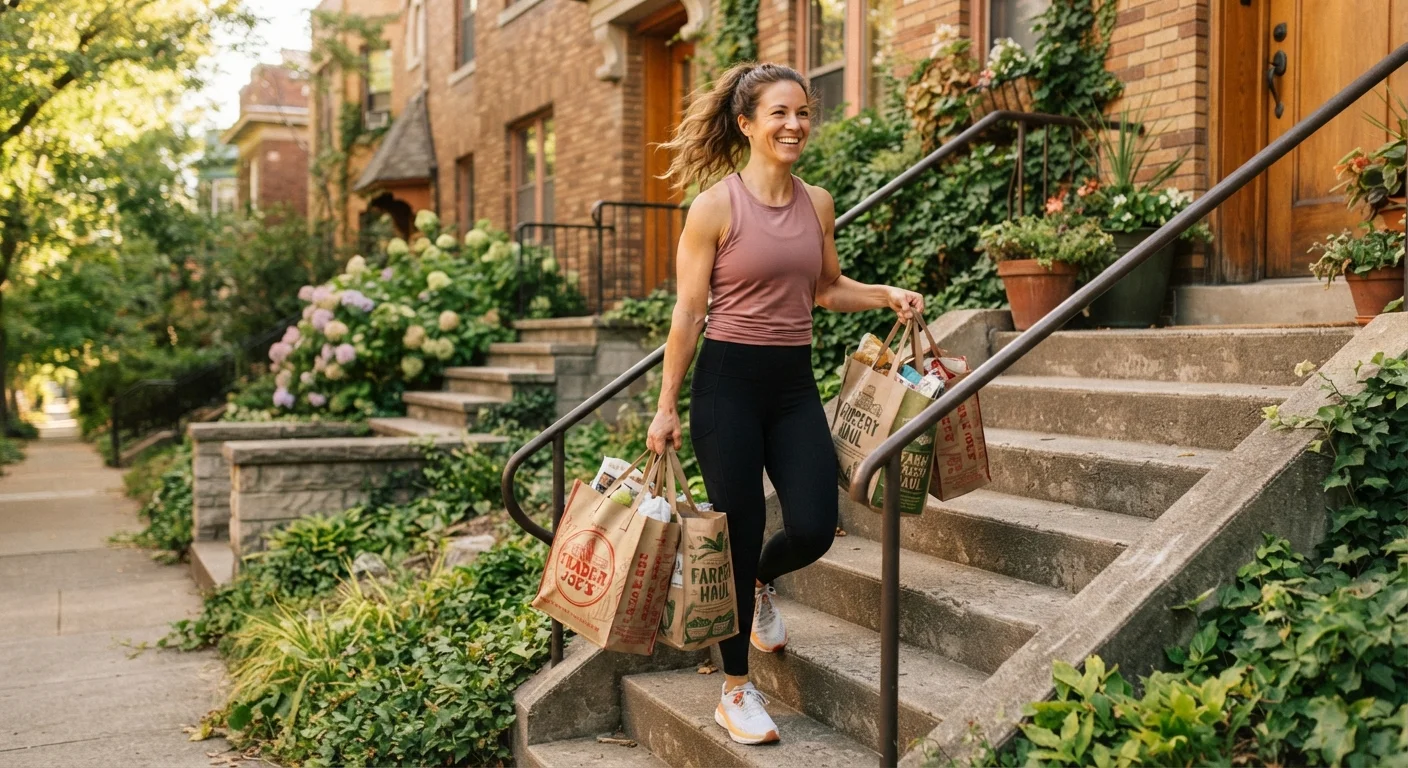
These aren't exotic gym movements — they're the physical vocabulary of ordinary life. A deadlift trains the hip hinge you use every time you load the dishwasher. A farmer's carry mirrors what happens when you haul bags from the car. A single-leg balance drill prepares you for the moment you step off a curb without thinking about it.
80%
Adults who don't meet recommended activity guidelines
According to the CDC, approximately 80% of American adults do not meet both aerobic and muscle-strengthening physical activity guidelines — suggesting the current gym-centric fitness model isn't working for most people.
28%
Reduction in fall risk with functional strength training
A review published in the British Journal of Sports Medicine found that exercise programs targeting balance and functional strength reduced fall risk in older adults by around 28%, highlighting the real-world impact of this approach.
3 in 5
Women who cite enjoyment as key to exercise consistency
Research in exercise motivation consistently finds that women who cite enjoyment and intrinsic reward as primary reasons for moving are significantly more likely to maintain physical activity long-term.
None of this requires a gym membership, a personal trainer, or any specific equipment, though all of those can be helpful. It requires intentional attention to how you move, not just how much. For women who feel shut out of fitness culture — or burned by it — that's a meaningful reframe. If you're also looking at building a movement routine that fits an unpredictable schedule, functional training adapts particularly well to fragmented time.
The Case Against Making Aesthetics the Goal
This isn't an argument against caring about how you look — that's a personal choice and a legitimate one. It's an argument against making appearance the primary metric of fitness success, because research in exercise psychology consistently shows that intrinsic motivators (how movement makes you feel, what it lets you do) produce more durable exercise habits than extrinsic ones (how you look as a result).
“The goal of training should be to make you better at living — not just better at training. When we shift the focus from performance in the gym to performance in daily life, exercise becomes something you do for yourself rather than to yourself.”
— Brad Schoenfeld, Associate Professor of Exercise Science, CUNY Lehman College
Perfectionism-coded fitness culture — the language of "earning" meals, "fixing" your body, or measuring progress only in inches — tends to create an adversarial relationship with movement. Functional fitness reorients the question: not "does this make me look different?" but "does this make me move better?" That's a question with more honest, more frequent, and more encouraging answers.
It also connects naturally to broader wellbeing. The mindful living practices that help women stay grounded — presence, intentionality, awareness of the body — translate directly into how functional training asks you to move. You're paying attention to your body as a system, not performing for an audience.
And if you've been held back by the "no pain, no gain" mindset, it's worth reading about why that mantra may be undermining your consistency. Functional fitness, by contrast, celebrates movement that feels sustainable — even enjoyable — rather than punishing.
This article is for general informational purposes only and does not constitute medical or fitness advice. Please consult a qualified healthcare or exercise professional before starting a new physical activity program, particularly if you have existing health conditions or injuries.