

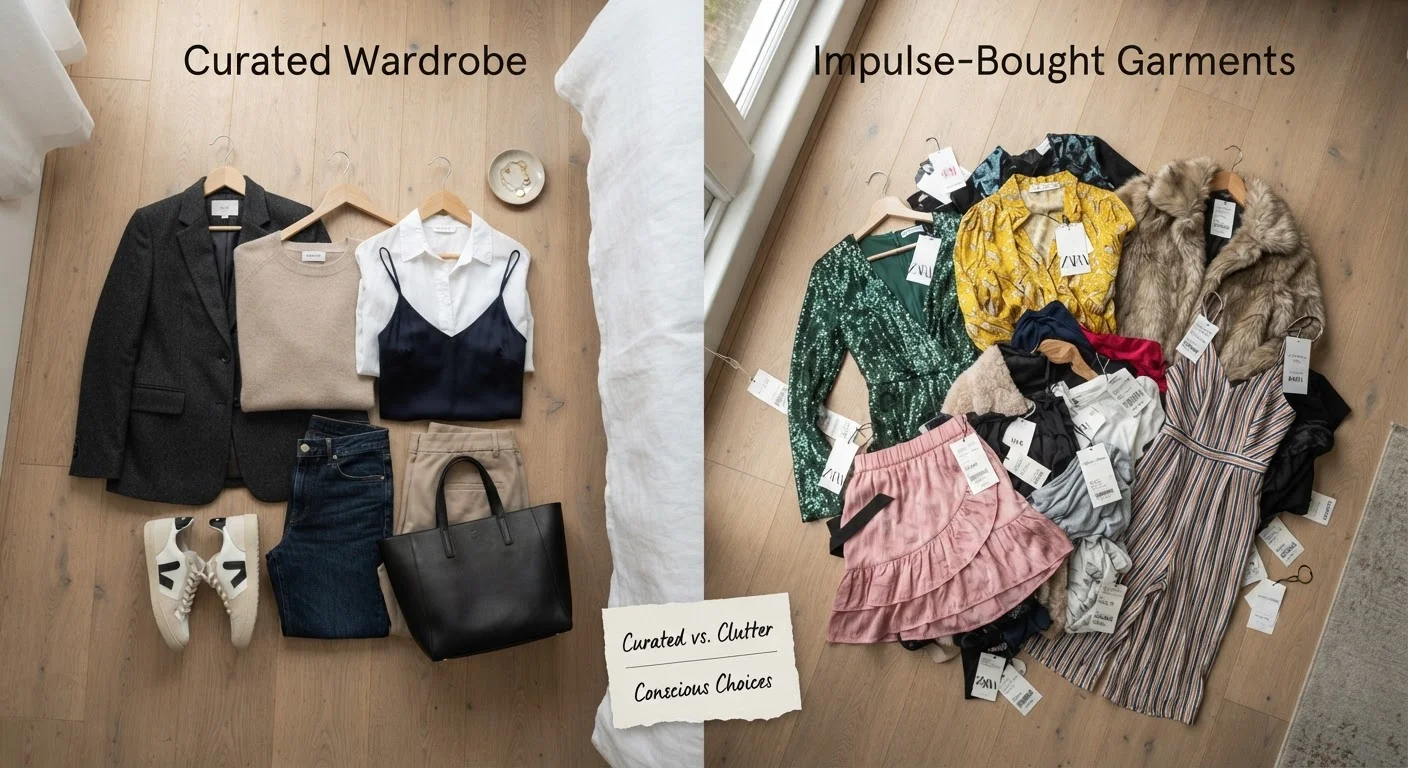
Key Takeaways
- Impulse buying often signals unmet style needs or emotional responses to external trend pressure.
- Intentional shopping is a skill built over time by knowing your style identity and wardrobe gaps.
- Neither habit is purely good or bad — the patterns they reveal are what matter most.
- A wardrobe audit helps bridge the gap between reactive and purposeful purchasing decisions.
- Understanding your shopping triggers is foundational to developing a consistent personal style.
Option A
Impulse Buying
The instinctive, emotion-driven response to shopping.
Best for: Moments of self-discovery when you're open to experimenting with pieces outside your usual comfort zone.
Option B
Intentional Shopping
The deliberate, values-led approach to building a wardrobe.
Best for: Anyone ready to stop accumulating and start curating a closet that genuinely reflects who they are.
If your closet is full but you feel you have nothing to wear
Intentional Shopping
A closet crowded with disconnected pieces signals reactive buying. Shifting to intentional shopping helps you build outfits, not just accumulate items.
If you want to discover what genuinely excites you about style
Impulse Buying (selectively)
Occasional unplanned purchases can surface aesthetic preferences you hadn't consciously identified — treat them as style data, not failures.
If you are building a foundational, versatile wardrobe
Intentional Shopping
Foundational pieces require deliberate selection. Intentional shopping ensures each addition integrates into what you already own and love.
If you frequently experience buyer's remorse after shopping
Intentional Shopping
Repeated regret is a clear signal that purchases aren't aligning with your actual style identity or lifestyle needs.
What Your Shopping Habits Are Actually Telling You
Every purchase you make — planned or spontaneous — is a piece of information. Together, your shopping habits form a pattern that reveals where your style identity stands: clearly defined, still forming, or quietly shaped by forces outside yourself.
Impulse buying is often framed as a flaw, but it's more accurate to read it as a signal. When you reach for something because it's on a table at the front of a store, because a trend is everywhere, or because you're having a hard week, you're responding to an external pull rather than an internal compass. That's not a moral failing — it's a gap between your style clarity and the pressure of the moment. The psychology behind retail therapy is worth understanding if you notice shopping functioning more as an emotional outlet than a creative one.
Intentional shopping, by contrast, requires that you already know something about yourself: your aesthetic preferences, your lifestyle demands, what's missing and what's redundant in your wardrobe. It's a skill, not a personality trait — and it becomes easier once you've done the foundational work of identifying your personal style base.
Side-by-Side: How the Two Approaches Differ
Understanding the structural difference between impulse and intentional purchasing helps you see which mode you're operating in — and why.
| Criterion | Impulse Buying | Intentional Shopping |
|---|---|---|
| Decision driver | Emotion, trend, or environment | Style identity and wardrobe gaps |
| Time horizon | Immediate satisfaction | Long-term wardrobe coherence |
| Outcome | Disconnected, orphaned pieces | Integrated, versatile additions |
| Style signal | Style identity still forming | Clear aesthetic direction |
| Buyer's remorse risk | Higher | Lower |
| Value as style data | High — reveals latent preferences | High — confirms defined taste |
Neither column is an absolute verdict on your shopping character. Most women move between both modes depending on context, mood, and clarity of intent. What matters is the ratio — and whether your wardrobe reflects who you actually are or who you were briefly convinced you wanted to be. If you're finding that inspiration boards are driving more purchases than your own preferences are, dressing for your life rather than your Pinterest board offers a grounding reframe.
The Style Data Hidden in Your Impulse Purchases
Before dismissing every impulse buy as a mistake, look at the pattern across them. Do your unplanned purchases lean toward a specific color palette? A recurring silhouette? A texture or fabric you keep reaching for? Impulse purchases, reviewed collectively, often reveal aesthetic preferences you haven't yet consciously claimed.
The problem isn't usually the individual piece — it's that it arrives without context. It doesn't connect to what you already own, so it sits unworn, and the purchase feels like a waste. A structured closet audit is one of the most practical tools for making sense of these orphaned pieces and turning their patterns into actionable style intelligence.
Impulse Buys Aren't Always Wasted
An unplanned purchase that you reach for constantly and style effortlessly is telling you something important about your aesthetic. The goal isn't to eliminate spontaneity from shopping — it's to understand what's driving it. When an impulse buy becomes a wardrobe staple, it's worth asking what it has in common with your other most-worn pieces. That intersection is where your signature style lives.
Intentional shopping doesn't mean rigid or joyless shopping. It means you've done enough self-study to know what earns a place in your wardrobe — and you're less susceptible to the noise around you.
Building Toward Intentional: A Practical Shift
The shift from reactive to intentional shopping isn't about willpower — it's about process. Having a short list of genuine wardrobe gaps, a clear sense of your style identity, and a pause-before-purchase habit replaces the need for restraint with the clarity of purpose.
Practical friction helps. Waiting 24–48 hours before completing an online purchase, or leaving a store without an item and seeing whether you think about it again, are low-effort ways to distinguish genuine want from situational impulse. The questions to ask before you buy can serve as a reliable gut-check before committing.
Your wardrobe should function as an expression of your identity, not a record of your most susceptible moments. When the ratio of intentional to impulsive purchases shifts, so does the coherence of your closet — and the ease with which you get dressed every day. For a broader framework on mindful living, the same principles of pause and presence that apply to daily habits translate directly into how you shop.