

Key Takeaways
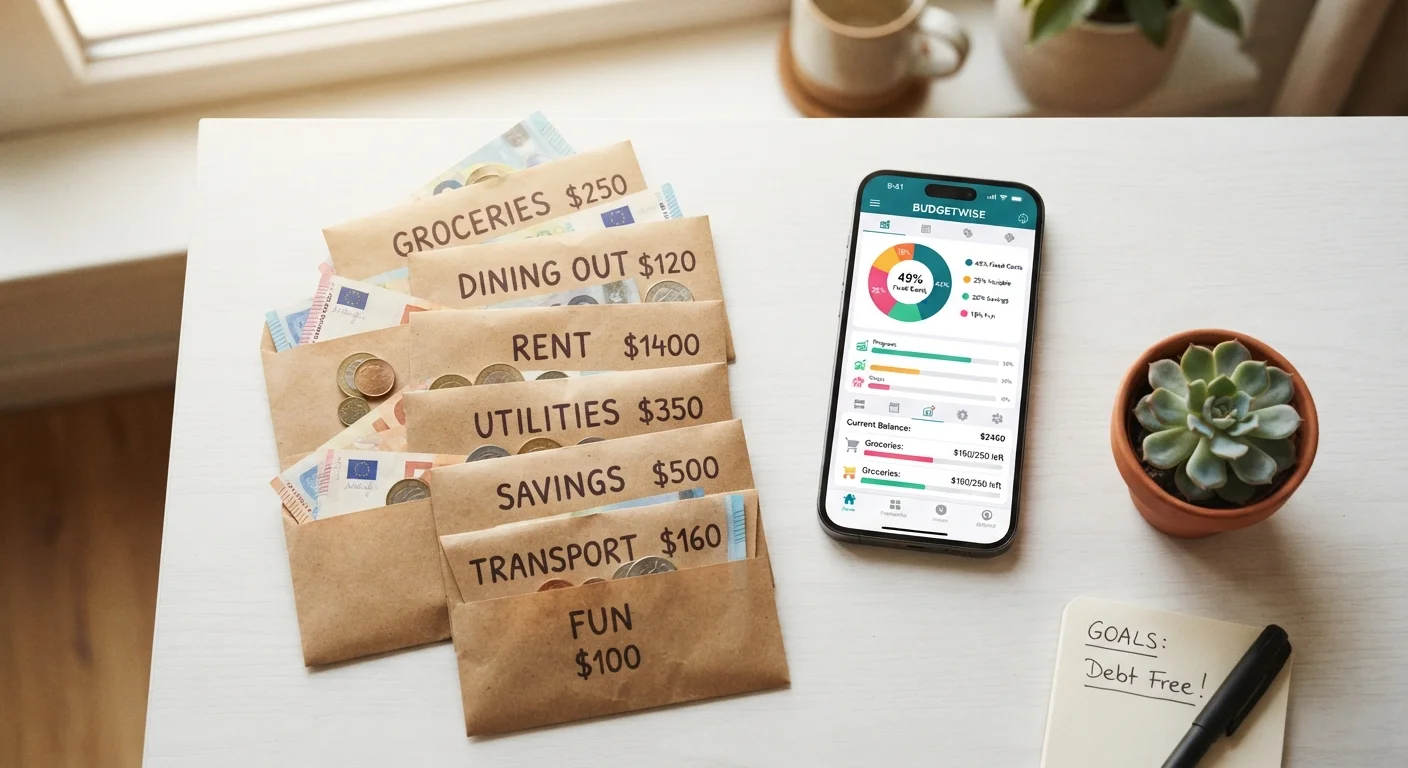
- Envelope budgeting uses physical cash divided into categories to create hard spending limits.
- Digital tracking apps sync with accounts automatically, offering detailed spending data with less manual effort.
- The envelope method tends to reduce impulse spending; digital tools excel at revealing patterns over time.
- Neither method is universally superior — the right choice depends on your spending habits and lifestyle.
- Hybrid approaches combining both methods are a practical option for many budgeters.
Option A
Envelope Budgeting
The tactile, zero-temptation cash method.
Best for: People who want physical spending limits and benefit from the psychological weight of handling real cash.
Option B
Digital Tracking
The automated, data-rich modern approach.
Best for: People who manage mostly card-based spending and want real-time visibility across all accounts.
If you tend to overspend on discretionary categories like dining or shopping
Envelope Budgeting
The physical act of handing over cash — and watching the envelope empty — creates a natural brake on spending that a notification rarely replicates.
If most of your spending is cashless or you travel frequently
Digital Tracking
Digital tools integrate with cards and accounts seamlessly, making them practical when carrying cash is inconvenient or impractical.
If you're new to budgeting and want to understand your spending patterns first
Digital Tracking
Several weeks of tracked data gives you a clear baseline before you commit to any category allocations.
If you're managing a tight budget and need absolute category discipline
Envelope Budgeting
When the envelope is empty, spending stops — a built-in constraint that digital alerts alone often fail to enforce.
If you want comprehensive financial oversight including saving and investing goals
Digital Tracking
Most budgeting apps display savings progress, debt payoff timelines, and net worth alongside day-to-day spending in one unified view.
What Each Method Actually Involves
Envelope budgeting is a cash-based system popularised by personal finance educators for decades. At the start of each pay period, you withdraw your budgeted cash and divide it among labeled envelopes — one per spending category, such as groceries, transport, or entertainment. When an envelope is empty, that category is done for the month. The constraint is physical and immediate.
Digital tracking works differently. Apps and personal finance platforms connect to your bank accounts, credit cards, and payment services, categorising every transaction automatically. You see spending in real time across all accounts, can set category budgets, and receive alerts when you approach a limit. No cash withdrawal is required.
If you're building your first budget from scratch, start with the fundamentals before choosing a tracking method — understanding your income and fixed obligations comes first.
| Criterion | Envelope Budgeting | Digital Tracking |
|---|---|---|
| Core mechanism | Physical cash divided into categories | Automatic account syncing and categorisation |
| Best spending type | Cash-based, in-person purchases | Card, online, and multi-account spending |
| Spending friction | High — empty envelope stops spending | Low — alerts only; no hard stop |
| Setup effort | Moderate — requires cash withdrawal routine | Low — accounts connect automatically |
| Ongoing effort | Low — physical system is self-enforcing | Moderate — requires reviewing and correcting data |
| Data and trend insight | Limited — no automatic reporting | High — detailed history and spending patterns |
| Privacy and security | High — no data shared with third parties | Variable — depends on app's security practices |
| Flexibility for irregular expenses | Lower — requires envelope reallocation | Higher — categories can be adjusted instantly |
The Psychology Behind Each Approach
The envelope method draws on a well-documented behavioral principle: paying with physical cash tends to feel more real than a card tap or digital transaction. Research in behavioral economics has consistently found that cash payments are associated with greater spending awareness, because the exchange feels more tangible. This friction isn't a flaw — it's a feature for anyone who struggles with discretionary overspending.
Digital tracking offers a different psychological lever: visibility. Seeing a categorised breakdown of three months of spending can be genuinely eye-opening. Patterns that felt invisible — a steady stream of small purchases, subscription creep, frequent restaurant meals — become hard to ignore when presented as data. Understanding the emotional drivers behind those patterns matters too; money and emotion are deeply connected, and the right method should work with your psychology, not against it.
~33%
Americans with a formal monthly budget
Gallup polling has consistently found that roughly one in three U.S. adults maintains a detailed household budget, suggesting most people track spending informally if at all.
Less spending
Cash vs. card payment effect
Multiple behavioral studies, including research published in the Journal of Consumer Research, have found that consumers typically spend less when paying with cash compared to credit or debit cards.
Top reason
Why people abandon budgets
Financial educators and surveys frequently cite the perceived complexity and time required to maintain a budget as the leading reason people discontinue the habit within the first three months.
Practical Trade-Offs Worth Knowing
Envelope budgeting has real limitations in a cashless world. Online payments, subscriptions, and card-only merchants don't fit neatly into a cash system. Workarounds exist — some people use labeled physical pouches alongside a debit card, mentally deducting from the relevant category — but this requires consistent discipline to maintain accurately.
Digital tracking tools, meanwhile, are only as useful as their categorisation accuracy. Auto-categorisation errors are common, and accounts with unusual transactions may require regular manual corrections. Data security is also a consideration: connecting financial accounts to third-party apps involves reviewing each platform's privacy and security practices carefully.
Before choosing, it helps to map out your fixed and variable costs clearly — this shapes which method will handle your specific spending structure more gracefully. For context on how rigid budget structures work more broadly, the case for and against a strict monthly budget offers a useful parallel perspective.
A Note on Digital App Security
When using any app that connects to financial accounts, review the platform's data-sharing practices and security certifications before linking sensitive information. Look for apps that use read-only account access, strong encryption standards, and clear data retention policies. No tracking tool, however convenient, is worth compromising your account security.
Can You Use Both at Once?
Many people find that a hybrid approach captures the advantages of each method. A common version: use digital tracking for recurring bills, savings transfers, and investment contributions — categories that are fixed or automated — while applying the envelope principle to discretionary spending like food, clothing, and leisure. This keeps cash where its friction is most useful and data where its clarity is most valuable.
If your broader goal includes building an emergency fund or growing savings alongside day-to-day budgeting, understanding how emergency funds differ from savings accounts will help you allocate those buckets correctly. Similarly, if you're weighing broader budgeting frameworks, zero-based versus percentage budgeting explores two structural approaches that work with either tracking method.
The goal of any budgeting method is clarity and control — not perfection. Starting with one system, evaluating it honestly after 60–90 days, and adjusting is more effective than searching indefinitely for the ideal setup before beginning.
This article is for general informational and educational purposes only and does not constitute personalised financial advice. For guidance specific to your financial situation, consult a qualified financial professional.