

Key Takeaways
- Terry cloth towel turbans create friction that physically roughens and snaps the hair cuticle.
- Elastic hair ties with metal seams are among the most common sources of mechanical breakage.
- Skipping regular trims allows split ends to travel up the shaft, worsening breakage over time.
- Brushing wet hair without the right tools stretches already-swollen strands past their elastic limit.
- Sleeping on rough cotton pillowcases generates nightly friction that compounds quietly for months.
Why Small Habits Create Big Damage
Hair breakage rarely announces itself with a single dramatic event. Instead, it accumulates — one tight elastic here, one rough towel dry there — until the cumulative effect shows up as snapping mid-shaft strands, fuzzy halo breaks around the hairline, and ends that split faster than they grow. Understanding the mechanism matters: hair is a dead protein fiber (primarily keratin) with a layered cuticle that, once compromised, cannot self-repair. That means every abrasive or over-stretching habit you repeat daily is permanently subtracting from the integrity of the strands you already have.
The habits below are worth examining not because they are obscure, but precisely because they feel harmless — and that invisibility is what makes them so effective at causing damage. Many of them also pattern-match to the same logic explored in our skincare habits worth reconsidering piece: the routines most likely to work against you are the ones you never think to question.
Wrapping wet hair in a terry cloth turban
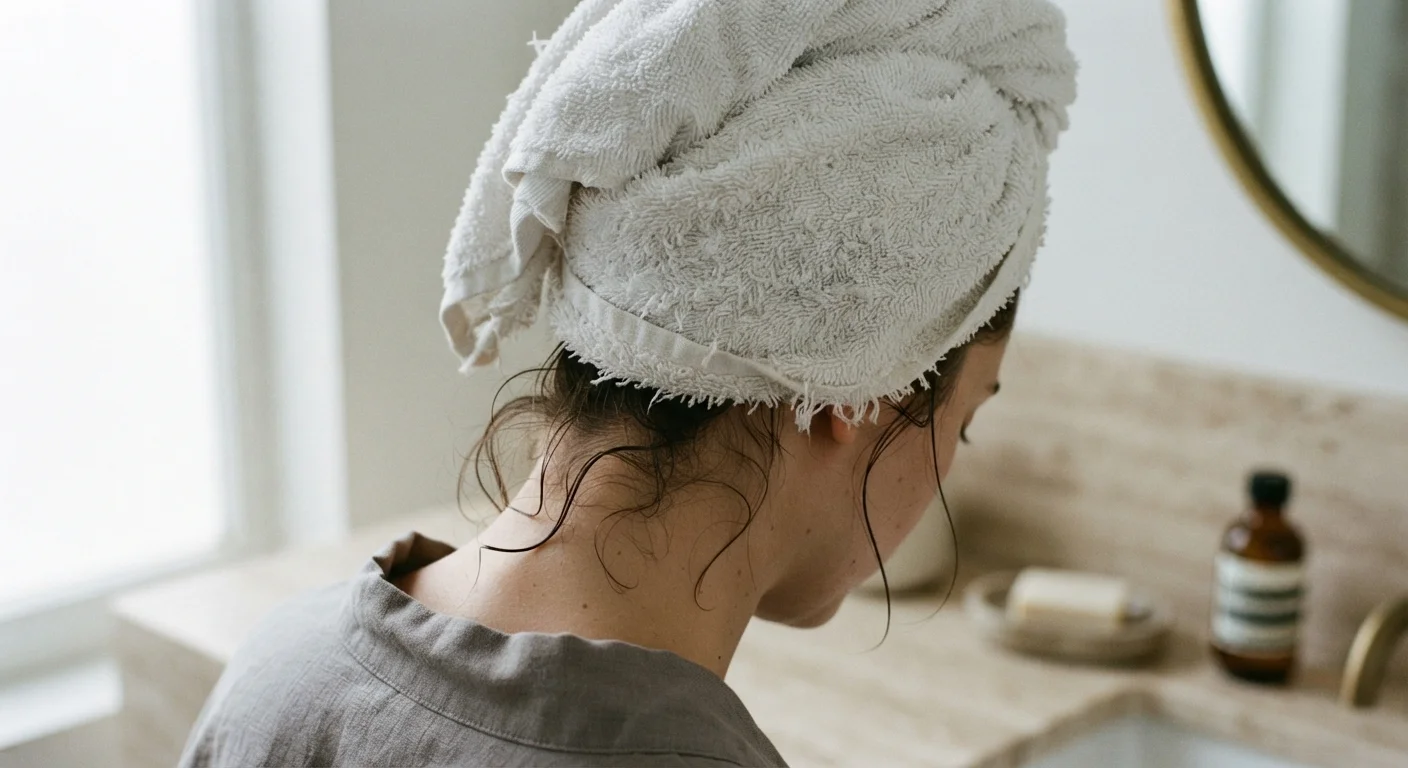
Terry cloth is woven from looped fibers designed for maximum absorption — which is exactly what makes it so abrasive against wet hair. When you twist damp strands into a turban and leave it in place, you are pressing thousands of rough fiber loops against the cuticle for an extended period. Wet hair has also absorbed water into its cortex, which swells the shaft and raises the cuticle scales, making them far more vulnerable to mechanical friction than dry hair. The result is cuticle lifting, roughening, and mid-shaft snapping — particularly noticeable at the nape and crown where the towel grips tightest. A microfiber towel or a clean, smooth cotton T-shirt creates a fraction of the surface friction and absorbs water nearly as effectively.
Wet hair's swollen cuticle is far more vulnerable to the friction that terry cloth creates.
Using elastics with metal seams or clasps
The small metal crimp that joins the two ends of a standard hair elastic is a literal cutting edge against hair fiber. Every time you remove the tie — especially if you pull rather than unwind it — strands catch on that seam and snap cleanly. Over weeks, this creates a consistent breakage pattern at whatever length you habitually wear your ponytail or bun. Seamless fabric ties, spiral coils, and ribbon-style elastics eliminate this point of contact entirely. Beyond the seam issue, wearing any elastic at the same tension point daily can weaken hair in a localized band, so rotating your tie placement slightly each day distributes the stress.
The metal seam on a standard elastic acts as a cutting edge against hair fiber every single use.
Skipping regular trims
A common misconception is that avoiding the scissors preserves length. In practice, an untreated split end does not stay contained: the split travels up the hair shaft over time, and the weakened section becomes prone to breaking at a point higher than the original damage. This means avoiding trims can actually cost you more length than the trim itself would have removed. For most hair types, a light trim every eight to twelve weeks — removing just enough to clear visible splitting — prevents the upward progression that leads to significant mid-shaft breakage. Trims do not make hair grow faster, but they do protect the length you already have.
Untreated split ends travel up the shaft, causing breakage well above the original damage point.
Brushing or detangling wet hair aggressively
Hair at its wettest has the lowest tensile strength of its natural cycle. Research in hair fiber mechanics consistently shows that wet hair stretches significantly more before breaking than dry hair — but it also reaches its breaking point more readily under sustained tension. Dragging a paddle brush or fine-tooth comb through knotted wet hair creates rapid, high-force pulling that snaps strands rather than releasing tangles. The better approach is to apply a detangling product or conditioner while hair is wet, then work through sections from the ends upward using a wide-tooth comb or a brush specifically engineered for wet detangling. Starting at the roots and pulling down is the habit most likely to cause mechanical breakage. This connects directly to the evidence covered in our heat styling and hair damage piece — tool choice matters as much as technique.
Wet hair stretches more before breaking, but it also snaps more readily under sustained tension.
Sleeping on rough cotton pillowcases
Seven or eight hours of contact with a standard percale cotton pillowcase generates significant surface friction as you shift positions throughout the night. That friction translates to cuticle roughening, tangling, and — particularly for those with curly or textured hair where the cuticle is naturally more raised — breakage concentrated along the outer perimeter of the hair where it contacts the pillow most. A tightly woven satin or silk pillowcase dramatically reduces this friction coefficient. An alternative is wrapping hair loosely in a satin-lined sleep cap or bonnet, which serves the same mechanical purpose. Neither of these substitutions changes your product routine; they simply reduce the nightly physical abrasion that accumulates invisibly over months.
Hours of nightly friction against rough cotton roughens the cuticle in ways that compound invisibly over months.
Applying heat without distributing it evenly
Repeated passes of a flat iron or curling tool over the same section — because a style is not setting, or because an even tension was not maintained on the first pass — means that localized stretch of hair receives two, three, or four times the thermal exposure of surrounding strands. Heat denatures the proteins within the cortex above a certain temperature threshold, and repeated denaturation in the same spot creates structural weakness that eventually presents as breakage at that precise point. The fix is not necessarily to stop using heat, but to use a lower, effective temperature setting consistently, move tools through sections at a steady pace, and rely on a single clean pass rather than repeated corrections. This reduces cumulative thermal stress to a manageable level rather than concentrating it.
Multiple passes over the same section multiply thermal exposure and create localized structural weakness.
Building a Habit That Actually Protects Your Hair
None of the habits on this list require an expensive product overhaul — they require substitution and awareness. Swap the terry towel for a microfiber cloth or a clean cotton T-shirt. Replace seamed elastics with snag-free fabric ties. Schedule trims every eight to twelve weeks as a non-negotiable appointment rather than a reactive crisis fix. If you want a structured way to monitor whether your adjustments are working, the weekly hair care audit is a useful framework for reading your hair's actual feedback.
Consistency matters more than perfection. One rough towel dry after months of careful handling will not ruin your hair, but a daily rough towel dry will. The same logic that applies to anchor habits in a daily routine applies here: identify the two or three highest-friction moments in your hair care day and address those first. Small, reliable changes outlast ambitious overhauls every time.
Start With the Two Highest-Frequency Habits
Rather than overhauling everything at once, identify the two habits in your current routine that occur most frequently — daily towel drying and nightly sleep surface are often the easiest wins. Addressing high-frequency contact points first gives you the greatest return because the damage they cause is cumulative and constant. Once those substitutions feel automatic, layer in the next adjustment.